Helping design and engineering professionals discover, evaluate and specify technologies and processes that shorten the design cycle and enable success.



Digital Engineering April 2026
In the latest issue of Digital Engineering, we take a look at the latest innovations in design for additive manufacturing, including the use of natural language inputs, social media cosplayers, and AI integration. The issue also includes a feature…

January Special Focus Issue: Design for Additive
In this Special Focus Issue of Digital Engineering, learn about the latest advancements in design for additive manufacturing, including new software tools, additive in automotive, custom medical devices, and more.
With additive manufacturing (AM) steadily taking its place as another tool in the part-manufacturing toolbox, some rules of thumb about when to use it could be quite helpful. Specifically, when would AM win out over standard CNC machining?
DE asked Greg Paulsen, director, applications engineering at Xometry, for his input on this topic. Founded in 2014, Xometry operates a technology-agnostic, instant quoting platform and nationwide network of machine shops, providing customers efficient, manufacturing-on-demand solutions to parts-procurement challenges.
Xometry can connect users with capabilities that include CNC machining, sheet metal fabrication, direct metal laser sintering (DMLS), selective laser sintering (SLS), Fused Deposition Modeling (FDM), PolyJet 3D printing, urethane casting and injection molding. The quote process offers fast turn-around pricing, expected lead times and manufacturability feedback; it is this latter subject that has made Xometry a resource for the pros and cons of various production approaches.
Dictionary.com says a “rule of thumb” is 1. a general or approximate principle, procedure, or rule based on experience or practice, as opposed to a specific, scientific calculation or estimate. 2. A rough, practical method of procedure.
Two entertaining books, Never Trust a Calm Dog, and Other Rules of Thumb (Harpercollins 1991), and more recently, Rules of Thumb (Workman Publishing Company 2017), both by Tom Parker, offer snippets of wisdom such as, “A U.S. quarter is just under one inch” (Kate Gladstone) and “Volts hurt; amps kill” (Waldo Weyeris).
Comparable considerations for using AM might include: If making the part via CNC machining will end up removing more than 50% of its structure, consider AM to reduce material waste. Or perhaps you should contrast the time involved for the complete workflow of AM vs. CNC, since the former may involve time-consuming post-processing steps while the latter may require a long programming/set-up phase and tooling changes.
Whether you have your own AM equipment or are evaluating the economics of having a service bureau build your parts, consider Paulsen’s “Ten Rules of Thumb for AM versus CNC fabrication” below (they may also apply for comparison with other manufacturing processes). All of them are made to be broken but in total can help give you confidence in your decisions.
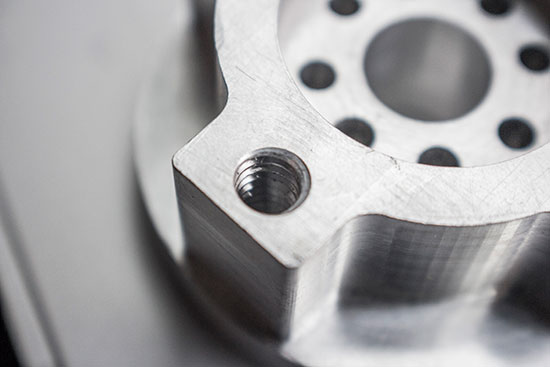 This tapped metal bearing is of a straightforward design and is most cost-effectively produced with by CNC machining. Image courtesy Xometry.
Use additive manufacturing if:
As Paulsen points out, your part may not conform to all 10 rules, but can still be perfect for AM. Think of the thousands of molds produced daily for orthodontic aligners (against Rule #8), or the rise in very-large-scale printers for both metals and filament/extrusion applications (against Rule #3).
When all is said and done, Xometry doesn’t rate additive “higher” than machining but it also doesn’t put it lower. “We look at it from the solution side,” Paulsen says. “In our world, the design is already set. You can put in the spec for your work and change the material, then see what the trade-offs are and see about the manufacturability feedback per process.”
The Xometry platform is offers a number of in-depth resources: check out the FAQ, First Shift Blog, Design Guides, Manufacturing Standards, Materials Guide and Ultimate Guide for a plethora of useful information across all manufacturing processes. Because a stitch in time saves nine.
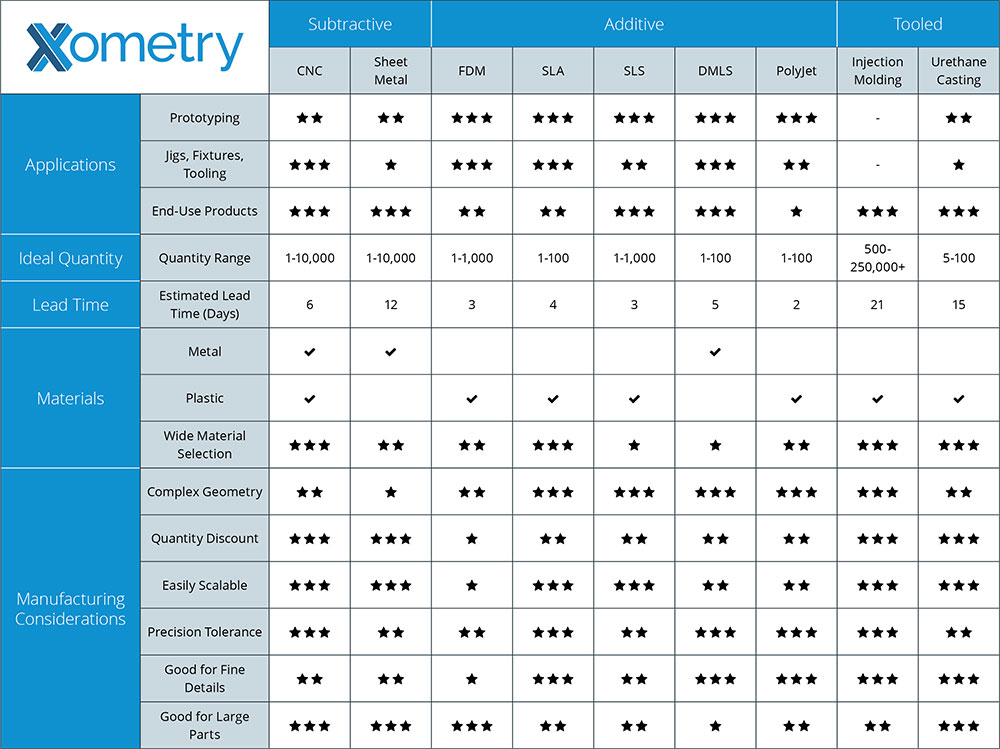

On-demand manufacturing

Pamela Waterman worked as Digital Engineering's contributing editor for two decades. Contact her via DE-Editors@ digitaleng.news.
Follow DE
Join over 90,000 engineering professionals who get fresh engineering news as soon as it is published.






About Us · Contact Us · Editorial Team · Advertising · Privacy Policy · Subscriber Services · © 2026 Digital Engineering 24/7 · Peerless Media