Helping design and engineering professionals discover, evaluate and specify technologies and processes that shorten the design cycle and enable success.


Alert!
Digital Engineering ceased publication on July 1, 2026. This website remains available as an archive of engineering content.
For inquiries or information, please email [email protected].

Digital Engineering April 2026
In the latest issue of Digital Engineering, we take a look at the latest innovations in design for additive manufacturing, including the use of natural language inputs, social media cosplayers, and AI integration. The issue also includes a feature…

January Special Focus Issue: Design for Additive
In this Special Focus Issue of Digital Engineering, learn about the latest advancements in design for additive manufacturing, including new software tools, additive in automotive, custom medical devices, and more.
AMT’s Executive VP Americas, Luis Folgar, will be presenting at the RAPID + TCT 2019 conference on May 22 on the importance of automated post-processing for industrial applications of 3D printing/additive manufacturing.
The 3D printed production process chain often consists of a series of unconnected digital manufacturing processes, which require manual intervention that can slow down production rates and add costs. Folgar will highlight how AMT’s BLAST process intersects material science, hardware engineering and process automation as a solution to these challenges. The BLAST process is at the heart of the PostPro3D portfolio of hardware that AMT says offers performance and aesthetic enhancement for 3D-printed parts for mass production applications.
Folgar will also introduce the PostPro3DColor and PostPro3DMini systems, which visitors to the exhibition will be able to see in person at the AMT booth (#656). Visitors can also learn more about the digital manufacturing system developed by AMT.
According to AMT, the value of the PostPro3D hardware system for surface engineering can be harnessed in a number of ways. First, by offering a fast and automated solution to post-processing, PostPro3D reduces lead-times and the overall cost of manufacture. A typical process run-time is 90-120 minutes with parts ready for end use application without any additional process steps, AMT says. Second, the BLAST process that enables the PostPro3D system is capable of achieving a finished surface quality equal to or better than injection molding on parts 3D printed using laser sintering, HP Multi Jet Fusion, high-speed sintering, or fused deposition modeling processes, according to the company. Parts processed in the PostPro3D machine exhibit no more than 0.4% dimensional change irrespective of desired surface finish, AMT says. The BLAST process is said to be highly controllable, allowing reproducible results with no degradation of a parts’ mechanical properties, which can actually be improved through sealing the surface of the parts being processed removing porosity and thus sealing them against liquid or gas ingress.
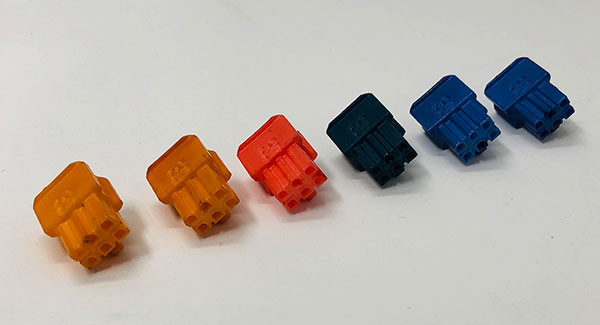
The new PostPro3DColor is a major breakthrough for automated post-processing, as it incorporates all of the benefits of the original system, with the added capability of uniformly coloring polymer 3D printed parts in a single step without the use of water and disposable waste streams. The cartridge system of the PostPro3DColor permits the selected color pigment to be delivered into the processing chamber as an atomized mist, which bonds directly to the polymer substrate as it is being smoothed to add the color to the part consistently, according to AMT.
The new PostPro3DMini offers a smaller and more versatile version of the PostPro3D system. It has been specifically designed to accommodate lower volume production runs. The sale price of thePostPro3DMini is $32,000. It will be available in the fourth quarter of 2019, with pre-orders being taken now. The Mini has a process chamber of 11.8x13.8x11.8 inches.


DE's editors contribute news and new product announcements to Digital Engineering. Press releases may be sent to them via [email protected].
Follow DE






About Us · Contact Us · Editorial Team · Advertising · Privacy Policy · Subscriber Services · © 2026 Digital Engineering 24/7 · Peerless Media