Helping design and engineering professionals discover, evaluate and specify technologies and processes that shorten the design cycle and enable success.


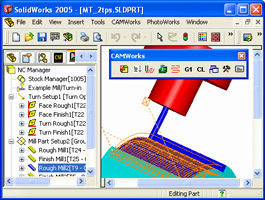 New module CAMWorks for Mill-Turning
 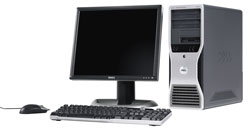 Dell Inc. (Round Rock, TX) announced its new Precision 380 workstation on April 11, with shipments beginning today, April 20.The Precision 380 starts with a convertible mini-tower/desktopchassis design that's easy to open up for adding new components. Thenew chassis includes rotating optical storage so that the correctorientation is presented to the user regardless of how the system isinstalled.The heart of the Precision 380 is the Pentium 4 processor with up to2MB L2 cache in addition to the Intel Pentium Extreme Edition 64-bitdual-core processor technology. (In simplistic terms, dual-coretechnology means twice the CPU on a single socket.) Intel Pentium 4processors provide support for EM64T technology. (Hyperthreading, whichmight increase the performance of some applications, is available withsome Pentium 4 Extreme Edition processors. Contact Dell for a completeexplanation of this functionality.)The Dell Precision 380 can support up to 8GB of memory. Otherfeatures include Intel 955X Express chipset supports up to four SATA IIdrives and RAID 0, 1,5,10; DDR2 ECC memory for reliable operation, andrack-mountable chassis. The Precision 380 will support MicrosoftWindows XP Professional x64, when available.Pricing for the Precision 380 begins at $2,567, according to the Dell website. For more information on the Dell Precision 380, click here.
 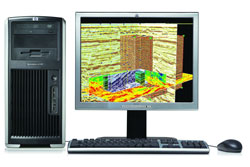 Hewlett Packard(HP; Palo Alto, CA) calls its new HP xw9300 Workstation its "top of theline" high-end performance and expandability workstation. Built tohandle intensive computing jobs - CAE, MCAD, 3D animation, oil and gasexploration, and scientific research - the HP xw9300 is the company'sfirst workstation to include AMD Opteron processors and support forNVIDIA Quadro SLI (Scalable Link Interface) dual PCI Express graphics.The AMD Opteron processor has the ability to run 32- and 64-bitapplications simultaneously, giving you a smooth pathway to 64-bitcomputing. The Opteron's Direct Connect Architecture helps increaseperformance by reducing memory and other system bottlenecks by directlyconnecting memory and I/O to the central processor. This in turnreduces latency and memory consumption while increasing bandwidth whenexecuting demanding applications.The HP xw9300's graphics subsystem can support dual PCI Express x16graphic slots. This workstation also introduces NVIDIA Quadro SLI,which integrates two PCI Express graphics boards. With dual PCI Expressgraphics, you can run huge models and display complex graphics withrealism and speed. The xw9300 is the first workstation to be certifiedby NVIDIA to support SLI for NVIDIA Quadro, according to HP.The HP xw9300 Workstation supports single and dual AMD Opteron 200series processor Models 246 (2.0 GHz), 248 (2.2 GHz), and 250 (2.4GHz). It can handle dual NVIDIA Quadro PCI Express x16 graphic boards,the NVIDIA nForce Professional MCP, and up to 16 gigabytes of memory.It comes with IEEE 1394 and USB 2.0 ports in the front and back, andfive internal hard-drive bays -- including four SATA II interfaces --for up to 1.5 terabytes of storage. It supports Windows XP Professionaland Red Hat Linux WS3.0 (64-bit) operating systems.Shipping now, the HP xw9300 starts at $1,899, estimated street price. For more details, go to HP's website.
 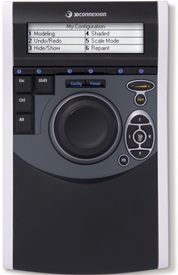 3Dconnexion's SpacePilot senses and adapts to applications and workflowsOn April 4, 3Dconnexion (Los Gatos, CA), a Logitechcompany, announced its new SpacePilot, which, says the company, is thefirst 3D motion controller that senses and adapts to the user'sapplication and workflow.SpacePilot, says 3Dconnexion, brings to market technology developedafter extensive research into CAD and animation user workflows. Itprovides rapid, single-key access to frequent application commandsthrough function speed keys.These function keys feature LCD-based labeling that dynamically updatesbased on a given application and function. You can organize these keysinto multiple banks, and switching among banks gives you access to anunlimited number of keys. The SpacePilot also has keys labeled forcommon functions across professional 3D applications such as keyboardmodifiers (Ctrl, Shift, Alt, and Esc), standard orthographic views, andthe fit function.SpacePilot uses auto-sensing technology to sense the currentapplication and then set the controller's navigation and thefunctionality of its keys accordingly. Speed keys adapt to a change inthe application as well as to specific tasks within the application.For example, in some applications during part modeling mode you haveaccess to one set of functions. As you switch to assembly mode, theSpacePilot will switch to a different set of functions, which aredisplayed on the LCD. Thus, if you are using SolidWorks, the functionkeys automatically sense the SolidWorks mode, map applicable functionsto the speed keys, and display the mapping on the LCD.The SpacePilot supports more than 100 analysis, design, manufacturing,and content creation applications, such as CATIA, ProE/Mechanica, andUnigraphics. It is available immediately through 3Dconnexion'sresellers and distributors.3DConnexion offers a no obligation, no money up-front test drive of the SpacePilot. Click here to sign up for it. For more details on SpacePilot, supported applications, datasheets, or to view an online video, go to the 3Dconnexion website.


DE's editors contribute news and new product announcements to Digital Engineering. Press releases may be sent to them via [email protected].
Follow DE
Join over 90,000 engineering professionals who get fresh engineering news as soon as it is published.






About Us · Contact Us · Editorial Team · Advertising · Privacy Policy · Subscriber Services · © 2026 Digital Engineering 24/7 · Peerless Media