Helping design and engineering professionals discover, evaluate and specify technologies and processes that shorten the design cycle and enable success.



Digital Engineering April 2026
In the latest issue of Digital Engineering, we take a look at the latest innovations in design for additive manufacturing, including the use of natural language inputs, social media cosplayers, and AI integration. The issue also includes a feature…

January Special Focus Issue: Design for Additive
In this Special Focus Issue of Digital Engineering, learn about the latest advancements in design for additive manufacturing, including new software tools, additive in automotive, custom medical devices, and more.
It seems that someone at Autodesk is paying attention. The company recently decided to invest $10 million into Carbon3D from the Spark Investment Fund. The fund had been set up to demonstrate Autodesk’s dedication to launching the Spark program, including the Ember, as a tool for research and development.
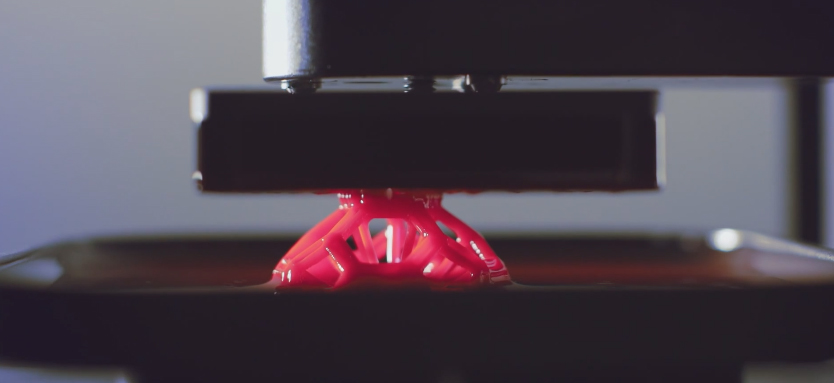 Grown, not built, an object begins to emerge from the resin pool. Courtesy of Carbon3D
“We started the Spark Investment Fund to help drive the 3D printing industry forward,” said Carl Bass, Autodesk president and CEO. “Carbon3D embodies the innovation that’s required to change how products are made. The incredible speed of its CLIP technology makes 3D printing accessible for true manufacturing, beyond the prototyping and the one-offs we see it being used for now."
For the link shy, Carbon3D has developed an AM system that uses a proprietary process the company has dubbed CLIP. CLIP stands for continuous liquid interface production technology and operates through photo polymerization. Unlike standard stereolithography, which builds an object one layer at a time by curing the topmost layer of a resin pool, CLIP projects light through the pool, encouraging the object to grow together simultaneously.
The result of CLIP is a 3D object that, according to Carbon3D, can be built up to 100 times faster than competing AM systems, all without leaving strata lines in a finished build.
“By working at the intersection of hardware, software and molecular science, we are aiming to fundamentally address the issues that have held 3D printing back from becoming a manufacturing process,” said Dr. Joseph DeSimone, CEO and co-founder, Carbon3D. “We’re honored to have an industry powerhouse like Autodesk recognize the transformative nature of our CLIP technology and engage with us in such a significant way.”
Below you’ll find a TED Talk by Carbon3D’s DeSimone.
Source: Autodesk


John Newman is a Digital Engineering contributor who focuses on 3D printing. Contact him via [email protected] and read his posts on Rapid Ready Technology.
Follow DE
Join over 90,000 engineering professionals who get fresh engineering news as soon as it is published.






About Us · Contact Us · Editorial Team · Advertising · Privacy Policy · Subscriber Services · © 2026 Digital Engineering 24/7 · Peerless Media