Helping design and engineering professionals discover, evaluate and specify technologies and processes that shorten the design cycle and enable success.



May 2026 Special Focus: Artificial Intelligence in Design and Simulation
In this Special Focus Issue, learn about the latest developments in the integration of artificial intelligence into engineering workflows.

Design & Simulation Software Guide 2025
In this Special Issue, Digital Engineering presents its second annual guide to design and simulation software vendors.
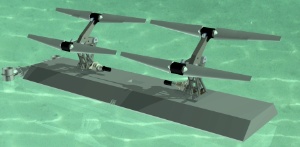 IT Power, an energy consultancy headquartered in the United Kingdom, is using 3D design software from Autodesk, Inc. to develop renewable energy devices for harnessing wave and tidal power.
IT Power is the lead company in an EU funded project to develop the Pulse Tidal device. The company is providing engineering, design, management and project management services to the consortium.
The Pulse Tidal device uses oscillating horizontal hydrofoils in place of more traditional rotating blades to generate renewable energy. This approach could offer many advantages over existing tidal stream technology by maximizing the area that can be swept" and hence the power captured" in a given depth of water. This makes the technology particularly suited to shallow tidal flows, while requiring smaller support structures and lower installation costs than many competing systems.
IT Power is also the lead engineer in the UK’s Technology Strategy Board funded Offshore Wave Energy Limited (OWEL) Marine Demonstrator project. OWEL is developing an innovative wave energy device and the current project will produce and deploy a machine with a target output of 500-kilowatt at the wave hub facility in the UK.
The Autodesk Clean Tech Partner Program" which provides software for emerging clean tech companies in North America and Europe" enabled IT Power’s Marine Group to use digital prototyping technology to accelerate design of the mechanical and structural elements of its energy capture systems. IT Power used Autodesk Inventor software to simulate the Pulse Tidal device’s transmission mechanism. Placing load data for the hydrofoils into a 3D model in Inventor and running a simulation enables the team to optimize the design of the mechanism and verify mathematical models of the system.
“Inventor has saved us time, effort and money,” says Tim Twibell, senior marine engineer at IT Power. “In addition to running these kinds of calculations using complex mathematical models, we now have a compelling visual means of verifying accuracy, simply by running these simulations in Inventor.”
Using Inventor has helped IT Power speed the development of a preproduction 1.2-megawatt prototype of the Pulse Tidal energy device. IT Power is also using Inventor to assist the mechanical and structural designs of the OWEL device.
For more information, visit Autodesk.
Sources: Press materials received from the company and additional information gleaned from the company's website.


DE's editors contribute news and new product announcements to Digital Engineering. Press releases may be sent to them via [email protected].
Follow DE
Join over 90,000 engineering professionals who get fresh engineering news as soon as it is published.






About Us · Contact Us · Editorial Team · Advertising · Privacy Policy · Subscriber Services · © 2026 Digital Engineering 24/7 · Peerless Media