Helping design and engineering professionals discover, evaluate and specify technologies and processes that shorten the design cycle and enable success.



Digital Engineering April 2026
In the latest issue of Digital Engineering, we take a look at the latest innovations in design for additive manufacturing, including the use of natural language inputs, social media cosplayers, and AI integration. The issue also includes a feature…

January Special Focus Issue: Design for Additive
In this Special Focus Issue of Digital Engineering, learn about the latest advancements in design for additive manufacturing, including new software tools, additive in automotive, custom medical devices, and more.
Australian researchers have further perfected a portable 3D printer that can be used to print artificial tissue for surgical implantation using living stem cells. In a recent proof-of-concept study, researchers reported the BioPen could carry and support stem cells with a 97% viability rate.
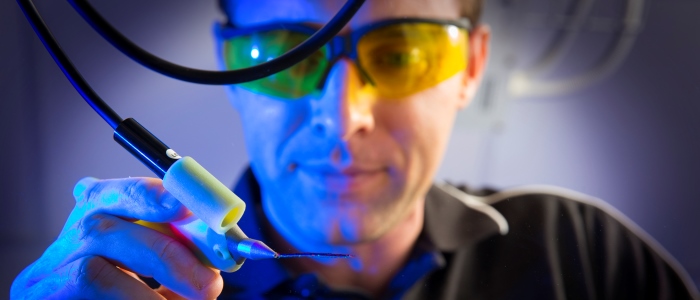 The BioPen can print with living stem cells. Image courtesy ACES
The researchers published their findings in the journal Biofabrication in March.
The pen was first announced in 2013 by researchers from the Australian Research Council Center of Excellence for Electromaterials Science (ACES) at the University of Wollongong (UOW). The team there previously regrew knee cartilage on 3D scaffolds. The pen itself is constructed using 3D-printed medical grade plastic and titanium.
Professor Peter Choong, Director of Orthopaedics at St Vincent’s Hospital Melbourne, developed the concept with ACES Director Professor Gordon Wallace.
The BioPen uses a mix of biopolymers and living cells, which are injected onto damaged bone and solidified using a low-powered UV light source. The pen could also use drugs or growth factors to further encourage tissue and bone development.
According to the researchers, during the most recent test: “A gelatin–methacrylamide/hyaluronic acid–methacrylate (GelMa/HAMa) hydrogel was printed and UV crosslinked during the deposition process to generate surgically sculpted 3D structures.”
Surgeons could repair cartilage or bone damage in situations where the exact geometry of an implant can’t be known prior to surgery. The implantable material biodegrades as cells form on the injury site.
“The biopen project highlights both the challenges and exciting opportunities in multidisciplinary research. When we get it right we can make extraordinary progress at a rapid rate,” Professor Wallace said.
Source: ARC Centre of Excellence for Elecromaterials Science


Brian Albright is the editorial director of Digital Engineering.
Contact him at [email protected].

Join over 90,000 engineering professionals who get fresh engineering news as soon as it is published.






About Us · Contact Us · Editorial Team · Advertising · Privacy Policy · Subscriber Services · © 2026 Digital Engineering 24/7 · Peerless Media