Helping design and engineering professionals discover, evaluate and specify technologies and processes that shorten the design cycle and enable success.


Sponsored
 Dear Desktop Engineering Reader:
You can inadvertently make a lot of mistakes buying used equipment whether from a dealer, at auction or online. Today’s Check It Out link takes you to a complimentary white paper packed with tips and reminders that will help you avoid turning that great deal you found on a piece of used equipment into a great white elephant.
No matter what you’re looking for, “Buying Used Wide Format Printers – What You Should Know” from Canon Solutions America, Large Format Solutions, will serve as a sensible guide to buying used technical gear. It offers insights, tips and warnings to any engineer tempted by a used equipment deal needs to consider, whether it’s a used benchtop analyzer or last generation’s workstation. And if you’re eyeballing used wide-format printers, nothing is going to beat this paper.
This four-page paper offers eight key factors to evaluate before purchasing a used wide-format printer: Security, software licenses, file processing speed, service and parts, printer drivers, print quality and color output, financing and total operating cost. Each discussion is brief and helpful.
Take the security section, for example. It reminds you that an older printer’s operating system is old too. It may not be upgradable or won't support features like requiring user authentication before printing sensitive information. And a golden-aged printer may not have the removable drives your IT gumshoes require it to have.
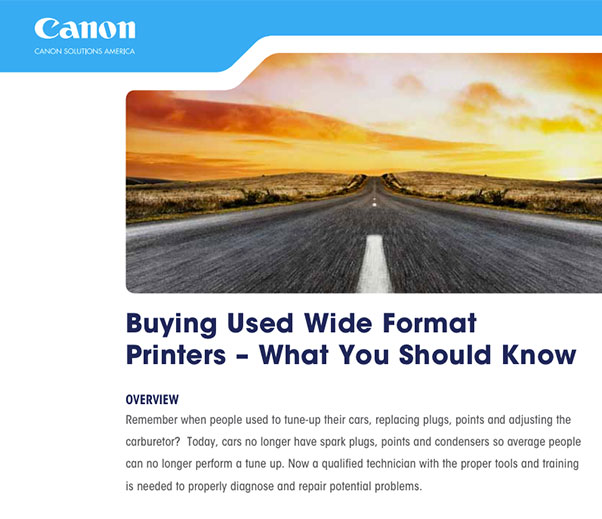 This white paper covers eight major points to remember when purchasing a used wide format printer. Image courtesy of Canon Solutions America.
That segues nicely into the service and parts segment and its litany of considerations. Perhaps the most-forgotten item is that service contracts on as-is purchases are pretty much non-existent. And you also have to think about the approaching end of service life for specialized parts. What do you do if an unavailable board goes kaput on power up?
The quick discussion on print quality and color output is interesting. Older wide-format printers may well be monochrome only. Printing your full-color CAD drawings in 50 shades of gray might not bother you much. But an older color printer’s lower-resolution print quality might not excite you at all.
And on it goes. “Buying Used Wide Format Printers – What You Should Know” is a strong paper. It is packed with all kinds of details that are easy to forget when you’re enamored with a seemingly great bargain. Hit today’s Check it Out link and download your complimentary copy. You’ll be glad to have it around someday.
Thanks, Pal. – Lockwood
Anthony J. Lockwood
Editor at Large, Desktop Engineering
Download "Buying Used Wide Format Printers — What You Should Know" here.


Anthony J. Lockwood is Digital Engineering's founding editor. He is now retired. Contact him via [email protected].
Follow DE
Join over 90,000 engineering professionals who get fresh engineering news as soon as it is published.






About Us · Contact Us · Editorial Team · Advertising · Privacy Policy · Subscriber Services · © 2026 Digital Engineering 24/7 · Peerless Media