Helping design and engineering professionals discover, evaluate and specify technologies and processes that shorten the design cycle and enable success.



May 2026 Special Focus: Artificial Intelligence in Design and Simulation
In this Special Focus Issue, learn about the latest developments in the integration of artificial intelligence into engineering workflows.

April 2026 Special Focus Issue: Generative Design
In this Special Focus Issue, Digital Engineering takes a look at how generative design solutions can be used across different types of design problems and with a variety of manufacturing approaches to accelerate design space exploration, and…
Obviously AM isn’t going to solve every design or manufacturing challenge, but I find such a rapid 180° turn in point of view to be somewhat disingenuous. It was with that general thought floating around in my head that I watched C.ideas' first video with delight. The video showcases how the differing AM processes can be used together to create a near-perfect replica of the 1927 Miller 91 race car.
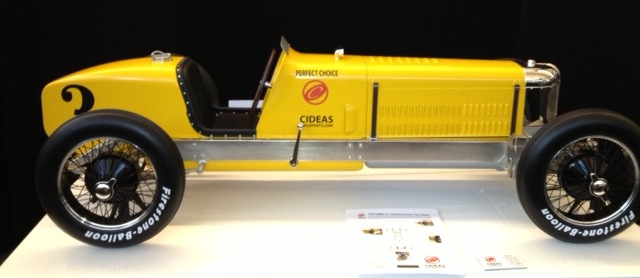
What C.ideas has done is almost a refutation of the negative backlash against AM. You can talk all you like about how the technology isn’t ready to compete with traditional manufacturing, but when a major service bureau rolls out a 40% scale model of a classic race car that has been entirely constructed through 3D printing, the words sound rather hollow.
Situated in Crystal Lake, IL, C.ideas has a large number of AM systems at hand, including 17 of Stratasys’ Fortus FDM systems. The service bureau also has other 3D printing processes available, including SLA, SLS, and Polyjet. Even if you discount the plethora of potential material mixes that come with Polyjet, the company can print in 24 materials. None of that sounds limited to me.
The company decided to build the 40% model of the 1927 Miller 91 race car as an example of the different AM processes to draw attention and expand what most people think is possible with the technology. By combining FDM, SLA, SLS and Polyjet parts into one completed whole, C.ideas created a model that defies the stereotype that AM is only useful for small parts or clunky prototypes.
You don’t have to take my word for any of this. Below you’ll find the C.ideas video to watch for yourself. Maybe you could even forward it on to some of the doubters out there. They say a picture is worth a thousand words, after all.
Source: C.ideas


John Newman is a Digital Engineering contributor who focuses on 3D printing. Contact him via [email protected] and read his posts on Rapid Ready Technology.
Follow DE
Join over 90,000 engineering professionals who get fresh engineering news as soon as it is published.






About Us · Contact Us · Editorial Team · Advertising · Privacy Policy · Subscriber Services · © 2026 Digital Engineering 24/7 · Peerless Media