Helping design and engineering professionals discover, evaluate and specify technologies and processes that shorten the design cycle and enable success.



Digital Engineering April 2026
In the latest issue of Digital Engineering, we take a look at the latest innovations in design for additive manufacturing, including the use of natural language inputs, social media cosplayers, and AI integration. The issue also includes a feature…

January Special Focus Issue: Design for Additive
In this Special Focus Issue of Digital Engineering, learn about the latest advancements in design for additive manufacturing, including new software tools, additive in automotive, custom medical devices, and more.
 CAASE keynote speaker Dan Robles, founder and CEO of The Integrated Engineering Blockchain Consortium (IECB). Image courtesy of Robles.
Most people associate blockchain with cryptocurrency, not with engineering or manufacturing. But CAASE keynote speaker Daniel R. Robles, himself a professional engineer with commercial and military aircraft design experiences, thinks it's a mistake to overlook the technology's potential applications in engineering.
“We have an opportunity to modernize our compensation structure from salary to percent of contract while elevating our profession to the status of financial instruments, but will we organize ourselves to do it?" he wondered.
A blockchain is "an incorruptible digital ledger of economic transactions that can be programmed to record not just financial transactions but virtually everything of value." — Don & Alex Tapscott, authors of Blockchain Revolution: How the Technology Behind Bitcoin is Changing Money.
The blockchain resource and education site Blockgeeks explains, "By allowing digital information to be distributed but not copied, blockchain technology created the backbone of a new type of internet ... The blockchain network lives in a state of consensus, one that automatically checks in with itself every ten minutes. A kind of self-auditing ecosystem of a digital value, the network reconciles every transaction that happens in ten-minute intervals.”
The term blockchain describes a type of registry network — not a specific registry. Therefore, there are many different blockchains that are derived and spawned from earlier versions. The well-known blockchains include Steemit, Hyperledger, Counterparty, and Bitnation. Just like cloud clusters, a blockchain can be private (controlled by a single company, accessible only to its partners, customers, and employees) or public (controlled and monitored by a community).
The blockchain technology proves appealing to financial and insurance sectors because of its innovative digital record-keeping system.
By contrast, design and engineering is governed by constant changes and revisions, dictated by the need for members of various disciplines (mechanical, electrical, software and systems engineering, among others) to simultaneously develop new products. Project teams use PLM, PDM, and collaboration tools as traffic cops to avoid collisions in the data flow. Could blockchain be suitable for such a change-heavy environment?
“You can use blockchain to manage the points of risk transfer,” says Robles. This could be the point where specific versions of the design are released for manufacturing or delivered to a partner is completed assignments.
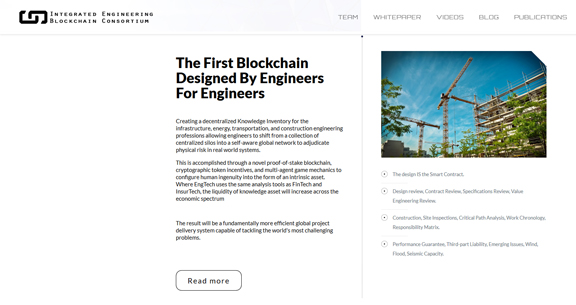
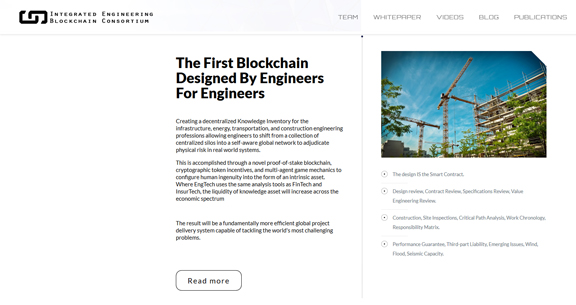 The IEBC plans to launch a blockchain for engineering, dubbed CoEngineers.io.
Robles is the founder and CEO of the Integrated Engineering Blockchain Consortium (IEBC), which aims to create “a decentralized Knowledge Inventory for the infrastructure, energy, transportation, and construction engineering professions, allowing engineers to shift from a collection of centralized silos into a self-aware global network to adjudicate physical risk in real world systems.”
It plans to launch CoEngineers.io, described as the first blockchain designed by engineers for engineers. CoEngineers.io is intended to be a public blockchain accessible by anyone and managed with game mechanics, though maintained by the IEBC, according to Robles.
“Our blockchain has a three-second block time [that is, it self-checks in three-second intervals]. So, if you want to corrupt our blockchain, you’ll have to intercept the target document and corrupt more than half of our participating servers—the witnesses to the transaction—within three seconds. The likelihood is astronomically small," said Robles.
For more on Robles's upcoming talk at CAASE, see the abstract here.


Kenneth Wong is Digital Engineering's resident blogger and senior editor. Email him at [email protected] or share your thoughts or suggestions at digitaleng.news/facebook.
Follow DE
Join over 90,000 engineering professionals who get fresh engineering news as soon as it is published.






About Us · Contact Us · Editorial Team · Advertising · Privacy Policy · Subscriber Services · © 2026 Digital Engineering 24/7 · Peerless Media