Helping design and engineering professionals discover, evaluate and specify technologies and processes that shorten the design cycle and enable success.



Digital Engineering April 2026
In the latest issue of Digital Engineering, we take a look at the latest innovations in design for additive manufacturing, including the use of natural language inputs, social media cosplayers, and AI integration. The issue also includes a feature…

January Special Focus Issue: Design for Additive
In this Special Focus Issue of Digital Engineering, learn about the latest advancements in design for additive manufacturing, including new software tools, additive in automotive, custom medical devices, and more.
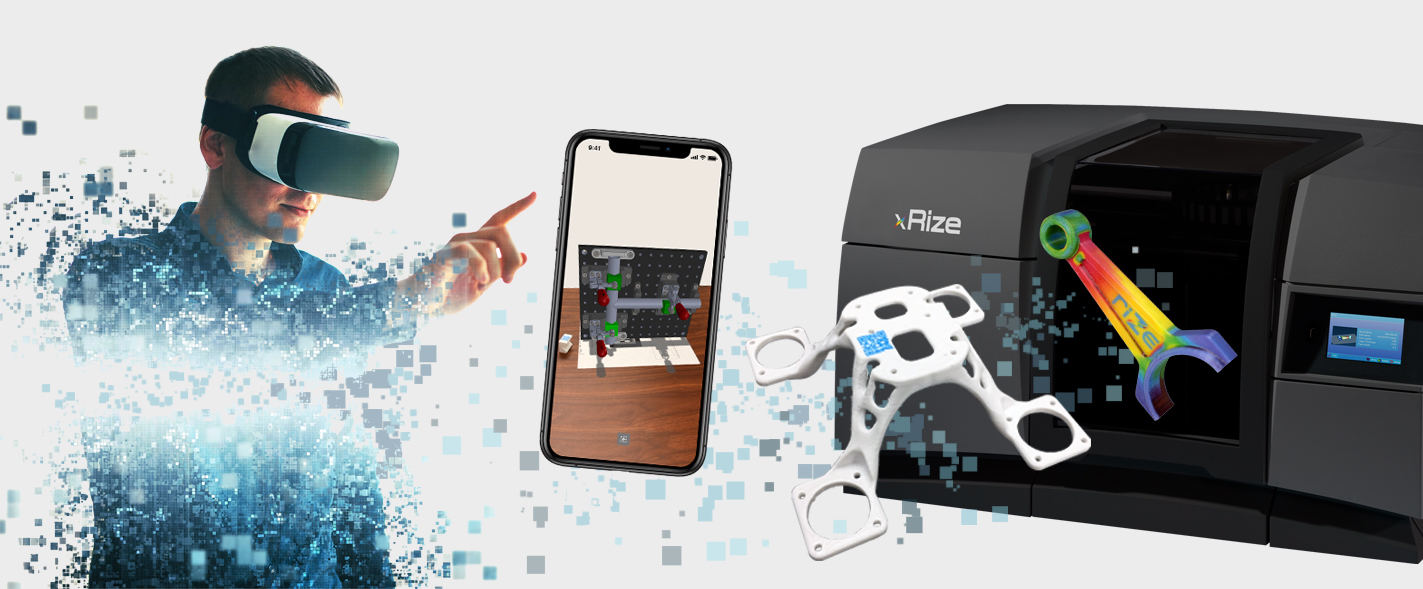
Looking beyond a straight additive manufacturing play, RIZE is touting its new Smart Space solutions, which integrate 3D printing with other intelligent technologies such as augmented reality (AR) and blockchain to create a connected and intelligent environment for product design, manufacturing and service.
Smart Spaces, cited by Gartner as a top 10 technology trend for 2019, are defined by the market research firm as “physical or digital environments in which humans and technology-enabled systems interact” as part of an intelligent ecosystem. As explained by Gartner: people, processes, services and things come together in a smart space to create immersive, interactive, and automated experiences.
RIZE has used that interpretation to design its own rendition of Smart Spaces built around its XRIZE 3D printer, which supports full-color 3D printing through its Augmented Polymer Deposition process. The technology combines thermoplastic extrusion with inkjet printing, allowing for voxel-level control over RIZE’s 3D printing process. This approach simplifies support removal, but also enables traditional 2D print inks to be incorporated into the process to add text, symbols and images to prints such as QR codes for enhanced traceability. “We are driving intelligence into parts, which makes them identifiable, traceable and authentic,” explains Andy Kalambi, president and CEO of RIZE.
The Smart Space Solutions build on this notion of intelligent parts to cover three areas: Product Innovation, Manufacturing Innovation and Service Innovation. The bundled offerings are designed to bring the advanced technologies typically offered in a maker space to the engineering desktop, Kalambi says.
“The problem with maker spaces is they are not integrated into the engineering environment—you have to go to a separate place to take advantage of these new technologies,” he explains. “Our Smart Solutions bring together many of the new technologies that enable engineers to rapidly iterate. Through the concept of a Smart Space, we are bringing all these initiatives together rather than having organizations apply them in a discrete fashion.”
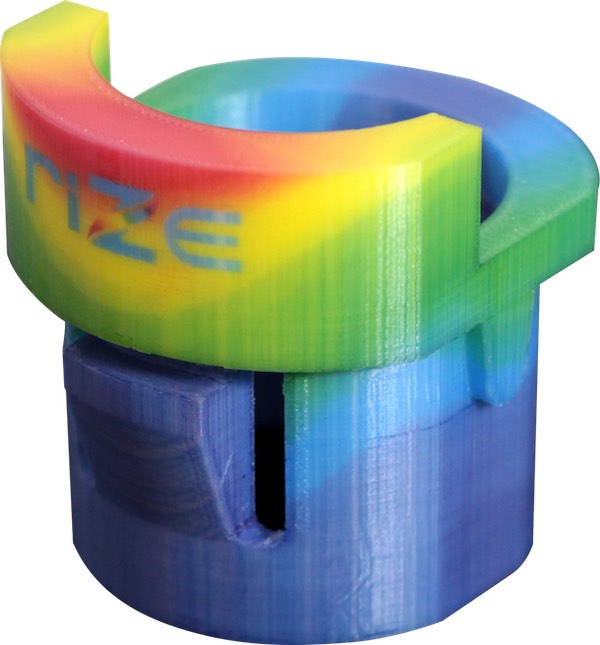
For example, the Smart Spaces in Product Innovation bundle offers engineers a new haptic experience for accelerating part delivery via the output of full-color parts that allow for design and simulation work to happen simultaneously. The color capabilities of the XRIZE can be tapped to print a finite element analysis (FEA) heat map directly on the printed part, which helps guide further design iterations.
Support for color, along with the ability to add elements like QR codes to a part, aids in manufacturing applications as well. The Smart Spaces in Manufacturing solution supports an interactive environment between the digital part and the physical part, allowing organizations to add capabilities like AR/VR to aid in product assembly, for example, or to incorporate additional information so the parts can be evaluated in full context. Blockchain capabilities could also be integrated into this scenario to establish an immutable audit trail that ensures a part is authenticated and that any eligible royalties are captured throughout the supply chain.
With the Smart Spaces in Service Innovation bundle, organization can extend the traditional 3D printing capabilities of the XRIZE with ink marking to ensure full traceability of parts and to leverage AR/VR technology to showcase proper instructions for performing part maintenance.

Rize Inc. is unlocking industrial 3D printing for new markets and driving the next wave of innovation and advancement in product design and manufacturing with the Rize One 3D printer, a versatile industrial-class 3D printer suitable for the office…

Beth Stackpole is a contributing editor to Digital Engineering. Send e-mail about this article to [email protected].
Follow DE
Join over 90,000 engineering professionals who get fresh engineering news as soon as it is published.






About Us · Contact Us · Editorial Team · Advertising · Privacy Policy · Subscriber Services · © 2026 Digital Engineering 24/7 · Peerless Media