Helping design and engineering professionals discover, evaluate and specify technologies and processes that shorten the design cycle and enable success.



Digital Engineering April 2026
In the latest issue of Digital Engineering, we take a look at the latest innovations in design for additive manufacturing, including the use of natural language inputs, social media cosplayers, and AI integration. The issue also includes a feature…

January Special Focus Issue: Design for Additive
In this Special Focus Issue of Digital Engineering, learn about the latest advancements in design for additive manufacturing, including new software tools, additive in automotive, custom medical devices, and more.
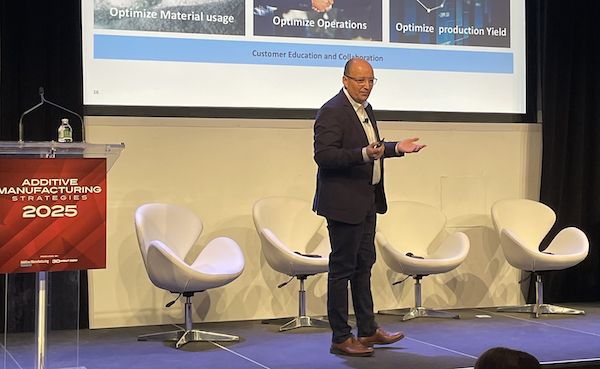
The Additive Manufacturing Strategies conference, held in early February in New York, brings together high-level executives from the 3D printing industry. Last year, in the wake of some dire revenue reporting and market volatility, the mood was pretty gloomy. At the 2025 meeting, by comparison, things were a bit sunnier – from cautiously optimistic speeches from key industry CEOs and some positive market indicators, to Barnes Global Advisors founder John Barnes quoting AC/DC’s “It’s a Long Way to the Top (If You Want to Rock and Roll)”, executives at the event seemed to have a clearer view of a profitable path forward.
In his opening remarks on the second day of the event, Alex Monino, senior vice president and general manager for personalization and 3D printing at HP, noted that his company sees additive as “not a transactional sale. This is not a box-moving sale. It needs to be a consultative, end-to-end sale.”
“Adoption is not about having a system or a solution, but about engaging with the customer in a discussion of how we can help [with] that particular application,” he said. He also discussed HP’s investment in artificial intelligence to help aid design for additive, including the HP 3D Build Optimizer and the HP AI Text-to-3D part generator. While the tool is targeted at simple gaming accessory applications right now, “We believe this is a tool that will help us generate content,” he said. “Before if we wanted to personalize a part it took hours; now it takes minutes.”
Barnes noted that the industry was becoming more optimistic about the future, while acknowledging current market challenges. “For example, 20% of the cost of making a pound of steel is in [capital expenditures],” he said. “For titanium, it’s 50%. What does it cost to make a pound of AM metal? It’s over 70%. We have work to do in this area. We need to get the cost of making that shape or pound of additive metal lower.”
Directly addressing the AM executives in the crowd, he added: “If you are not ruthlessly attacking the cost of your equipment, China will.”
Scott Dunham, executive vice president of research at Additive Manufacturing Research, gave a presentation that afternoon on the AM materials market that also included some promising data. Materials, unlike hardware and services, have experienced steady growth over the past several years. In fact, materials sales are superseding hardware sales as of 2023. In 2024, the materials market globally reached $3.5 billion, with metal powders showing a 22% CAGR (compared to 11% for polymers). That means while printer sales have struggled, people are still using the equipment they already own, or are having parts printed by service bureaus.
The 2025 event also featured more presentations by active end users across verticals. Stefanie Brickwede, managing director of Mobilty goes Additive, explained how 3D printing is being used in German rail systems, while Stefanus Bosch, head of additive manufacturing predevelopment and planning at BMW Group, outlined how the automaker is using additive in its operations.
Representatives from Würth Additive Group, Wurth Canada and IMS Verbindungstechnik discussed how they are using 3D printing and “digital inventory” to print spare parts on site at distributed locations. There were also panels on third-party print services, robotics and automation, and a panel (led by Digital Engineering editorial director Brian Albright) on AM and industrial scale automation, that touched on everything from hybrid manufacturing to artificial intelligence.
The conference ended with a CEO roundtable that included the top execs from Stratasys, Materialise, 3D Systems, Formlabs and Carbon.
For more information, visit additivemanufacturingstrategies.com.


Brian Albright is the editorial director of Digital Engineering.
Contact him at [email protected].

Join over 90,000 engineering professionals who get fresh engineering news as soon as it is published.






About Us · Contact Us · Editorial Team · Advertising · Privacy Policy · Subscriber Services · © 2026 Digital Engineering 24/7 · Peerless Media