Helping design and engineering professionals discover, evaluate and specify technologies and processes that shorten the design cycle and enable success.


Alert!
Digital Engineering ceased publication on July 1, 2026. This website remains available as an archive of engineering content.
For inquiries or information, please email [email protected].

Digital Engineering April 2026
In the latest issue of Digital Engineering, we take a look at the latest innovations in design for additive manufacturing, including the use of natural language inputs, social media cosplayers, and AI integration. The issue also includes a feature…

January Special Focus Issue: Design for Additive
In this Special Focus Issue of Digital Engineering, learn about the latest advancements in design for additive manufacturing, including new software tools, additive in automotive, custom medical devices, and more.
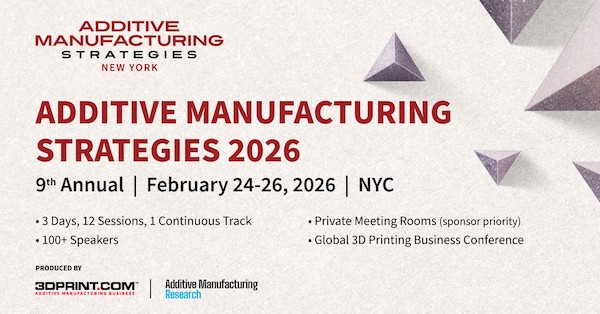
A late winter snowstorm that shut down airports and parts of New York City didn’t stop the 2026 Additive Manufacturing Strategies conference. Despite the snow and several speaker cancellations due to flight delays, the annual meeting of high-level AM industry executives, analysts, and end users soldiered on Feb. 24-26.
AMS Chair and 3DPrint.com editor Joris Peel opened the event with a keynote titled “3D Printing in a Fractious World.” Stratasys CEO Yoav Zeif, having been delayed by the storm, delivered his keynote address on day two, and organizers helpfully streamed the speech online for those that weren’t able to attend.
Zeif described 2025 as another challenging year for the industry, but “we are on the right path. It is in our hands. There is no magic here. It is in our hands to do it, and we know exactly what we need to do.”
He noted that the 3D printing industry has been hurt by uncertainty, high interest rates, and long sales cycles. He noted that CNC machining took 40 years to become a mainstream manufacturing method, and did so by removing operational barriers, creating smaller equipment, user friendly interface, and standard programming and CAD software interoperability.
“We can almost copy-paste that strategy,” he said.
He also said there had been a large increase in low-end printers, which he said should benefit the entire industry. “Low requirements in that space drive awareness and we enlarge the entire cake,” he said. He also noted that an emerging middle-ground between lower-end printers and high-end industrial machines includes solutions aimed at creating molding and tooling.
Zeif said that the industry should focus on applications where it has a strategic advantage. Those include low-volume/high-mix scenarios; geometries that create light weight; secure supply chain environments; sustainability; and rapid prototyping.
Other positive signs for the industry include increased awareness, growth in usage and customer satisfaction, expanding intent to buy, adoption in the aerospace and defense sectors, and the use of artificial intelligence in manufacturing.
“AI makes … it significantly cheaper to go from an idea to a design. The bottleneck is moved to the physical ability to produce the part,” he said. To take the next leap, the industry needs end-to-end workflows, better reliability, more automation and software integration, and better economic stories.
Attendees that braved the weather also heard from John Barnes, founder of The Barnes Global Advisors and CEO of Metal Powder Works, and saw a presentation from Carbon CEO Phil DeSimone and staff from Riddell to talk about 3D printed liners for football helmets.
Formlabs CEO Max Lobovsky made waves at the show when he announced that his private company had achieved a $2 billion valuation.
You can learn more about the event at its website.


Brian Albright is the editorial director of Digital Engineering.
Contact him at [email protected].






About Us · Contact Us · Editorial Team · Advertising · Privacy Policy · Subscriber Services · © 2026 Digital Engineering 24/7 · Peerless Media