Helping design and engineering professionals discover, evaluate and specify technologies and processes that shorten the design cycle and enable success.



Digital Engineering April 2026
In the latest issue of Digital Engineering, we take a look at the latest innovations in design for additive manufacturing, including the use of natural language inputs, social media cosplayers, and AI integration. The issue also includes a feature…

January Special Focus Issue: Design for Additive
In this Special Focus Issue of Digital Engineering, learn about the latest advancements in design for additive manufacturing, including new software tools, additive in automotive, custom medical devices, and more.
Just one small part of a new product for the aerospace industry, a two-pound investment casting went through a number of design changes during the product development process. In the last two years, KomTeK, an investment casting facility in Worcester, MA, made more than 800 castings of the component on a contract basis for its manufacturer.
Because of the frequency of design changes, the manufacturer was reluctant to invest in wax pattern tooling for the component. KomTeK opted to use QuickCast patterns from Express Patterns (Vernon Hills, IL), a rapid prototyping service bureau and specialist in prototype and short-run investment casting patterns.
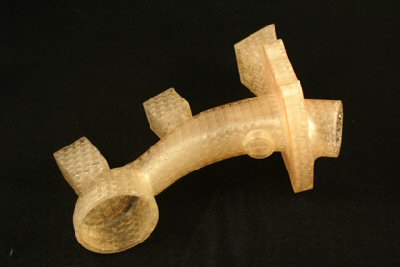 |
| ProtoCast AF 19120 resin from DSM Somos was used to create this QuickCast pattern for KomTeK. |
The usual process is for foundries to burn out QuickCast patterns in a furnace, cool down the shell, flush out any ash and then reheat the shell prior to pouring in molten metal. KomTeK was concerned that, given its shell composition, the cool-down required to clean out ash might compromise the shell integrity. "We can't risk a shell failure that could result in a spill of molten metal," added Chan Nguyen, foundry engineer. KomTeK elected to skip the normal ash removal step and pour immediately after burnout.
Skipping the ash removal step increases the risk of casting flaws caused by interaction of the molten metal with ash. It also provides several benefits—processing time is shortened by several hours, and it eliminates the manual labor needed to remove the ash as well as potential damage to shell integrity from the cooldown, particularly for fused silica shell systems.
Patterns for the first few hundred castings were built using the DSM Somos 11120 WaterShed resin, the most popular resin for QuickCast patterns. Though virtually all patterns were successfully cast, most of the castings had flaws caused by residual ash in the shell. Flaws were typically minor pitting or inclusions that required weld repair, which entailed welding the flawed area and grinding the weld flush.
"We had to weld repair 60% of the castings made from the WaterShed patterns", said Bob McQuade, foundry manager. Time required for a weld repair was about 15 minutes, so weld repair added 9 minutes of labor for each part delivered.
Last year, Express Pattern began beta testing the new ProtoCast AF 19120 resin from DSM Somos. In addition to being antimony free, the ProtoCast resin has significantly less residual ash than the Watershed. KomTeK wanted to try the new resin in hopes of reducing weld repairs.
Now that more than 300 ProtoCast patterns have been cast, KomTeK reports that weld repairs are needed on only 15% of castings, resulting in a significant reduction in their processing cost. "I see very little slag inclusions for the ProtoCast patterns compared to the WaterShed patterns," said Nguyen.
Repair cost is now 2.25 minutes per part—a 75% reduction in repair costs. If foundry labor and overhead rates total $60 per hour, or a dollar a minute, using ProtoCast patterns instead of WaterShed patterns reduces the casting cost by $6.75 per casting.
McQuade also noticed a significant reduction in the smoke generated during pattern burnout. "Lower smoke levels help us maintain our 'good neighbor' status," he said.
Sources: Press materials received from the company and additional information gleaned from the company's website.


DE's editors contribute news and new product announcements to Digital Engineering. Press releases may be sent to them via [email protected].
Follow DE
Join over 90,000 engineering professionals who get fresh engineering news as soon as it is published.






About Us · Contact Us · Editorial Team · Advertising · Privacy Policy · Subscriber Services · © 2026 Digital Engineering 24/7 · Peerless Media