Helping design and engineering professionals discover, evaluate and specify technologies and processes that shorten the design cycle and enable success.



May 2026 Special Focus: Artificial Intelligence in Design and Simulation
In this Special Focus Issue, learn about the latest developments in the integration of artificial intelligence into engineering workflows.

April 2026 Special Focus Issue: Generative Design
In this Special Focus Issue, Digital Engineering takes a look at how generative design solutions can be used across different types of design problems and with a variety of manufacturing approaches to accelerate design space exploration, and…
Under the direction of the newly formed COFES Institute, the annual Congress on the Future of Engineering Software (COFES) returned. Departing from the usual Arizona location, COFES 2019 took place in Hotel Nia in Menlo Park, California—about 10 minutes' drive from Facebook headquarters. In fact, the show managed to secure Facebook as a sponsor, along with Microsoft and Dell. (More on the history of COFES here.)
The keynote speaker this year was Elizabeth Baron, an AR-VR pioneer who once headed the automaker Ford's immersive realities unit. She currently runs an independent firm called Immersionary, specializing in enterprise deployment of mixed reality (MR) technologies.
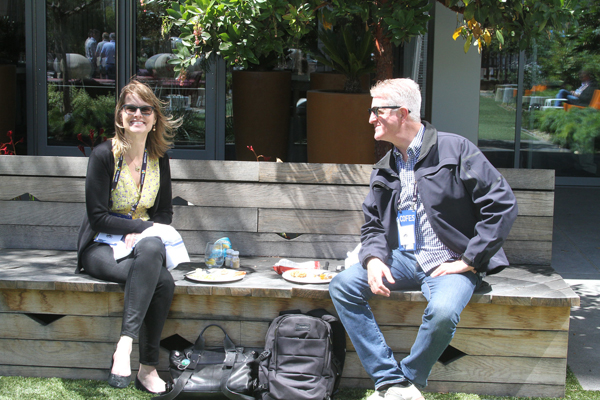
In her talk, Baron recounted a skeptical client's initial response to MR. Being a leading farm equipment maker, the client wasn't easily convinced of the value of visual experiences. "He told me, 'Why do I need photorealistic colors? To us, everything is green and yellow.' He kept saying, 'We don't need it. And I kept saying, 'Yes, you do!'" she remembered.
But she felt vindicated a few weeks later when the client called back. "He said, 'Guess what? It does matter. We're getting better answers because we can provide [users] with a more realistic environment,'" she said. "Providing high visual fidelity is really important for these [MR] environments. Immersion is experiential ... It lets us combine the emotive aspect and the scientific aspect into one rich experience. It's at the heart of how we understand our world ... Our products are better because of it."
The ability to reuse detailed CAD assembly models along with joint and connection characteristics (such as bolted seats, swinging doors, rotating parts, and so on) speeds up the MR deployment for design studies. To create MR from scratch (for example, building the 3D digital model of a vehicle from engine blocks to leather interiors, along with all the possible interactions) can take weeks or months. By contrast, Barron was able to create MR experiences in a matter of days during her time at Ford using existing engineering data, she revealed during the Q&A.
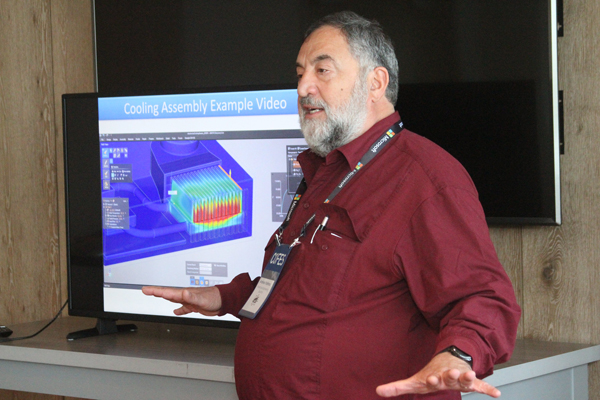
Andreas Vlahinos, CTO of Advanced Engineering Solutions and a recognized voice of authority on generative design, moderated a roundtable to tackle a thorny question: Do the newly released real-time simulation tools democratize simulation?
Examples of such tools would include ANSYS Discovery Live, a designer-friendly simulation program that gives quick answers. Such simplified simulation tools and other CAD-embedded simulation plug-ins allow designers with limited simulation expertise to conduct design studies. But critics have also pointed out they provide approximations instead of accurate answers to the simulated scenarios, be it a drop test or a heat flow problem.
"With them, you get amazing design insights, design innovation. You can ask, what if I go in this direction with my design? Or that direction instead? But these tools are not simulation replacements. Don't let the vendors oversell you. They are design guidance," warned Vlahinos.
To promote diversity, the organizers also hosted a panel on women in engineering, featuring the keynote speaker Elizabeth Baron, Linda Lokay (PTC), Jennifer Ferello (TechSoft), Karen Caswelch (SciArt Software) and Michelle Boucher (Tech-Clarity).
"If you want to see more women participate in your community, the key is to reflect that," advised Ferello. "For instance, make sure the speakers you choose at your event reflect the diversity you want. If you want to see more women in software development, make sure you're giving women that opportunity. Create a culture where women can be who they are."
COFES is one of the few independent events not associated with a software brand or a company. Under the previous organizer Cyon Research, the show began with the idea to focus on conversations and networking instead of presentations. The 2019 event shows the tradition is still alive and well.


Kenneth Wong is Digital Engineering's resident blogger and senior editor. Email him at [email protected] or share your thoughts or suggestions at digitaleng.news/facebook.
Follow DE
Join over 90,000 engineering professionals who get fresh engineering news as soon as it is published.






About Us · Contact Us · Editorial Team · Advertising · Privacy Policy · Subscriber Services · © 2026 Digital Engineering 24/7 · Peerless Media