Helping design and engineering professionals discover, evaluate and specify technologies and processes that shorten the design cycle and enable success.



Digital Engineering April 2026
In the latest issue of Digital Engineering, we take a look at the latest innovations in design for additive manufacturing, including the use of natural language inputs, social media cosplayers, and AI integration. The issue also includes a feature…

January Special Focus Issue: Design for Additive
In this Special Focus Issue of Digital Engineering, learn about the latest advancements in design for additive manufacturing, including new software tools, additive in automotive, custom medical devices, and more.
3D printing of aerospace parts is still a nascent application — in terms of space travel, there have been a few printed rocket components tested, and there are now 3D printers operating in the International Space Station.
Inglewood, CA-based Relativity Space hopes to leapfrog those current efforts, and has designed a rocket that will be built from 95% 3D-printed parts and carry a payload of up to 2,755 lbs. into low-Earth orbit.
The company was recently profiled in the Los Angeles Times and in Forbes.
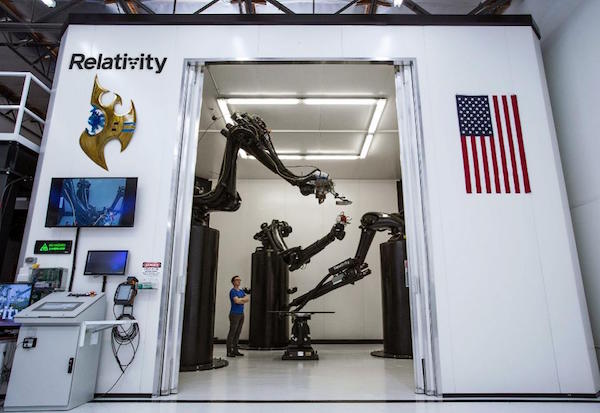
Relativity Space will print the rocket with an internally designed 24-ft.-tall unit called the Stargate, which is currently housed near the Los Angeles International Airport, and plans are underway to build an even bigger printer. The company has also developed a proprietary high-strength aluminum alloy with which to print its components.
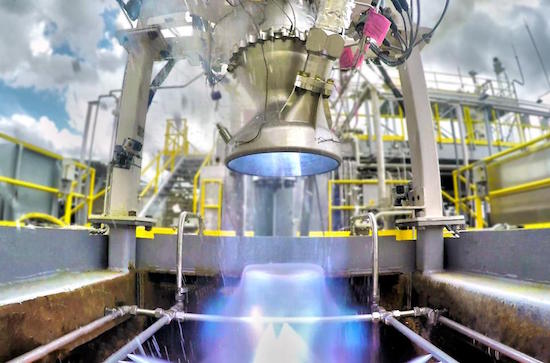
The company received seed funding from Mark Cuban, and has received as much as $1 billion in nonbinding launch term sheets and letters of intent, in addition to $45 million in venture funding. The company has also signed a lease agreement with NASA’s Stennis Space Center in Mississippi to test the rocket.
Relativity Space says it can complete a rocket and finish pre-flight testing in just 60 days. If all goes well, the Terran 1 rocket could be test flown as early as 2020. They hope to be able to launch satellites for clients for as little as $10 million
The company was founded by CEO Tim Ellis and CTO Jordan Noone. Noone previously worked at SpaceX on the Dragon 2 capsule, which includes the 3D-printed SuperDraco engine. Ellis worked at Blue Origin.
Relativity Space is one of a dozen or more rocket start-ups that hope to lower the cost of space flight. A few others are also leveraging 3D printing (although not the extent that Relativity Space plans to do so). Rocket Lab recently launched 13 of NASA’s CubeSat satellites aboard its Electron rocket, which includes printed components.
Source: LA Times


Brian Albright is the editorial director of Digital Engineering.
Contact him at [email protected].

Join over 90,000 engineering professionals who get fresh engineering news as soon as it is published.






About Us · Contact Us · Editorial Team · Advertising · Privacy Policy · Subscriber Services · © 2026 Digital Engineering 24/7 · Peerless Media