Helping design and engineering professionals discover, evaluate and specify technologies and processes that shorten the design cycle and enable success.


Alert!
Digital Engineering ceased publication on July 1, 2026. This website remains available as an archive of engineering content.
For inquiries or information, please email [email protected].

May 2026 Special Focus: Artificial Intelligence in Design and Simulation
In this Special Focus Issue, learn about the latest developments in the integration of artificial intelligence into engineering workflows.

April 2026 Special Focus Issue: Generative Design
In this Special Focus Issue, Digital Engineering takes a look at how generative design solutions can be used across different types of design problems and with a variety of manufacturing approaches to accelerate design space exploration, and…
Software manufacturer CoreTechnologie is presenting a revised version of its 3D printing software 4D_Additive. The focus is on the direct connection to 3D printers and the generation of advanced surface textures and grid structures.
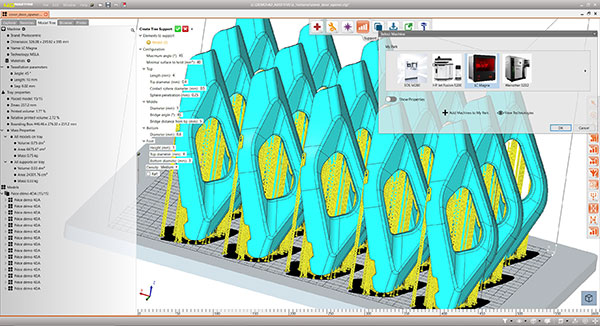
The German-French software specialist CoreTechnologie has further developed the 3D printing software 4D_Additive. By integrating the direct connection to EOS, Photocentric, HP and Volumic Printers into the new 4D_Additive software version, data handling becomes easier. Models of all common CAD formats as well as triangulated STL data can be read in, prepared for printing and now also sent directly to the printer. A unique feature is the handling of exact CAD data, allowing 3D models to be changed as in a CAD system.
The software suite eliminates the complex use of different tools. The 4D_Additive 1.4 version also allows print jobs to be sent to current EOS machines directly from the software by integrating the Eosprint software development kit (SDK).
The revised Lattice module of the 4D_Additive software enables the generation of complex 3D lattice structures within seconds. Using gyroid patterns and trabecular structures to emulate natural grids, new designs are generated to optimize the stability, stress distribution and shock absorption of components. The variation of the functional zones and their density as well as the use of different grid types allows the exact adaptation of the geometry to required properties.
With the new software, high-resolution textures and labels are generated on CAD models as well as on STL data. The new tool includes functions for generating DMC codes that can be read with a barcode scanner. The module's Substance database allows access to over 5,000 predefined surface designs. Users can also create individual surface designs as well as lettering.
The revised nesting module of the new 4D_Additive 1.4 version uses adaptive voxel technology and artificial intelligence to ensure efficient usage of the machines building space and even distribution of the parts to avoid heat nests. The new Powercopy function allows the multiplication close to the contour of the parts. High Nesting calculation speed is achieved through multiprocessor technology.
For SLA and FDM requirements, the new software has support geometries as well as special FDM hatching strategies and a G-code generator. The display of the individual layers is possible with a high-resolution 3D player. The support structures are automatically generated as B-Rep, that is, as editable CAD geometry for individual modification and adaptation by the user.
Further information is available here.
Sources: Press materials received from the company and additional information gleaned from the company’s website.

CT CoreTechnologie, headquartered in Frankfurt, Germany, with locations in the USA, Japan, India, France, Italy, and Japan. CT is the leading provider of 3D Computer Aided Design (CAD) translation software known as 3D_Evolution® (Conversion,…

DE's editors contribute news and new product announcements to Digital Engineering. Press releases may be sent to them via [email protected].
Follow DE
Join over 90,000 engineering professionals who get fresh engineering news as soon as it is published.






About Us · Contact Us · Editorial Team · Advertising · Privacy Policy · Subscriber Services · © 2026 Digital Engineering 24/7 · Peerless Media