Helping design and engineering professionals discover, evaluate and specify technologies and processes that shorten the design cycle and enable success.



Digital Engineering April 2026
In the latest issue of Digital Engineering, we take a look at the latest innovations in design for additive manufacturing, including the use of natural language inputs, social media cosplayers, and AI integration. The issue also includes a feature…

January Special Focus Issue: Design for Additive
In this Special Focus Issue of Digital Engineering, learn about the latest advancements in design for additive manufacturing, including new software tools, additive in automotive, custom medical devices, and more.
 |
Diebold, a manufacturer of ATMs, electronic-security systems, and voting systems, has had early success with direct digital manufacturing (DDM).
Previous applications proved that it could dramatically cut time and cost from component production for these sophisticated systems. This experience led to the discovery that DDM could do the same for assembly and machining fixtures. “Producing the fixtures using conventional machining methods could easily take a week,” says Rich Lute, Diebold senior mechanical engineer. Since production is at a standstill until fixtures are available, this delays a product’s release. “DDM helps us get to market faster by providing a quicker and less expensive method of building the fixturing.”
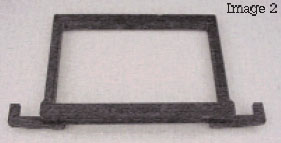 |
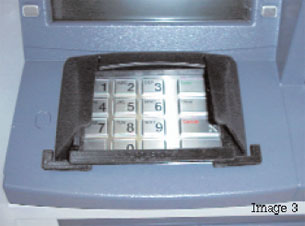
Having used fused deposition modeling (FDM®) for manufacturing of components and sub-assemblies, Diebold chose the technology to make its fixtures. The company needed accurate fixtures since there are many small components that are machined or assembled to tight tolerances. “FDM makes it possible to build fixtures from durable thermoplastics, such as polycarbonate and ABS. The fixtures can be produced to an accuracy of 0.005 inch, which is more than enough for this application,” says Lute. For a recently introduced ATM, Diebold used DDM to make several assembly aid fixtures. One such fixture (image 2) is used by production workers to precisely position a keypad privacy shield onto the ATM bezel (as shown in image 3). This ensures proper installation during assembly.
 |
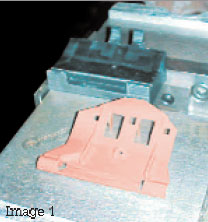
Diebold also uses DDM to make machining fixtures, such as the one shown in image 1 (black rectangular shape). This particular fixture is used to secure production parts during final machining. The red part to be machined gets held in the fixture. With FDM direct digital manufacturing, Diebold has saved as much as 80 percent in both time and cost. Commenting on average savings, Lute says, “FDM enables us to create assembly and machining fixtures in one-quarter the time and at one-half the cost of conventional machining.”
“We purchased an FDM Titan™ because it can produce machining and assembly fixtures in only a day or two,” says Lute. Combined with the time savings for components, Diebold is realizing the benefits of direct digital manufacturing in its ATM and security system product lines.
Stratasys, Inc.
7665 Commerce Way
Eden Prairie,MN 55344
888.480.3548
stratasys.com


DE's editors contribute news and new product announcements to Digital Engineering. Press releases may be sent to them via [email protected].
Follow DE
Join over 90,000 engineering professionals who get fresh engineering news as soon as it is published.






About Us · Contact Us · Editorial Team · Advertising · Privacy Policy · Subscriber Services · © 2026 Digital Engineering 24/7 · Peerless Media