Helping design and engineering professionals discover, evaluate and specify technologies and processes that shorten the design cycle and enable success.


Alert!
Digital Engineering ceased publication on July 1, 2026. This website remains available as an archive of engineering content.
For inquiries or information, please email [email protected].

Cut Retrieval-Augmented Generation (RAG) Hallucinations by 50%
Most teams hit the same wall with enterprise AI: LLMs that hallucinate, pipelines that don’t scale, and infrastructure that’s harder to design than the models themselves.

What Is Intelligent BOM Management? A Guide to Smarter Product Development
Learn how intelligent Bill of Materials (BOM) management helps teams collaborate, reduce errors, and bring innovative products to market faster with cloud-based PLM tools.
Editor's Note: This is sponsored content.
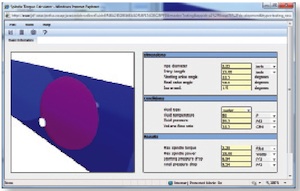 Frequently used Excel ® spreadsheets, MATLAB ® models, in-house codes, and CAE models can be exposed as web applications. Users need only a browser. |
The "Cloud" usually refers to a "public" or "external" cloud, accessed over the Internet, with an off-site provider. The possibilities for engineers are truly exciting, but there are some questions which we need to consider:
Organizations frequently opt to avoid these issues by using private (or "internal") clouds, while still achieving many of the benefits of cloud computing.
EASA -- an Easy Path to a private Engineering Cloud
Once installed on a server on your network, EASA becomes an internal cloud which hosts the applications and models your engineers and scientists use most frequently. Model "owners" use EASA to author and publish web applications that link to existing engineering models. No coding is required.
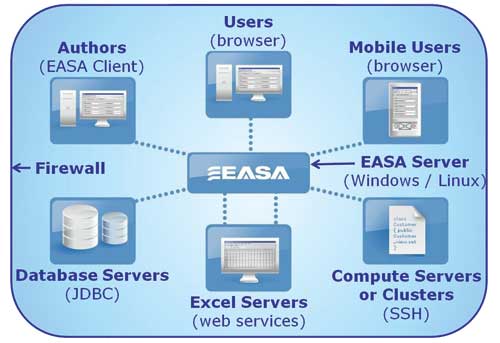
End-users need only a desktop or a mobile device with a browser. They do not need the underlying software installed locally. The EASA server not only hosts your web applications, but also provides a central repository of results, enabling users to collaborate when they need to.
About Us EASA is in use at companies such as Canon, Corning, Hewlett-Packard, General Electric, Procter & Gamble, and Xerox.
|
EASA may also be used to integrate multiple engineering tools under one web application, making a process more seamless for users.
Spreadsheets on the cloud
Excel ® may be the most commonly used engineering application. It is used to optimize operations, for preliminary design, engineering calculations, and for pricing and proposal generation. EASA enables you to transform spreadsheets into web applications suitable for multiple users, eliminating many issues which plague conventional spreadsheet usage:
Seb Dewhurst is director of business development, EASA, Inc. To view case studies and videos, or to download EASA, visit easasoftware.com.


DE's editors contribute news and new product announcements to Digital Engineering. Press releases may be sent to them via [email protected].
Follow DE
Join over 90,000 engineering professionals who get fresh engineering news as soon as it is published.






About Us · Contact Us · Editorial Team · Advertising · Privacy Policy · Subscriber Services · © 2026 Digital Engineering 24/7 · Peerless Media