Helping design and engineering professionals discover, evaluate and specify technologies and processes that shorten the design cycle and enable success.



Digital Engineering April 2026
In the latest issue of Digital Engineering, we take a look at the latest innovations in design for additive manufacturing, including the use of natural language inputs, social media cosplayers, and AI integration. The issue also includes a feature…

January Special Focus Issue: Design for Additive
In this Special Focus Issue of Digital Engineering, learn about the latest advancements in design for additive manufacturing, including new software tools, additive in automotive, custom medical devices, and more.
With the advent of the COVID-19 pandemic just two short years ago, we’ve been forced to quickly learn how easily economic sustainability can be disturbed. Its negative impact on supply chains and the global economy has been so significant that Governments are implementing initiatives in an effort to reverse the trend [e.g., President Biden’s Additive Manufacturing Forward (AM Forward), India’s National Strategy on Additive Manufacturing (AM)].
Globally, commercial and passenger transportation such as truck, bus, and rail has also fallen victim to this trend. These industries are in the midst of a deep slump due to reduced demand, labor shortages, and supply chain delays. Many of these manufacturers have begun to implement customized product configurations in an effort to maintain competitive advantage, but their ability to deliver these products has been deeply affected. When I worked as a program manager at John Deere Mexico, Antonio Garcia, then-President for John Deere Argentina said, “There is no more expensive part than the part that is not available.” He, like many others, acknowledged the need to implement more agile product innovation and flexible manufacturing processes to maintain sustainability strategies and assure business growth in this new post-pandemic reality.
The consequences of the deep reduction in cargo movement and passengers’ transit forced commercial freight companies and public transportation operators to park large portions of their assets. They are now in a position to return them in revenue service, and now find themselves in need of qualified maintenance labor and looking for hard-to-find spare parts. In light of this, transportation manufacturers and direct suppliers are re-evaluating their financial strategies to achieve resilient supply chains – placing increasing value on speed and component availability for critical parts, integrating vertical processes and establishing partnerships with regional suppliers located closer to their assembly sites.
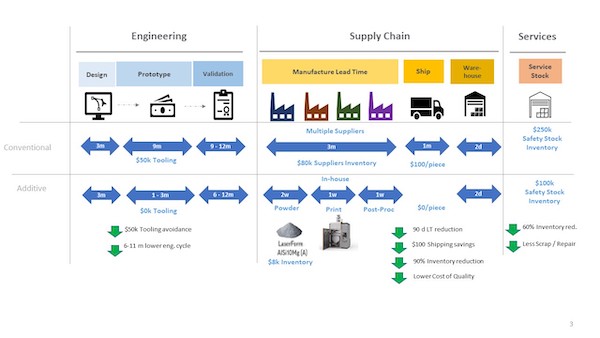
Additive manufacturing (AM) has demonstrated its value in bolstering economic sustainability by enhancing productivity. AM can facilitate rapid innovation and thus accelerate speed to market up to 3X by facilitating part count reduction, simplifying parts logistics, and reducing inventory levels by 90%. This results in myriad benefits including reduced risk for potential delays, and simplified assembly operations which reduce labor. Additionally, with monolithic parts enabled by AM, product quality is improved which in turn improves reliability. The need for service support is thus reduced and thus the number of replacement parts – we’ve seen a 60% reduction in some of our customers. With the need for less inventory on hand, there is also a reduced need to dispose of discontinued stock parts at the time of product obsolescence.
Additive manufacturing also demonstrates environmental sustainability advantages by enabling the production of parts, manufacturing aids, and tooling that requires less material yielding lower waste compared with subtractive manufacturing. Being able to produce parts and production tooling on-demand versus stocking them on shelves also saves warehouse space while eliminating the need to store costly inventory to support discontinued products. Finally, because AM provides design freedom to create parts not possible to produce with traditional manufacturing technologies, it offers engineers a path to design for the application versus designing for the manufacturing capability, thus enabling them to develop more energy-efficient products.
Additive manufacturing has evolved since its inception in the 1980s with the incorporation of many different types of printing technologies (e.g., photopolymers, powder bed fusion, direct metal printing, etc.). We’ve also seen an increase in the number of materials engineered to meet end-use production needs and the integration of advanced software applications that maximize design freedom. AM has become a transformational engineering tool for transportation innovation and a key accelerator in vertical integration strategies with a much simpler interface for ease of adoption. AM is much more than just a way to characterize a production method (i.e., additive versus subtractive), it enables a different paradigm with unique business benefits.
Production parts without tooling: Additive manufacturing is a process that inherently eliminates a major artifact in the production process – the tooling. The ability to directly produce a component from its digital representation not only makes the process more efficient but allows for the decentralization of the business model, quick adaptation, and delivery for the customer experience, as well as achieving this with less manufacturing overhead and waste.
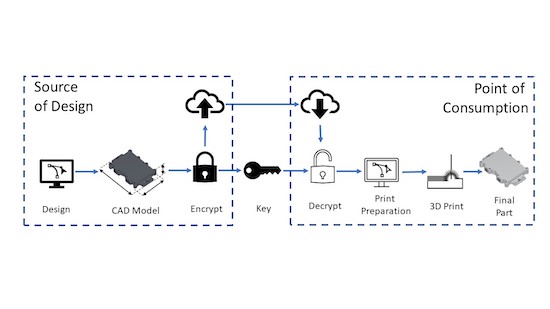
Digital inventory management: Thanks to the fast growth of digital encryption and IP protection technologies like Digital Right Management (DRM) or Blockchain systems, protecting 3D models and 3D printing parameters is a reality that perfectly marries with additive manufacturing technology. Design owners can now distribute digital information globally and control how many physical parts will be produced and guarantee quality while remote users or manufacturers can print them on demand without needing to ship, insure, store or maintain inventory.
Rapid production tooling: Compared to the auto industry, commercial and public transportation requires much larger parts and while additive manufacturing technology is growing in productivity and build sizes, some critical parts still cannot be produced using current AM printers. Many parts (e.g., large metal castings, external body parts, large interior panels) also cannot be produced as efficiently as desired for end-use consumption and thus need to be manufactured conventionally. In these cases, AM is the perfect solution to create rapid low-mid volume molds and casting patterns, either sacrificial or re-usable, with the advantage of maintaining them as digital inventory tools and eliminating the need for environmentally controlled storage spaces for years.
Companies with a solid long-term vision for sustainability endeavor to operate in a way that fosters economic growth, solves social challenges, and helps the planet by using renewable resources and eliminating waste. Leading transportation manufacturers and direct suppliers are re-evaluating their financial strategies to achieve resilient supply chains – placing increasing value on speed and component availability for critical parts, and many are realizing success by incorporating additive manufacturing into their production workflows. For those considering this journey, understanding initial capital investment levels, the right technology that aligns with the business need, and requirements for technical training can all seem daunting. This is where engaging a strategic partner can go a long way in providing technical assistance and end-to-end solutions that not only help execute the adoption of AM but also realize maximum benefits for their business. With the right partner and the right solution, I believe there is a tremendous opportunity for manufacturers and suppliers of all sizes to accelerate both their innovation and competitive position with the power of additive manufacturing.

From digitization, design and simulation through manufacturing, inspection and management, our comprehensive portfolio of technologies provides a seamless, customizable workflow designed to optimize products and processes while accelerating…
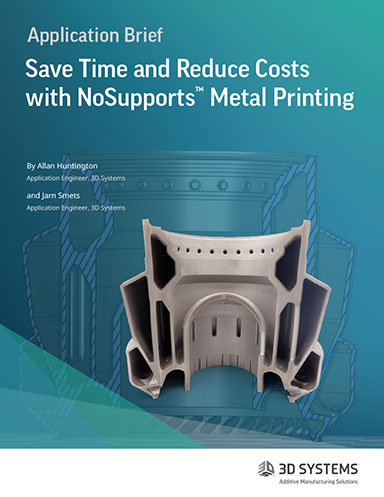
Save Time and Reduce Costs with NoSupports™ Metal Printing
Metal 3D printing is a high energy process in which it is possible for unmanaged heat and stress to build up and impact part quality, this guide presents a step-by-step methodology for how to apply NoSupports to a hot end section of a larger turbomachinery part.

Join over 90,000 engineering professionals who get fresh engineering news as soon as it is published.






About Us · Contact Us · Editorial Team · Advertising · Privacy Policy · Subscriber Services · © 2026 Digital Engineering 24/7 · Peerless Media