Helping design and engineering professionals discover, evaluate and specify technologies and processes that shorten the design cycle and enable success.



Digital Engineering April 2026
In the latest issue of Digital Engineering, we take a look at the latest innovations in design for additive manufacturing, including the use of natural language inputs, social media cosplayers, and AI integration. The issue also includes a feature…

January Special Focus Issue: Design for Additive
In this Special Focus Issue of Digital Engineering, learn about the latest advancements in design for additive manufacturing, including new software tools, additive in automotive, custom medical devices, and more.
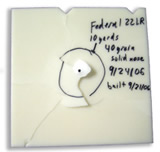 DMX-SLT 100 shot with a .22 caliber bullet. |
DSM Somos (Elgin,IL) is working to increase industry awareness around the impact testing of SL resins for the more accurate evaluation of material performance. Spurred by rapid prototyping’s move toward direct manufacturing, the company held live test demonstrations at the recent 2008 3DSUG conference in Costa Mesa, CA. RP users were invited to put various materials to test against Somos' latest high-impact SL resin, DMX-SLT 100, in Gardner impact tests.
The Gardner impact tester was used to showcase the wide range of impact resistance currently exhibited by today's RP materials. This testing method (ASTM 5420) allows designers to compare the relative impact resistance of materials under controlled laboratory conditions. According to the press release, the results obtained in Somos' live demonstrations at the 3DSUG Conference were used only to stimulate industry understanding and discussion of impact strength and how it can be used in the selection of RP materials for either functional testing or direct manufacturing applications.
A total of over twenty different materials were tested at the 3DSUG conference, ranging from 3D printing resins to SL resins to laser sintered resins. Ultimately each material tested was compared to Somos DMX-SLT 100, which exhibited “unprecedented” stiffness/toughness performance.
Based upon a chemistry platform that produces a stiffness/toughness combination, DMX-SL 100 is an SL resin designed for high durability applications. It is said to demonstrate the “stiffness of standard ABS-type resins but with more than twice the impact strength.” For more information about DMX-SL, as well as video footage of the live test demonstrations held at the 3DSUG conference, visit www.dsmsomos.com. More information about the impact testing of SL materials can also be found online in Somos' April 2008 newsletter, "The Part We Play."
Sources: Press materials received from the company and additional information gleaned from the company’s website.


DE's editors contribute news and new product announcements to Digital Engineering. Press releases may be sent to them via [email protected].
Follow DE
Join over 90,000 engineering professionals who get fresh engineering news as soon as it is published.






About Us · Contact Us · Editorial Team · Advertising · Privacy Policy · Subscriber Services · © 2026 Digital Engineering 24/7 · Peerless Media