Helping design and engineering professionals discover, evaluate and specify technologies and processes that shorten the design cycle and enable success.


Sponsored

Digital Engineering April 2026
In the latest issue of Digital Engineering, we take a look at the latest innovations in design for additive manufacturing, including the use of natural language inputs, social media cosplayers, and AI integration. The issue also includes a feature…

January Special Focus Issue: Design for Additive
In this Special Focus Issue of Digital Engineering, learn about the latest advancements in design for additive manufacturing, including new software tools, additive in automotive, custom medical devices, and more.

 Dear DE Reader:
Sometimes I mutter “that won’t fly” at new products announcements crossing my desk. When today's Editor's Pick of the Week came my way, the first thought was this should literally take off.
Stratasys recently announced its new Aircraft Interiors Certification Solution for 3D printing aircraft interior parts that meet demanding FAA (Federal Aviation Administration) and EASA (European Aviation Safety Agency) certification requirements. Right now, the solution is in a qualification program under FAA oversight at the National Center for Advanced Materials Performance (NCAMP), a part of the National Institute of Aviation Research at Wichita State University. Stratasys expects that process to conclude in late summer/early fall.
For engineers and the suits at aerospace companies as well as their suppliers, what NCAMP qualification of a 3D printing process means is that it should be less arduous getting FAA and EASA certification. You also should be able to fabricate more flight-certified parts more quickly.
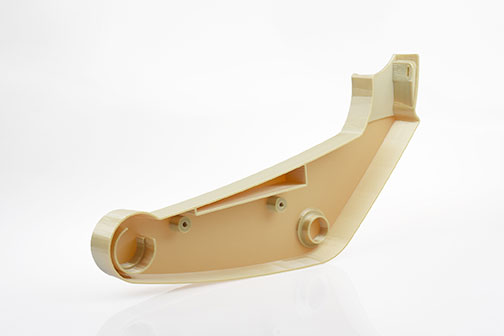 A Stratasys Fortus 900mc Production 3D Printer newly reconfigured with specialized hardware and software to deliver highly repeatable mechanical properties made this aircraft interior armrest component with Certified ULTEM 9085, a strong, lightweight thermoplastic that meets aircraft flame, smoke and toxicity regulations. Image courtesy of Stratasys Ltd.
But that's just a start. This also means you can design lighter components or open up new lines of business manufacturing specialized touches for customer styles. You should see fewer spare parts sitting on expensive warehouse shelves as well.
The Aircraft Interiors Certification Solution has two key components. The first is a new configuration of the Fortus 900mc Production 3D Printer. With its 36x24x36 in. (914.4x609.6x914.4mm) build size, it's Stratasys' largest-capacity FDM (fused deposition modeling) additive manufacturing system. This edition features specialized hardware and software for 3D printing parts with highly repeatable mechanical properties—an absolute must in aircraft component manufacturing. If you already deploy at Fortus900mc, you can upgrade your existing units with a kit.
Second is Certified ULTEM 9085 resin. This strong, lightweight thermoplastic meets aerospace flame, smoke and toxicity regulations, according to Stratasys. “Certified” means that it's produced in small batches, undergoes frequent testing and comes with all the various documentation providing full traceability and demonstrating compliance with airworthiness regulations.
The Aircraft Interiors Certification Solution has many other components like NCAMP-approved B-Basis design allowables datasets as well as a toolkit to calibrate and validate the Fortus 900mc's operations. Stratasys also provides on-site technical support for system setup validation before equivalency testing. Many of these are covered in today's main write-up, and deeper details are available from the links at the end of that content. Hit today's Editor Pick of the Week link and take off.
Thanks, Pal. – Lockwood
Anthony J. Lockwood
Editor at Large, DE


Anthony J. Lockwood is Digital Engineering's founding editor. He is now retired. Contact him via [email protected].
Follow DE
Join over 90,000 engineering professionals who get fresh engineering news as soon as it is published.






About Us · Contact Us · Editorial Team · Advertising · Privacy Policy · Subscriber Services · © 2026 Digital Engineering 24/7 · Peerless Media