Helping design and engineering professionals discover, evaluate and specify technologies and processes that shorten the design cycle and enable success.


Alert!
Digital Engineering ceased publication on July 1, 2026. This website remains available as an archive of engineering content.
For inquiries or information, please email [email protected].
 Dear DE Reader:
3D printers are cool and, arguably, the hottest of the lot make metal components. Today’s Pick of the Week takes a peek at a pair of new 3D metal printers.
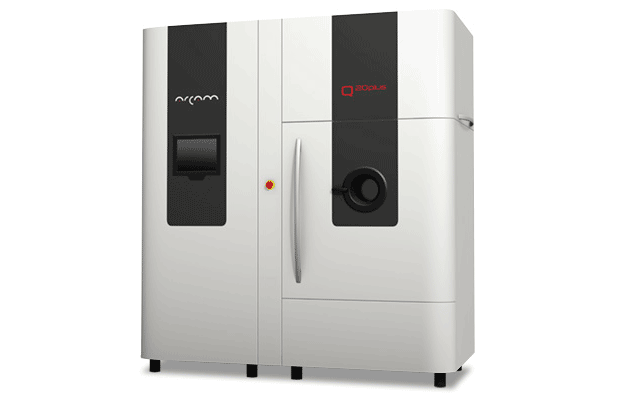
Arcam recently announced its new Arcam Q10plus and the Arcam Q20plus metal 3D printers. Actually successors to earlier models, these new units have been enhanced with new technologies such as an X-ray based technology for high-precision auto-calibration and all new control software. Both have been optimized for handling metal powders efficiently, and their software is ready for volume production. So turn-around times in a hectic production environment should be fast.
Arcam's 3D additive manufacturing process uses EBM (electron beam melting) technology to melt metal powders and build up parts layer-by-layer. It's a nifty process. It occurs in a controlled vacuum and uses deflection lens technology to maintain several melt pools simultaneously, making them precise and quick. A camera-based monitoring system helps you verify inline part quality.Arcam says that the parts you get have material properties better than cast and comparable to wrought materials. The supply chain for Arcam's standard metal powders — Cobalt-Chrome ASTM F75, Inconel 718 and three types of Titanium — is validated, and each batch of powder is fully traceable, which is a big deal. See, the Arcam Q10plus is designed for making orthopedic implants while the Arcam Q20plus is tuned for making aerospace components like turbine blades.
Among the notable features of the Arcam Q10plus is that it can make high-volume press-fit implants with advanced Tribecular Structures of engineered porous materials. It builds an implant’s solid and porous sections in one step, eliminating pricey secondary processes while ensuring structural continuity between the sections. Its maximum build size is 7.88x7.88x7 in.
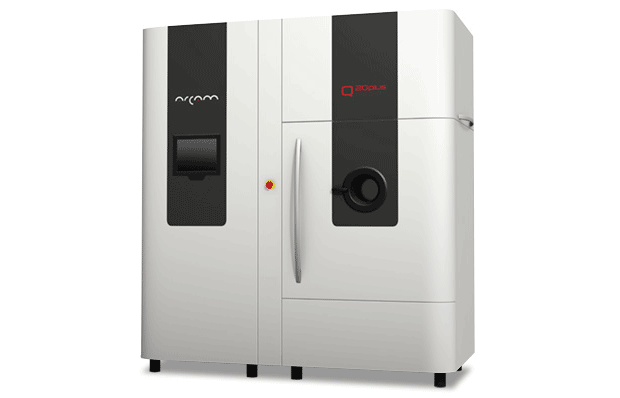 The Arcam Q20plus 3D printer uses electron beams to fabricate components from metal powders. Arcam AB says that that this 3D printer is designed for cost-efficient production of aerospace components. Image courtesy of Arcam AB.
The Arcam Q20plus has much the same features as the Q10plus such as the inline part quality verification and auto-calibration. But it has a much bigger build envelope – 13.77x14.96 in., so you can make large parts like structural airframe components. You can also stack smaller components in that chamber.
You can learn more about the Arcam Q10plus and the Arcam Q20plus metal 3D printers from today's Pick of the Week write-up. Make sure to download the brochure linked at the end of the account. It has a terrific introduction to Arcam's EBM technology in addition to covering the product line-up.
Thanks, Pal. – Lockwood
Anthony J. Lockwood
Editor at Large, DE


Anthony J. Lockwood is Digital Engineering's founding editor. He is now retired. Contact him via [email protected].
Follow DE






About Us · Contact Us · Editorial Team · Advertising · Privacy Policy · Subscriber Services · © 2026 Digital Engineering 24/7 · Peerless Media