Helping design and engineering professionals discover, evaluate and specify technologies and processes that shorten the design cycle and enable success.



Digital Engineering April 2026
In the latest issue of Digital Engineering, we take a look at the latest innovations in design for additive manufacturing, including the use of natural language inputs, social media cosplayers, and AI integration. The issue also includes a feature…

January Special Focus Issue: Design for Additive
In this Special Focus Issue of Digital Engineering, learn about the latest advancements in design for additive manufacturing, including new software tools, additive in automotive, custom medical devices, and more.
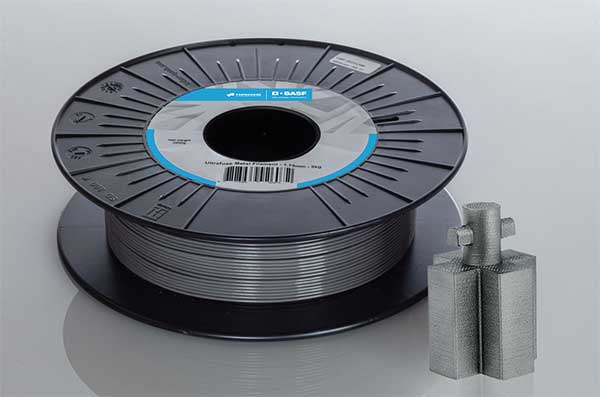
Forward AM, a subsidiary of chemicals giant BASF, introduces the latest in its growing line of fused filament fabrication (FFF) 3D printing materials. Ultrafuse 17-4PH is a filament comprising metal powder with a polymer binder. After debinding and sintering, the final 3D printed part is 17-4 stainless steel.
Forward AM says Ultrafuse 17-4PH can be fully heat treated to high levels of strength and hardness. This makes it ideal for petrochemical, aerospace, automotive and medical manufacturing.
The filament obtains its final hardness through a catalytic debinding and sintering, known from traditional metal injection molding.
The company says this new stainless steel filament is an “easy and affordable way” to bring stainless steel into additive manufacturing (AM). It combines high strength and hardness with good corrosion resistance. A wide variety of post-processing options are available to finish prints as green parts.
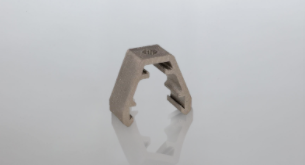
An example part created by Forward AM during final testing is a spare part solar panel clamp. The clamp was a discontinued serial product. Replacement parts had to match the original for weather resistance (UV radiation, heat, moisture) and be a long-life solution, as it was an upgrade from aluminum to stainless steel.
Ultrafuse 17-4PH is compatible with most FFF 3D printers; many are open source.
Ultrafuse 17-4PH is also referred to as Type 630. The company says this chromium-copper martensitic precipitation hardened stainless steel is magnetic and fully heat treatable. The material is able to maintain its mechanical and corrosion resistance at temperatures up to 315°C (600°F).
Ultrafuse 17-4PH filaments can be ordered from distributors if users want to print themselves. A full list of sales partners of Ultrafuse 17-4PH filaments is available here. Alternatively, there is the possibility to order parts printed with Ultrafuse 17-4 PH through Sculpteo’s online platform.
Sources: Press materials received from the company and additional information gleaned from the company’s website.


DE's editors contribute news and new product announcements to Digital Engineering. Press releases may be sent to them via [email protected].
Follow DE
Join over 90,000 engineering professionals who get fresh engineering news as soon as it is published.






About Us · Contact Us · Editorial Team · Advertising · Privacy Policy · Subscriber Services · © 2026 Digital Engineering 24/7 · Peerless Media