Helping design and engineering professionals discover, evaluate and specify technologies and processes that shorten the design cycle and enable success.



Digital Engineering April 2026
In the latest issue of Digital Engineering, we take a look at the latest innovations in design for additive manufacturing, including the use of natural language inputs, social media cosplayers, and AI integration. The issue also includes a feature…

January Special Focus Issue: Design for Additive
In this Special Focus Issue of Digital Engineering, learn about the latest advancements in design for additive manufacturing, including new software tools, additive in automotive, custom medical devices, and more.
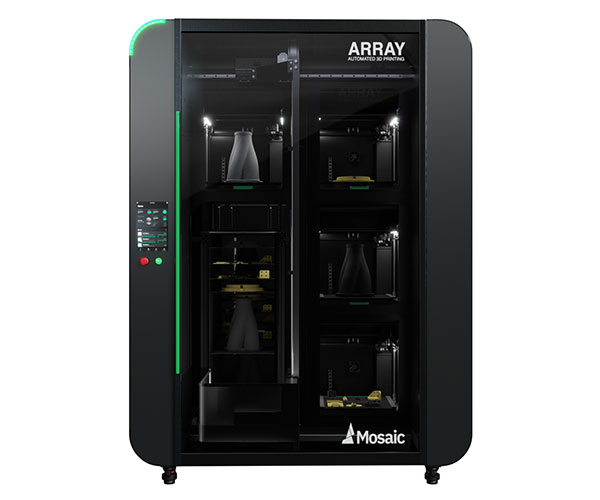
Mosaic Manufacturing introduces Array, a new modular 3D printing system for plastics. The company says Array offers lower costs in material use, extends uptime and can work with multiple materials. The Array line is designed for use by high-volume manufacturing facilities looking to reduce costs and increase throughput.
The Array system features automated bed changing and material handling systems. It works with various manufacturing plastics including PEEK (polyether ether ketone), PEKK (polyether ether ketone ketone), Ultem and various Nylons.
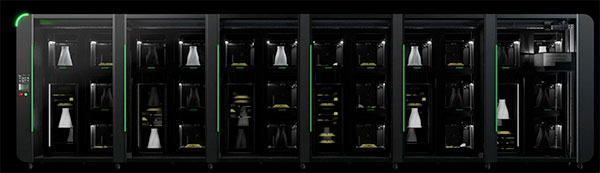
Array can be purchased as a single printing unit, or expanded with extra units to deliver up to 5,000 parts per day. The single Array and the multi-unit Array Production use Mosaic’s Element HT, a high-temperature modular print box that can handle up to eight separate material inputs.
The full Array product ecosystem offers a scaled approach to industrial 3D printing.
“Flexible output, mass customization, faster turnaround times and unrestricted part geometries are now able to be accessed in production volumes of hundreds of thousands of parts per year,” says Chris Labelle, COO of Mosaic Manufacturing. “Array’s impact on manufacturing comes from the benefits of enabling 3D printing for scaled applications.”
The flagship product is the Array printer. It contains four individual Element HT 3D printers working in tandem. The Array system is designed for around-the-clock unattended operation. Each module features the Palette X material handling system, which can switch between filaments mid-print.
The Array also features a robotic part removal system that serves to substitute out print beds after every build. The company says this allows all four printers in the Array to be active with less than 10% downtime. The system can run unattended, further improving throughput.
The Element HD 3D printer is also available as a standalone device. The build volume is 355x355x355 mm, and includes a heated platform and a heated build chamber.
Also introduced as part of the Array ecosystem is the Palette 3 and Palette 3 Pro multi-material filament switching system, which can be used with printers from other manufacturers as well as in the Array. Both allow for real-time switching between four and eight filaments, respectively.
Array and the Array Production will be available in December 2021. Full systems start at $59,999. Element and Element HT will begin shipping November 2021, starting at $5,999 and $9,999, respectively. The Palette 3 ($599) and the Palette 3 Pro ($799) will start shipping June 2021.
Sources: Press materials received from the company and additional information gleaned from the company’s website.


DE's editors contribute news and new product announcements to Digital Engineering. Press releases may be sent to them via [email protected].
Follow DE
Join over 90,000 engineering professionals who get fresh engineering news as soon as it is published.






About Us · Contact Us · Editorial Team · Advertising · Privacy Policy · Subscriber Services · © 2026 Digital Engineering 24/7 · Peerless Media