Helping design and engineering professionals discover, evaluate and specify technologies and processes that shorten the design cycle and enable success.



Cut Retrieval-Augmented Generation (RAG) Hallucinations by 50%
Most teams hit the same wall with enterprise AI: LLMs that hallucinate, pipelines that don’t scale, and infrastructure that’s harder to design than the models themselves.

What Is Intelligent BOM Management? A Guide to Smarter Product Development
Learn how intelligent Bill of Materials (BOM) management helps teams collaborate, reduce errors, and bring innovative products to market faster with cloud-based PLM tools.
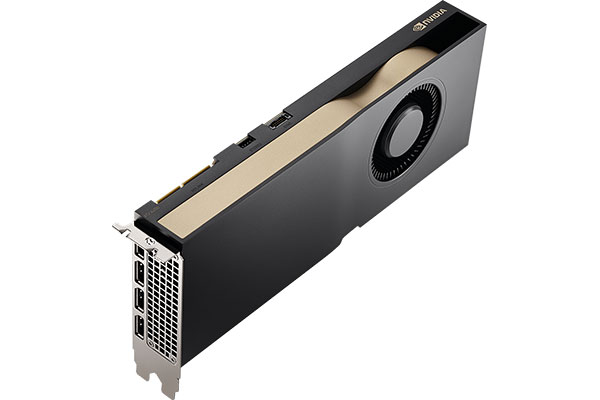
PNY announces the immediate availability of the NVIDIA RTX A4500, a next-generation workstation graphics processing unit (GPU). This is one of several GPUs to bring NVIDIA Ampere technology to the segment of the workstation GPU market where high-performance and a large amount of GPU memory are a must.
PNY says this new GPU brings the capability to work with larger models, renders, datasets and scenes with higher fidelity and greater interactivity. It offers enhanced real-time ray tracing, accelerated AI, and advanced graphics and compute capabilities.
The company says more than 70 leading professional applications—including most CAD and CAE products—support RTX technology.
Key specs include 7168 CUDA cores, 224 Tensor cores, 56 RT cores and 20GB of GDDR6 memory running at 640GB-per-second memory bandwidth. PNY says this card is aimed at the workstation market, and is not intended to be a gaming GPU like the NVIDIA GeForce RTX series of GPUs. These specs mean the new board sits between NVIDIA’s other Ampere-generation workstation GPUs, the A4000 and A5000.
More specifications for the RTX A4500 include ECC memory support, a PCIe Gen 4 x16 interface and four DisplayPort 1.4a ports. PNY says this new GPU also features NV-Link support for pairing multiple A4500s together, which supports GPU memory pooling and performance scaling, for more intensive workloads. Maximum power output is 200W. The RTX A4500 offers 23.7 TFLOPS of compute performance, which slots in between the A4000's 19.2 TFLOPS of performance and the A5000's 27.8.
The graphics card is two PCIe slots thick and features a blower-style cooler like many other workstation GPUs. Supplementary power is provided by a single eight-pin connector, allowing the card to reach its maximum power consumption of 200W.
The NVIDIA RTX A4500 GPU is now shipping from PNY and can be found in systems from workstation OEM’s and other selected vendors. A list of sources is here.
Sources: Press materials received from the company and additional information gleaned from the company’s website.


With over 3 decades of experience in manufacturing and enterprise support, PNY delivers high-performance NVIDIA® GPU solutions ranging from AI and HPC enterprise data centers to graphics and AI workstations. Established in 1985, PNY…

NVIDIA RTX PRO Blackwell Desktop GPUs
NVIDIA RTX PRO™ Blackwell Desktop GPUs feature the latest breakthroughs in AI, ray tracing, and neural rendering technology to power the most innovative workflows in design, engineering, and beyond.

DE's editors contribute news and new product announcements to Digital Engineering. Press releases may be sent to them via [email protected].
Follow DE
Join over 90,000 engineering professionals who get fresh engineering news as soon as it is published.






About Us · Contact Us · Editorial Team · Advertising · Privacy Policy · Subscriber Services · © 2026 Digital Engineering 24/7 · Peerless Media