Helping design and engineering professionals discover, evaluate and specify technologies and processes that shorten the design cycle and enable success.


Alert!
Digital Engineering ceased publication on July 1, 2026. This website remains available as an archive of engineering content.
For inquiries or information, please email [email protected].


Digital Engineering April 2026
In the latest issue of Digital Engineering, we take a look at the latest innovations in design for additive manufacturing, including the use of natural language inputs, social media cosplayers, and AI integration. The issue also includes a feature…

January Special Focus Issue: Design for Additive
In this Special Focus Issue of Digital Engineering, learn about the latest advancements in design for additive manufacturing, including new software tools, additive in automotive, custom medical devices, and more.
EOS, supplier in the field of industrial 3D printing of metals and polymers, is showcasing its Fine Detail Resolution (FDR) technology for processing polymers for the first time at the formnext trade show in Frankfurt, Germany (November 19-22, 2019, hall 11.1, stand D31).
EOS has developed a solution for powder-based industrial 3D printing using a CO laser. This will make it possible to produce delicate, robust parts with fine detail resolution surfaces and minimum wall thicknesses of only 0.22 mm, the company says. It will open up new applications for series production and will offer a broader variety to the industry when choosing a suitable 3D printing technology from EOS for processing polymers, the company reports.
FDR is a solution for wherever delicate structures, surfaces with a fine detail resolution and thin wall thicknesses are requirements, the company says. Unlike the existing EOS product range, a 50-watt CO laser is being used. This laser type creates an ultra-fine laser beam with a focus diameter that's half the size of current SLS technologies. This enables new exposure parameters resulting in parts with superfine surfaces. Initially, the certified material PA 1101 is used and is processed in layer thicknesses of 40 and 60 µm. It features high impact resistance and elongation at break. It is made from renewable raw materials.
The FDR technology is being developed for the EOS polymer production platform and opens up options for new applications in polymer-based additive manufacturing, such as for filter units and fluid channels, plugs and other electronic components as well as consumer goods such as eyeglasses. EOS is presenting this technological concept for the first time at formnext 2019.
“The new technology will combine the best of two worlds—the detailed resolution of stereo lithography (SLA) with the durability and quality of selective laser sintering (SLS)," Dr. Tim Rüttermann, senior vice president Polymer Division, says. “In future, depending on application requirements, customers will therefore be able to choose between the existing EOS P 500 version with a CO2 laser for high productivity and material flexibility; or the CO laser-based FDR technology for manufacturing extremely delicate components; or, if the focus is on maximum productivity with dedicated application material, they can decide for the upcoming EOS LaserProFusion technology concept that was showcased for the first time at the formnext 2018."
The EOS P 500 platform is primarily designed for companies that want to produce polymer components reproducibly on an industrial scale using additive manufacturing. In an initial step, a CO2 laser with a focus diameter of 0.5 mm and a laser output of 2x70 watts will be used on the platform. This automatable system makes it possible to minimize costs per part and process polymer material classes such as PA 12, PA 11, PA 6, TPU and other polymers. The use of this platform will also open up applications in the mobility and automotive industry as well as in the manufacturing of electronic components.
Sources: Press materials received from the company and additional information gleaned from the company’s website.

EOS enables their customers to produce innovative and high quality products based on industrial 3D printing technologies. EOS is a global technology and quality leader for high-end solutions in the field of additive manufacturing (AM). Founded in…
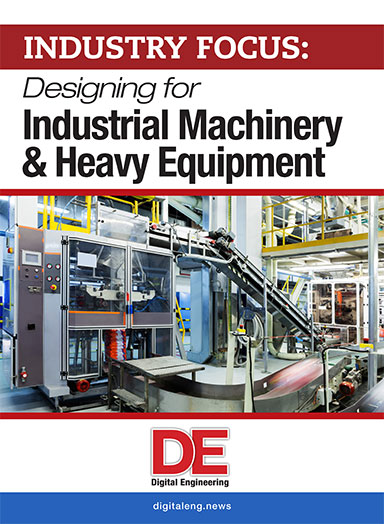
Industry Focus: Designing for Industrial Machinery and Heavy Equipment
The articles compiled in this special digital issue focus on how vendors are reacting to the need to digitize the factory floor and connect it all the way back through the enterprise to front-end product design and development.

DE's editors contribute news and new product announcements to Digital Engineering. Press releases may be sent to them via [email protected].
Follow DE






About Us · Contact Us · Editorial Team · Advertising · Privacy Policy · Subscriber Services · © 2026 Digital Engineering 24/7 · Peerless Media