Helping design and engineering professionals discover, evaluate and specify technologies and processes that shorten the design cycle and enable success.



Digital Engineering April 2026
In the latest issue of Digital Engineering, we take a look at the latest innovations in design for additive manufacturing, including the use of natural language inputs, social media cosplayers, and AI integration. The issue also includes a feature…

January Special Focus Issue: Design for Additive
In this Special Focus Issue of Digital Engineering, learn about the latest advancements in design for additive manufacturing, including new software tools, additive in automotive, custom medical devices, and more.
EROFIO Group, an industrial molding sector company and user of GE Additive’s direct metal laser melting (DMLM) technology, was selected to test and put the GE Additive Concept Laser M Line through its paces ahead of its commercial readiness later this year, the companies report.
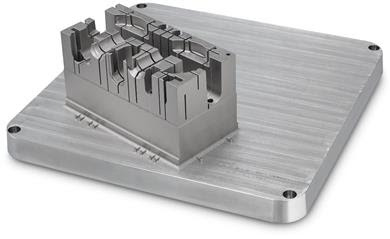
Less than three months since receiving and installing an M Line system at its 6,500 m2 mold-making facility in Batalha, central Portugal, a team led by EROFIO Group’s metal additive manufacturing leader, Luís Santos has successfully 3D-printed its first Mold Core.
The Core was manufactured using M300 hot work tool steel—a material often used for the production of injection molding and die-casting tool inserts with conformal cooling, as well as functional components. The Core contains more than eight independent, internal conformal cooling channels, stretching over 8 m in length and between 5 to 8 mm in diameter.
Santos and his team already developed for the Concept Laser M2 Series 5—and made only very minimal changes to adapt it for the M Line system.
After remote optimization support from the GE Additive team in Lichtenfels, the part was successfully printed on its first attempt, over a 6-day period in May 2021.
“Having the first part come off our system is a great milestone and we’re looking forward to supporting the wider team as the solution comes to market and beyond,” says Luís Santos, EROFIO Group.
“We have a solid working relationship with the team at EROFIO that goes back well over a decade. As we near a critical phase in commercializing the M LINE system, we specifically sought out a trusted partner to gain early installation experience, data and honest customer feedback,” says Wolfgang Lauer, Concept Laser M Line product manager, GE Additive.
“We fully expected the first part to be printed on the M Line to go well. And when it did there was a rush of excitement felt across the entire team here in Lichtenfels. Work continues here in Germany on the M Line, ahead of the launch, and we will factor in additional feedback from the team at EROFIO,” says Jan Siebert, general manager, laser technologies, GE Additive.
“It is critically important that when GE Additive brings new solutions to market, it can tangibly and immediately demonstrate business impact. Our M Line system operates at higher levels of reliability and repeatability, meeting customers’ needs from day one. This is not a science experiment and we are not developing laboratory equipment,” he adds.
Sources: Press materials received from the company and additional information gleaned from the company’s website.


DE's editors contribute news and new product announcements to Digital Engineering. Press releases may be sent to them via [email protected].
Follow DE
Join over 90,000 engineering professionals who get fresh engineering news as soon as it is published.






About Us · Contact Us · Editorial Team · Advertising · Privacy Policy · Subscriber Services · © 2026 Digital Engineering 24/7 · Peerless Media