Helping design and engineering professionals discover, evaluate and specify technologies and processes that shorten the design cycle and enable success.



Digital Engineering April 2026
In the latest issue of Digital Engineering, we take a look at the latest innovations in design for additive manufacturing, including the use of natural language inputs, social media cosplayers, and AI integration. The issue also includes a feature…

January Special Focus Issue: Design for Additive
In this Special Focus Issue of Digital Engineering, learn about the latest advancements in design for additive manufacturing, including new software tools, additive in automotive, custom medical devices, and more.
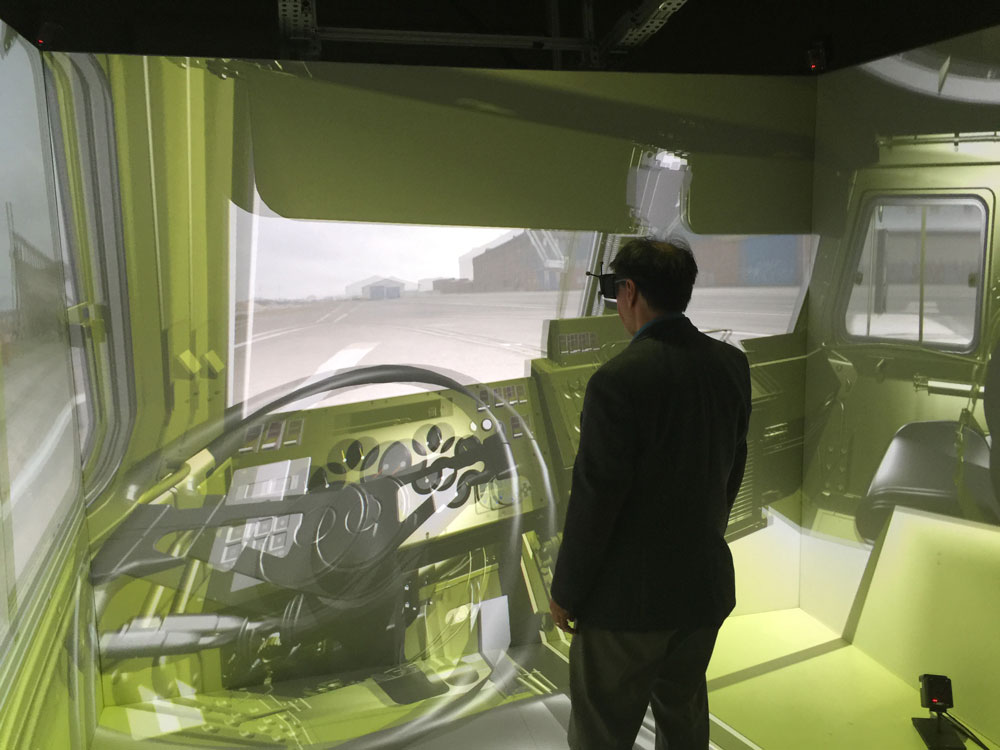
 DE Editorial Director Jamie Gooch prepares to take the wheel of some heavy equipment.
The Rave Cave is located in the Defense Corridor Center for Collaboration and Synergy (DC3S) office building, which houses a number of technology-related companies in an attempt to promote creativity and collaboration between the businesses. DC3S is also right across the parking lot from RAVE Computer, which helped establish the Rave Cave as a non-profit as part of a cooperative research and development agreement with TARDEC (the U.S. Army's Tank Automotive Research Development and Engineering Center). Rave Computer is a manufacturer of commercial-off-the-shelf and custom computing solutions. One of its specialties is providing ruggedized hardware that meets MIL-SPEC standards, though it also targets engineers who need computing power for modeling, simulation and visualization.
The mission of the Rave Cave is to facilitate government research into VR, promote STEM (science, technology, engineering and math) education for Kindergarten through 12th-grade students, be a resource for higher education, and encourage the development and retention of a high-tech workforce in the region.
 Rave Cave President Art Adlam prepares for virtual surgery in front of a more portable, but less immersive VR CAVE.
"We are like a technology warehouse where people can come to see how different software is used in different areas," says Art Adlam, president of Rave Cave. "We're agnostic in hardware and software."
Visitors range from schools, to manufacturers, to the Army, to healthcare providers who want to see how VR technology could be applied to their needs. For example, manufacturers may want to use VR for product evaluation or to see how machines in a factory could be arranged. Hospitals and the Army are interested in VR for training.
"AR is a great collaboration tool," says Adlam, noting that serving VR data from a remote computer has come of age, which enhances collaboration without risking any sensitive intellectual property. "Engineering can remotely communicate and display designs with people on the factory floor before a machine is produced, for instance."
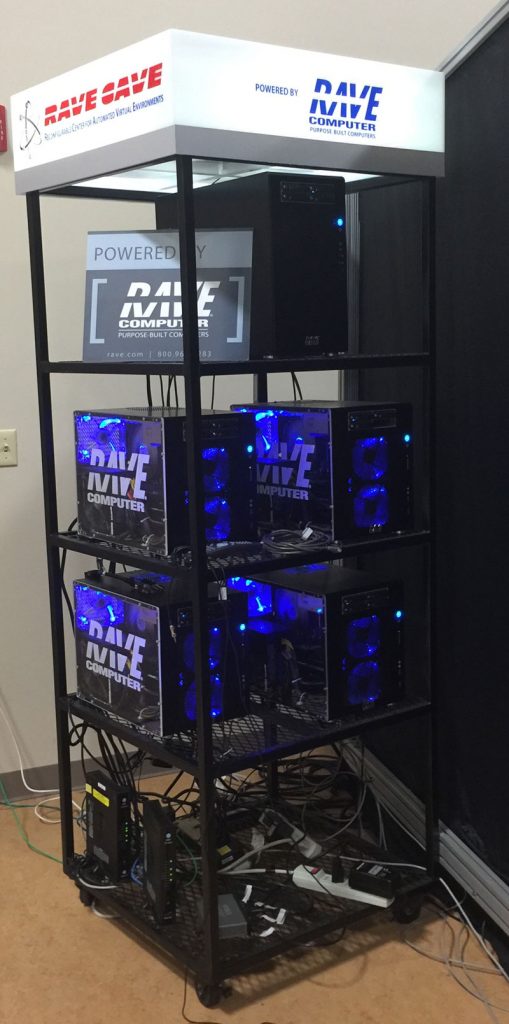 A cluster of workstations created and maintained by Rave Computer keeps the rear projectors, goggle sensors and graphics in sync.
In addition to a large and small CAVE environment, the Rave Cave also has desktop and head-mounted display-based VR hardware and software available—the kind design engineers might use to create a virtual environment. However, the software is still labor intensive. While I was trying to climb into the driver's seat of a virtual armored personal carrier using a head-mounted display and joysticks, I found myself easily overshooting the vehicle, "falling" through it or hovering and spinning above it. It was a minor victory to finally take a seat. Adlam assured me it wasn't just my 45-year-old reflexes, saying the user interface still has some kinks to work out.
As DE's Kenneth Wong noted in the August 2017 cover story, "Modeling for the Augmented Reality Age," the consumption of virtual content is much more far along than the development of it. Large companies have been using VR for visualization purposes years, but the jury is still out on whether VR can be used for actual design work—as opposed to using a keyboard an mouse. Still, the benefits of VR for collaboration and product evaluation are clear.
"It saves time and money," says Adlam. "Time is more critical than money in a lot of situations. You have to get to market faster for the return on investment to be there."
With head-mounted displays and even desktop monitors with 3D features prices dropping, Adlam says even small- and medium-sized businesses can dip a toe into VR. Get more information on the use of augmented and virtual reality here.


Jamie Gooch is the former editorial director of Digital Engineering.
Follow DE
Join over 90,000 engineering professionals who get fresh engineering news as soon as it is published.






About Us · Contact Us · Editorial Team · Advertising · Privacy Policy · Subscriber Services · © 2026 Digital Engineering 24/7 · Peerless Media