Helping design and engineering professionals discover, evaluate and specify technologies and processes that shorten the design cycle and enable success.



Digital Engineering April 2026
In the latest issue of Digital Engineering, we take a look at the latest innovations in design for additive manufacturing, including the use of natural language inputs, social media cosplayers, and AI integration. The issue also includes a feature…

January Special Focus Issue: Design for Additive
In this Special Focus Issue of Digital Engineering, learn about the latest advancements in design for additive manufacturing, including new software tools, additive in automotive, custom medical devices, and more.
The growth in the 3D printed electronics market reveals a pathway paved with potential. Manufacturing electronics via 3D printing offers capabilities not typically achievable via traditional manufacturing, experts say. Various industries, such as aerospace, medical, and consumer sectors, are navigating this space with success. And experts point to projected growth in customization, miniaturization and on-demand manufacturing.
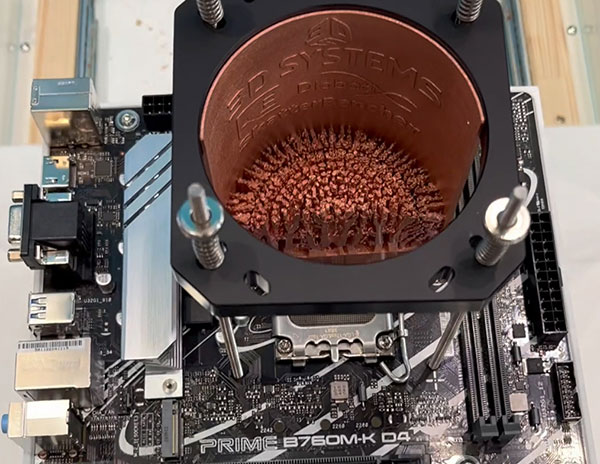
At one intersection of electronics and 3D printing, DE explores a case study from 3D Systems who collaborated with Diabatix on a liquid nitrogen heatsink that generates extreme CPU cooling for data centers, which demonstrates extreme CPU cooling at the intersection of material science, generative design, and additive manufacturing. It’s built with the help of Diabatix generative AI technology and 3D Systems’ use of metal 3D printing.
Following the case study is a sidebar with perspectives from experts on how additive manufacturing figures into the manufacturing of electronics now and in the near future.
The 3D Systems/Diabatix heatsink innovation got its wings thanks to a request from overclocking pros SkatterBencher and Elmorlabs, according to Scott Green, principal solutions leader for industrial applications at 3D Systems, who authored the technical paper on it. “There’s a class of users that are extreme overclockers, which take accessible CPUs on the market and try to push them as far as they can without breaking them. Our technology demonstration moves the goal post for those users on what is possible,” Green says.
Extreme CPU cooling using liquid nitrogen is gaining ground among those skilled at computer overclocking because it enables significantly low temperatures that are needed if you want extreme clock speeds, 3D Systems explains.
By using the Diabatix’ ColdStream platform, the engineering team at 3D Systems worked to build a heatsink maximizing thermal performance of liquid nitrogen cooling. ColdStream used two-phase boiling physics mixed with advanced multiphysics geometry optimization. The result: ColdStream automatically produced a structure that provided precise geometry to meet the boundary conditions of the problem.
A first round of tests, reported by 3D Systems, showed thermal resistance as low as 0.011K/W. It is 1.1°C of temperature difference between the heatsink base and liquid nitrogen per 100W of CPU power.
“We broke a world record—none of the other record holders had approached the problem with the level of technology that we used, but we hope that it excites some friendly competition and interest in overtaking the record,” Green says.
The heatsink uses 3D Systems’ Direct Metal Printing technology, and is made with commercially pure oxygen-free copper for thermal conductivity of 390 W/mK, according to the company. It enabled geometries not normally seen in traditional manufacturing when optimizing parts for performance.
Green elaborates, “… With direct metal 3D printing, the materials associated with it and novel generative design, which is very unique automated design software, you can create what we call precision cooling. That’s the technological feat—materials science, additive manufacturing, and software converging to provide a result that literally cannot be beaten by any other combo of those three things.”
“When you work with cooling, you have an off-the shelf cooling medium—typically water or ethanol coolant—but in this case we’re using liquid nitrogen,” he adds. The material used was commercially pure oxygen-free copper. “Our feedstock is nearly 100 % pure elemental copper, which provides an incredible 103 IACS conductivity measurement,” he says. “Maintaining an oxygen-free pure environment, you get the best possible utility of that material in the application, so it’s not mixed or tarnished or damaged by oxygen in the environment.”
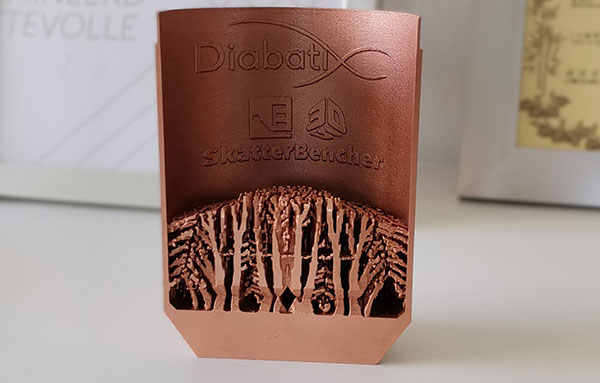
The commercially pure copper heat sink is a result of efforts from 3D Systems, Diabatix, skatterbencher, and Elmorlabs. Image courtesy of 3D Systems.
3D Systems combined the material with its means of construction—direct metal printing or laser powder bed fusion.
The software component was the Diabatix platform. “From a software perspective there are now easily accessible tools on the market to be able to do geometry optimization for a number of different physical use cases. This tool allows you to do multiphysics optimizations, using many physical simulation requirements in parallel to optimize.”
The software enabled the ability to combine two different physical phenomena: thermal and fluid dynamics, at the same time, together, is topological geometry optimization in iterative loops,“ Green explains.
“Typically you’re doing one or the other. It’s very hard to do both. The massive multiscale optimization means you can simulate or optimize to multiple physical requirements like strength, thermal, and flow, etc., and combine those to do a multiscale optimization. Historically that would be extremely difficult or impossible either from a software perspective or logistically impossible because of the amount of cycles (and time) needed for it to crunch and figure out the perfect combination of those two requirements.”
The liquid-nitrogen heatsink, though appealing to overclockers, isn’t for everyone. “There’s always been some desire by additive manufacturing companies to do something in this computer cooling space. But when it comes to the average consumer-level computers, it’s really not required or cost-effective,” Green says.
The cost to make it would run about $9K to $10K. “It’s not really a prosumer thing,” Green admits. But he says what is interesting is that it “broadly speaks to the high-performance computing market and those involved in AI infrastructure—beyond prosumers, the professional capital compute people. Those folks are paying attention to the fact that this is a fancy solution for an average person, but for a data center, this shows that maybe we’re not going to use liquid nitrogen but with much better geometry and additive manufacturing as a way to express that geometry, we’re able to achieve significantly better protection or performance from the data center.”
High-performance cooling using various types of media beyond commercially pure copper could be useful, if liquid nitrogen was replaced with ethanol or another cooling medium.
“This is directly interesting for high-performance computing and scientific computing communities [who are] doing things like drug discovery, cancer research, DNA sequencing, oil and gas discovery, geospatial modeling—heavy data crunching type of applications,” Green says, adding it could also have use in the space of AI infrastructure in writing large-language models and compute-intensive AI applications. DE
By Stephanie Skernivitz
Companies in the space of additive manufactured electronics and the equipment used to output such offerings spoke with DE. Here’s a snapshot of what they’re seeing.
“We’ll continue to see miniaturization push the boundaries in industry innovation, and I expect to see design specifications for micro-sized parts requiring tight tolerances, ultra-high precision and accuracy,” says John Kawola, CEO of BMF. “Specialized, micro 3D printing solutions will likely become a go-to method for designers and engineers in the prototype-to-production cycle.”
BMF, a long-time player in additive manufacturing, makes 3D printers that incorporate Projection Micro Stereolithography (PµSL) technology, a stereolithography that uses a DLP light engine, optics, motion control, and software, according to Kawola. This method reportedly lessens the amount of support structures needed.
At Optomec, CEO Robert Yusin says the company offers Aerosol Jet Printing, which allows 3D printing of electronics on various surfaces, giving flexibility that traditional electronics can’t offer. “Fabrication on a printed circuit board (PCB) has been the traditional approach, but it is fixed and costly. Aerosol Jet offers nano printing on flat and curved surfaces, and on multiple types of materials including glass, plastics, ceramics, and many others,” Yusin explains.
There is a growing interest in this type of printed electronics, according to Yusin. “Demand has been strong in verticals such as defense, energy, enterprise and personal electronics,” he says. “The demand for smaller electronic products has required the optimization of the product real estate over time, which requires a more flexible approach. Even large objects such as windmill blades belonging to energy companies have a need for electronic printing of small sensors onto the blade that enable administrators to remotely manage and monitor performance,” he explains.
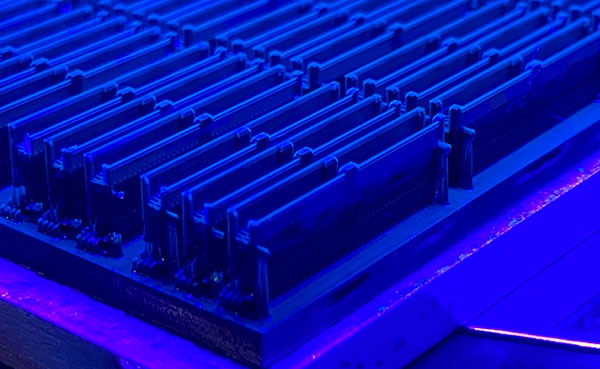
Example of an electronic connector. Image courtesy of BMF.
BMF’s Kawola shares how the company has collaborated with various electronics companies who are seeking precision, while other customers seek out BMF when certain materials, such as those that can sustain high heat, are needed.
In one example, Kawola shares how Z-Axis Connector Co. used BMF’s technology to create high-performance connectors with very small features and “tighter tolerances than other manufacturing methods would allow. They were also able to use materials engineered to withstand extreme temperatures, such as a reflow soldering oven, which helped them overcome a major design and material challenge.”
In another example, Kawola shares how BMF worked with Hirose electric for prototyping electronic circuit connectors. These connectors, “required very small and precise pin holes, which are used across a wide range of applications including smartphones, in-vehicle equipment, and industrial equipment, as the size requirements can change on a moment’s notice,” Kawola adds.
At Optomec, Yusin addresses several challenges in the 3D printed electronics space:
“Traditional electronic printing lacks the infrastructure for automated scheduling and performance monitoring. Advanced systems should enable machines to run on predefined schedules while providing alerts for maintenance, material shortages and performance anomalies,” Yusin notes.
BMF’s Kawola explains how many electronics require components that have tiny holes through the piece. “These holes are often extremely small, nearly microscopic, and are extremely difficult to produce with traditional manufacturing methods or, when possible, require a large investment in time and cost. Our technology is very valuable for electronic engineers and designers requiring this feature, as our 3D printers can produce these small features down to the 2µm,” he shares.
The company has also partnered with Mechnano to provide electrostatic discharge (ESD) safe resins. “ESD can pose significant challenges, especially when working with sensitive electronic components or where static could cause damage to equipment. ESD resins for 3D printing are specially designed to address these pain points and ensure the integrity of electronic components.”
Rich Neill, CEO, Advanced Printed Electronic Solutions (APES), forecasts that “Industry is headed towards continued use of technology in commercial and production applications,” pointing in part to “improved predictability of the 3D printed electronic processes,” as a reason for growth. “One ongoing issue is the ability to scale production as current machines are at best good for prototyping and R&D levels of manufacturing. A second challenge is integration with, or maturity of, CAD/CAM software technologies related to AME. [APES] is working to solve some of these issues.”
Adds Kawola, “The electronic industry moves quickly, and miniaturization is driving electronics makers to seek solutions that can accommodate their challenges. In many of these consumer electronics, there’s a growing number of components included in smaller devices and the cost of manufacturing are just two examples of the problems that have challenged companies for years. Increasingly, companies are turning to micro 3D printing to navigate this complexity, optimizing their design process and streamlining production workflows.”
He continues: “As we’ve seen across industries, automation with the integration of artificial intelligence (AI), machine learning (ML) and smart technology will continue to make waves in electronics,” Kawola notes. “Going forward, I expect that we’ll see AI used to optimize processes and make data-informed decisions to improve design and shorten production times.”

Optomec printers offer unique advantages over traditional approaches to 3D printing. Most industrial 3D Printers on the market today print plastic parts used as a visual mock-up for the real end-user part. In some cases, 3D Printers will deposit…

Stephanie is the Associate Editor of Digital Engineering.
Follow DE
Join over 90,000 engineering professionals who get fresh engineering news as soon as it is published.






About Us · Contact Us · Editorial Team · Advertising · Privacy Policy · Subscriber Services · © 2026 Digital Engineering 24/7 · Peerless Media