Helping design and engineering professionals discover, evaluate and specify technologies and processes that shorten the design cycle and enable success.



Digital Engineering April 2026
In the latest issue of Digital Engineering, we take a look at the latest innovations in design for additive manufacturing, including the use of natural language inputs, social media cosplayers, and AI integration. The issue also includes a feature…

January Special Focus Issue: Design for Additive
In this Special Focus Issue of Digital Engineering, learn about the latest advancements in design for additive manufacturing, including new software tools, additive in automotive, custom medical devices, and more.
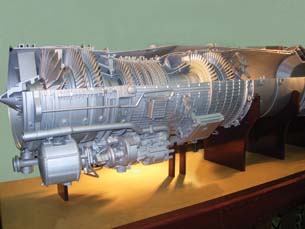 The Kaveri engine prototype had 2,500 parts produced via FDM additive fabrication. The model helped engineers best lay out complex piping runs. |
The Gas Turbine Research Establishment (GTRE) of Bangalore, India, is a government laboratory whose primary function is research and development of marine and aeronautic versions of gas turbines. Development of GTRE’s flagship product, the Kaveri jet engine, was commissioned for the HAL Tejas aircraft, which has an all-terrain capability that spans from hot deserts to the world’s highest mountain range.
Real Challenge
One of the greatest challenges in designing the Kaveri was positioning its many piping runs and line replaceable units (LRUs) on the outside of the aircraft. Many of the LRUs are connected to the interior of the engine with pipes that carry hydraulic fluid, fuel, and lubricants. It was a major challenge to design each piping run to minimize length to reduce weight and cost while avoiding interference.
The initial piping layout was created with CAD software, but CAD alone can’t portray the complex intertwined piping non-ambiguously to all the developers.
“The virtual environment cannot represent the design to the level that we need to meet our requirements,” says Dr. U. Chandrasekhar, GTRE group director. “The computer comes close, but close isn’t good enough when you are about to make a decision to invest tens of millions of dollars to bring a new product to market.”
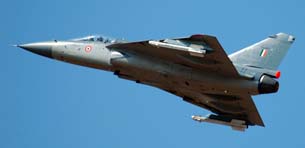 The Tejas is a lightweight, multi- role jet fighter, developed in India. |
Building an engineering prototype is easier said than done. There are approximately 2,500 engine components that had to be included in the assembly. In the past GTRE would have considered building the prototype using CNC machining. However, using these methods, it would have taken a minimum of one year and cost an estimated $60,000 to build the physical prototype assembly.
GTRE also considered stereolithography, but the project was not well-suited for this prototyping method due to excessive supports needed for components like turbine blades, combustor swirlers, inlet guide vanes and combustors. GTRE also realized that most conventional rapid prototyping methods would have made it necessary to produce solid pipes which would have eliminated the possibility of flow testing.
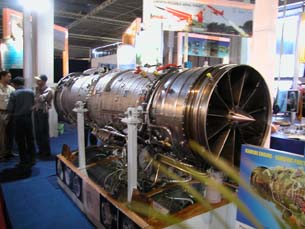 Kaveri engine at Aero India 2007. |
FDM Solution
“FDM technology provided the ideal solution because the supports and interior of hollow components can be easily dissolved in a water-based solution,” says Dr. Chandrasekhar. “It allowed us to create the geometry we needed. FDM was also much faster ]than traditional means] because it is possible to combine several parts into assemblies, which can be produced in a single run.” GTRE also like the fact that FDM creates parts from real engineering thermoplastics, such as ABS, which allowed them to make high-strength durable components for the project.
With more than 2,500 FDM components, the Kaveri jet engine prototype may well be the most complex rapid-prototype assembly ever created. It took GTRE only 30 days to produce all these components from ABS plastic using two FDM-based Fortus machines. It took another 10 days to assemble the engine. The total cost to produce the FDM assembly was about $20,000.
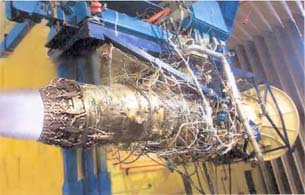 Kaveri engine on test-bed. |
Real Benefits
“With FDM we created an engineering prototype that perfectly reflected our design intent and facilitated the complex engine development,” says Dr. Chandrasekhar. “It enabled engineers to identify and resolve problems that would have been easy to miss with only the computer model.”
The FDM assembly allowed the design and manufacturing teams to better understand how the engine components would need to fit together during manufacturing. In addition, the prototype enabled a number of GTRE’s partners, including the Indian Air Force, to better understand the engine. The net result was a lighter engine that took less time to validate and build.
For more information, visit Stratasys' Fortus site.


DE's editors contribute news and new product announcements to Digital Engineering. Press releases may be sent to them via [email protected].
Follow DE
Join over 90,000 engineering professionals who get fresh engineering news as soon as it is published.






About Us · Contact Us · Editorial Team · Advertising · Privacy Policy · Subscriber Services · © 2026 Digital Engineering 24/7 · Peerless Media