Helping design and engineering professionals discover, evaluate and specify technologies and processes that shorten the design cycle and enable success.



Digital Engineering April 2026
In the latest issue of Digital Engineering, we take a look at the latest innovations in design for additive manufacturing, including the use of natural language inputs, social media cosplayers, and AI integration. The issue also includes a feature…

January Special Focus Issue: Design for Additive
In this Special Focus Issue of Digital Engineering, learn about the latest advancements in design for additive manufacturing, including new software tools, additive in automotive, custom medical devices, and more.
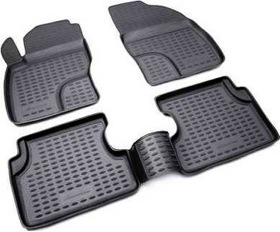 |
| The finished product. |
Based in Russia, Nika Holding is a manufacturer of automotive accessories. The company has been in the automotive accessories market for about two years, engaged in production of floor mats for trunks and interiors. During this period, many leading automakers, such as Nissan, Skoda, Reno and Peugeot, have become clients.
Nika Holding produces mats based on a method that is impossible without scanning. Computer processing of the data ensures a perfect fit of a pattern to the automobile surface. After researching the market for existing technologies, the company tried the M Model scanner made by Artec.
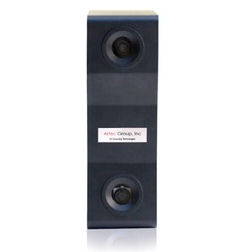 |
| The Artec M Model scanner. |
“In choosing this particular model, we knew we needed a rather compact device so that it would be easy to scan with it in the tight confines of a car interior. Also, the scanner would often be used in production in conditions where the sturdiness of the casing would be especially important,” comments an employee at Nika Holding.
This is how the process of making mats works:
1. An order to produce mats is received from an automaker.
2. A company employee goes out to the car showroom, where he scans the car interior.
 |
| A company employee scans the car interior |
Scanning the interior of an automobile is not easy because the space in a salon is rather tight and dark. Therefore, to obtain an acceptable result, about six scans are done from various angles. Scan time is 15 minutes. The ease of capturing depends on the upholstery material. Bright interiors scan more quickly and easily, while digitizing dark surfaces takes longer.
1. To obtain a quality model of a trunk interior, about 20 scans are done. Scanning takes about 30 minutes.
2. Data is processed in Artec Studio, and models are exported in a commonly used format and used as a template for sketches in other software.
3. A CNC turns out a semi-finished matrix out of medium-density fibreboard (MDF).
4. The semi-finished material is further processed until it is ready.
5. The next stage is forming. A polymer sheet is vacuum-formed by a special device to create the finished product.
6. The final stage is “cosmetic” detailing—trimming (removing burr) and packaging, after which the product is sent to the customer.
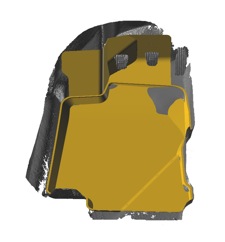 |
| Data is processed in Artec Studio. |
“The technological process based on 3D scanning of a car salon is much easier and faster,” says the chief technologist of Nika Holding. “Traditionally, one has to take all the measurements with a tape measure, and for reliability you would have to repeat each measurement many times. 3D scanning makes it possible to automate all measurements and immediately obtain an accurate computer model that is ready to be sent to the machine which produces the form.”
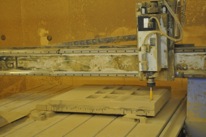 |
| A CNC machine creates an MDF template. |
An employee of Nika says the main advantages of working with Artec are the non-contact and rapid scanning of automobile interiors and trunks, the user-friendly interface of the Artec Studio 8.0 software, and the ease and simplicity of using the devices themselves.
Nika employees say they would like to see a Start button added to the scanner itself. Also, without a handle it is somewhat difficult to hold the scanner in the tight space of a car salon. Artec is constantly striving to improve its products. In new models that are in development, the company has added a Start button, and the body has been reshaped so that it is easier to hold during scanning.
Info
Artec 3D Scanners: Artec3D.com


DE's editors contribute news and new product announcements to Digital Engineering. Press releases may be sent to them via [email protected].
Follow DE
Join over 90,000 engineering professionals who get fresh engineering news as soon as it is published.






About Us · Contact Us · Editorial Team · Advertising · Privacy Policy · Subscriber Services · © 2026 Digital Engineering 24/7 · Peerless Media