Helping design and engineering professionals discover, evaluate and specify technologies and processes that shorten the design cycle and enable success.



Digital Engineering April 2026
In the latest issue of Digital Engineering, we take a look at the latest innovations in design for additive manufacturing, including the use of natural language inputs, social media cosplayers, and AI integration. The issue also includes a feature…

January Special Focus Issue: Design for Additive
In this Special Focus Issue of Digital Engineering, learn about the latest advancements in design for additive manufacturing, including new software tools, additive in automotive, custom medical devices, and more.
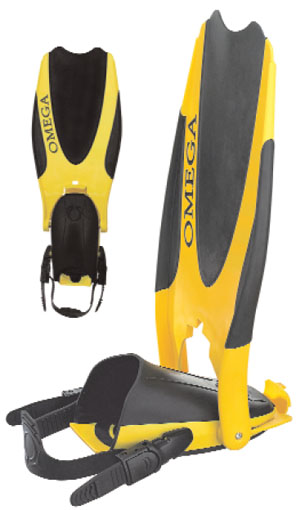 Engineers at Designcraft developed a hinged diving flipper for Omega Aquatics based on the idea of a fin that could fold up out of the way of the wearer whenon dry land or boat decks. |
Scuba fins are designed to propel divers swiftly and smoothly through the water. On land, it’s a different story. They’re not designed for walking, and putting them on before entering the water can pose both a challenge and a hazard to new as well as experienced divers.
Omega Aquatics of Buffalo Grove, IL, a company that focuses on developing innovative aquatic products, commissioned Designcraft of Lake Zurich, IL, to develop a fin that doesn’t hinder mobility either in or out of the water. The finished product is called the Amphibian dynamic scuba fin, also known as a flip fin. The Amphibian is designed to be strapped on prior to entering the water and removed after exiting. The two-piece fins feature a hinged mechanism that comprises a molded locking structure, blade hinge assembly, and anti-corrosive torsion springs.
When the wearer is out of the water, the springs push the flexible webbed blade up to ride gently against the shin. This makes walking, climbing boat ladders, and other movements as easy as wearing no fins at all. The bottom of the foot pocket features a soft tread design for slip resistance when walking on slick surfaces.
Once in the water, the blades flip down into swimming position automatically when the wearer kicks in the water. They flip back up when the wearer pushes back on the release levers, which can be done by hand or with the opposite heel.
Aside from being practical, the fins are also designed for high performance.
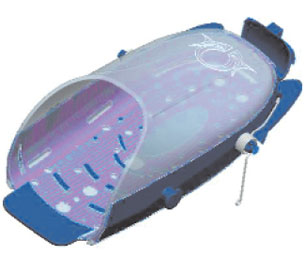 Once designers had the original 2D sketches in hand, they used Pro/E to run with the concept. After figuring out how the hinge mechanism would work and fitting it to the foot pocket (above), more detailed models were developed before building physical prototypes using a 3D Systems SLA 5000 andObjet Geometries’Acrylic Polyjet printer. Most were only sections of things. |
A Better Flipper
“The lightweight fin blade features a soft, central web configuration modeled after a duck web,” says Omega Aquatics President and Founder Ronen Moyal. “This design element contributes to increased propulsion and reduces the load required for sustained kicking.”
Moyal envisioned the need for a hinged fin years ago. “I always felt that the one thing standing in the way of a perfect dive was my fins,” said Moyal. “Walking on fins can be extremely dangerous and carrying fins in water, as most divers will tell you, can cause all kinds of problems like dropping equipment, drifting, and wasted time and energy.”
To develop and get a working prototype of his concept, Moyal turned to Designcraft, a rapid prototyping (RP) and product development company that specializes in high-quality industrial design models, engineering prototypes, high-speed CNC machining, 3D visual models, and product development.
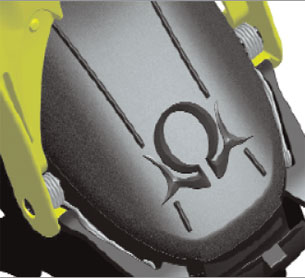 For example, a small section of the latch mechanism was built to observe how it behaved. Sections around the posts where the buckles attached and sections near the hinge pivot and lock were created to see how the parts interactedwith each other before moving on to final digital files (above). |
Tools for Better Swimming
“Omega Aquatics brought us an innovative concept in rough 2D sketches,” says Casey Stahl, lead designer at Designcraft. With the sketches in hand, Designcraft used PTC’s Pro/ENGINEER, its standard for 3D CAD/CAM/CAE, to develop the concept further. “Pro/ENGINEER allowed us to interpret and develop the idea into a 3D solid model that could easily be modified throughout the iterative design process,” said Stahl.
Once their client approved the drawings, Designcraft created various stereolithography apparatus (SLA) parts including a full foot pocket of a flipper without details to check the relative size and position of the key element to the new design: the flipper’s hinge. The company moved on to create sections near the hinge (pivot) and lock to see how the parts interacted with each other. Engineers also built full foot pockets and blades on the 3D Systems’ SLA 5000 to create “masters” for a pair of over-molded fins.
To create the strap posts — where the buckles for the straps attach to the foot pocket — Designcraft used its Objet Geometries’ Acrylic Polyjet printer. According to Stahl, “We printed various designs for this to allow us to tune in the correct dimensions and features we needed.”
Stahl said his team also cut various sections of the latch on a CNC machine from a material similar to the production plastic to observe how the “living hinge” aspect of the latch (on the front of the foot pocket) would behave. To produce that piece of the puzzle, the team used WorkNC from Sescoi and Creative Evolution CNC machines and controls.
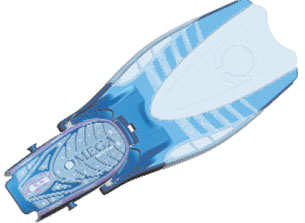 Engineers developed this hinged diving flipper from 2D sketches to working prototype in six months. |
The final design was to have over-molded parts. To accomplish that, says Stahl, “we made silicone molds from SLA masters and over-molded parts cut on the CNC machines. This gave us the first prototype pair of fins. The Omega Aquatics guys then tested them and gave us feedback.”
“Initial design and development was completed in less than six months,” Stahl notes. “The initial design has evolved since its debut, but because everything was designed in Pro/ENGINEER, it’s been easy to incorporate modifications without impacting production.”
The Amphibian is available in four two-tone colors and four sizes. Future plans include the release of interchangeable blades and a full boot design to offer divers a variety of choices when purchasing dynamic fins.
More Info:
Designcraft
Lake Zurich,IL
designcraft.com
Omega Aquatics
Buffalo Grove,IL
omegaaquatics.com
Objet Geometries
Rehovot,Israel
2objet.com
Pro/ENGINEER
PTC
Needham,MA
ptc.com
Contributing Editor Sara Ferris has covered the CAD industry since 1995. She was formerly editor-in-chief of Cadalyst magazine. You can e-mail comments about this article to her at [email protected].


DE's editors contribute news and new product announcements to Digital Engineering. Press releases may be sent to them via [email protected].
Follow DE
Join over 90,000 engineering professionals who get fresh engineering news as soon as it is published.






About Us · Contact Us · Editorial Team · Advertising · Privacy Policy · Subscriber Services · © 2026 Digital Engineering 24/7 · Peerless Media