Helping design and engineering professionals discover, evaluate and specify technologies and processes that shorten the design cycle and enable success.



Digital Engineering April 2026
In the latest issue of Digital Engineering, we take a look at the latest innovations in design for additive manufacturing, including the use of natural language inputs, social media cosplayers, and AI integration. The issue also includes a feature…

January Special Focus Issue: Design for Additive
In this Special Focus Issue of Digital Engineering, learn about the latest advancements in design for additive manufacturing, including new software tools, additive in automotive, custom medical devices, and more.
 As I write this, 2017 is drawing to a close. It’s a good time to reflect on the past and make plans for the future. Thankfully, I have the results of both our recent engineering technology outlook and reader surveys to guide me.
I want to thank everyone in our audience who took the time to let us know about the technologies they use and how they use them, as well as how they use DE’s print and digital magazine, social media, websites and newsletters. We use the feedback you provide us, along with the trends we see emerging in the market, to determine where to focus our efforts.
We shared the results of our engineering technology outlook survey in last month’s issue. As a high-level recap: Forty-two percent of you classified your organizations as innovators or early adopters of design strategies and technologies. Collaboration and short product development deadlines were neck-and-neck at the top of the list for your day-to-day work challenges.
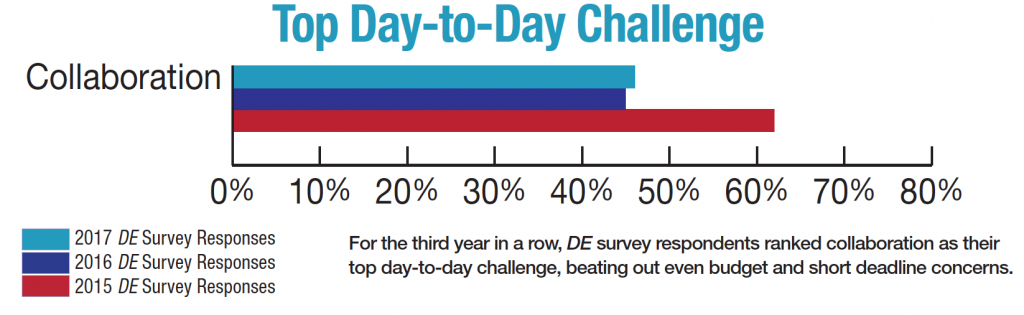
That’s a pretty clear indicator that you’re looking for cutting-edge technologies that make it easier to work together so that you can meet those tight deadlines. But which technologies? When asked what would have the greatest impact on product design and development over the next five years, you ranked these as your top five:
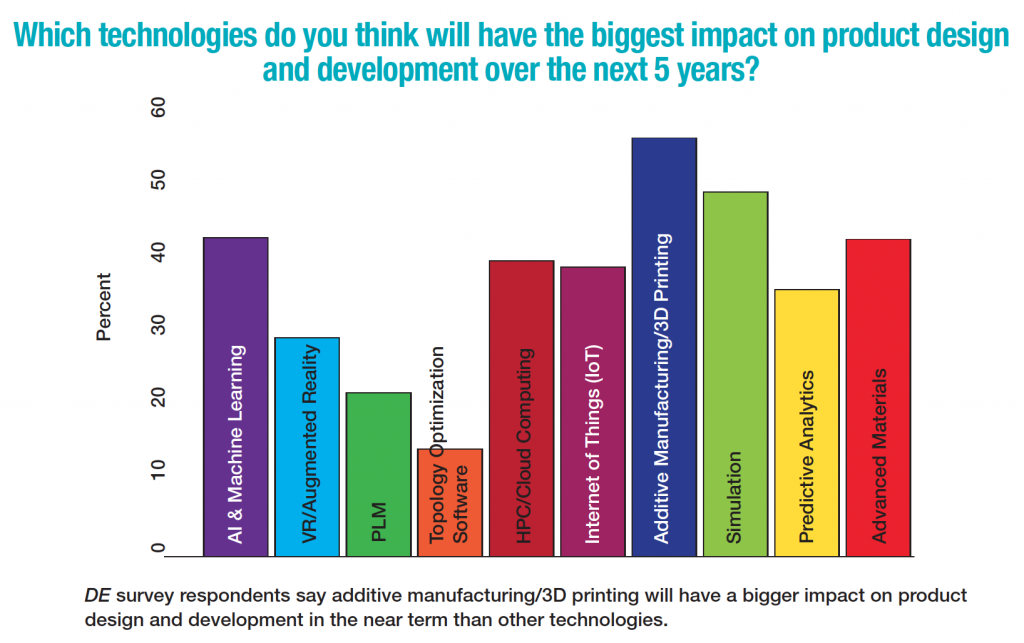
That technology outlook is half a decade away and pertains to the overall design engineering market, so in our reader survey we specifically asked what technologies you’d like us to cover more than we do now. At the top of that list on the hardware side were 3D printing, 3D scanning and sensors, while computer-aided design (CAD), software engineering and simulation topped the software side.
Perhaps not surprisingly for an audience focused on innovation through technology, the information you want more of and the technologies you see having the most impact on product design and development in the near future line up pretty neatly.
DE was founded in 1995 in large part to explain the novelty of CAD. Without asking you, we might have assumed that you’ve heard enough about it. But it’s clear from the surveys that you want more, so we’ve decided to begin reviewing CAD software regularly in 2018. Starting next month, we plan to publish monthly reviews of design software.
In recent years, DE has focused on simulation-led design. Your responses to our surveys show we’re on the right track, but, like CAD, you want more in-depth coverage. To that end, we’ll be bringing back regular reviews of simulation software. We are also looking forward to co-hosting the Conference on Advancing Analysis & Simulation in Engineering (CAASE) with NAFEMS June 5-7 (see nafems.org/CAASE18).
DE was covering 3D printing before covering 3D printing was cool. Now that the hype surrounding what 3D printing might do has been replaced with how it’s being put to use, 3D printing and scanning are hotter than ever. We’ll continue to cover 3D printing and scanning in each issue, including a special focus on it in April that includes an online editorial roundtable discussion on simulation for additive manufacturing. We will also continue to devote special coverage to its evolution online (see rapidreadytech.com) and via our Focus on Rapid Technologies e-newsletter.
If there was a surprise with this year’s survey results, it was how quickly software engineering joined the rankings of most-wanted coverage, no doubt led by interest in artificial intelligence (AI) and the internet of things (IoT). The IoT first made the cover of DE in March 2015, and IoT/sensors was added as a tent pole of our coverage last year. There was some internal debate about whether we were indulging in hype at the time, and whether design engineers would be interested in software engineering. Turns out we need not have worried about your appetite for cutting-edge technology coverage, and we will continue to expand it in the magazine, website and our Focus on IoT & Sensors e-newsletter this year.
We’ve got a lot planned for 2018. If you missed the chance to participate in our surveys, please contact me to let us know what technology topics are most important to you.


Jamie Gooch is the former editorial director of Digital Engineering.
Follow DE
Join over 90,000 engineering professionals who get fresh engineering news as soon as it is published.






About Us · Contact Us · Editorial Team · Advertising · Privacy Policy · Subscriber Services · © 2026 Digital Engineering 24/7 · Peerless Media