Helping design and engineering professionals discover, evaluate and specify technologies and processes that shorten the design cycle and enable success.



May 2026 Special Focus: Artificial Intelligence in Design and Simulation
In this Special Focus Issue, learn about the latest developments in the integration of artificial intelligence into engineering workflows.

Design & Simulation Software Guide 2025
In this Special Issue, Digital Engineering presents its second annual guide to design and simulation software vendors.
In August 2013, an invitation appeared on the Digital Engineering website that would quietly ignite a transformation in engineering simulation. This announcement invited engineers worldwide to submit real-world simulation projects to be tested on remote High-Performance Computing (HPC) systems—both on-premises and in the cloud. At the time, cloud-based HPC was still viewed with skepticism. Security concerns, performance doubts, software licensing hurdles, and cultural resistance stood firmly in the way. But rather than debate theory, the Cloud team chose experimentation, and the Cloud Experiments were born.
The first annual Compendium of case studies appeared in 2013, documenting 25 hands-on engineering experiments. Each project tested whether complex CAE applications could run efficiently in the cloud.
Early results were sobering. Success rates hovered around 40% in 2013 and 60% in 2014. Engineers encountered roadblocks everywhere: slow onboarding, licensing friction, data transfer bottlenecks, configuration complexity, and the ever-present need for scarce HPC expertise.
Yet every case study concluded with two powerful sections: Lessons Learned and Recommendations. These weren’t marketing summaries. They were hard-earned operational insights from real engineers trying to get real work done. Those lessons would later become the seeds of SimOps (Simulation Operations Automation).
A major turning point came in 2015. Based on patterns emerging from dozens of experiments, the team introduced novel HPC software containers tailored specifically for engineering workloads. Instead of installing and configuring simulation software on every cluster, applications were packaged into portable, ready-to-run containers.
The impact was dramatic. Onboarding time dropped from an average of three months to just a few days. Engineers no longer needed deep knowledge of system architecture or cloud infrastructure. Through a browser-based interface, they accessed what felt like a familiar remote desktop—backed by powerful bare-metal or virtualized HPC resources.
This abstraction between software and hardware removed one of the biggest operational barriers to cloud HPC adoption. It also quietly shifted the narrative: HPC was no longer just for specialists. It could become part of everyday engineering design.
As annual Compendiums of case studies continued—eventually totaling 232 cloud-based engineering projects—the evidence accumulated.
At Rimac, for example, engineers designing some of the world’s fastest electric hypercars gained on-demand access to powerful cloud resources. Simulation cycles shortened. Design iterations accelerated. More sophisticated geometries and physics became feasible. And because cloud resources were elastic, they paid only for what they used.
In another study, marine engineers running NUMECA (now at Cadence) FINE/Marine simulations found that bare-metal cloud infrastructure provided performance advantages over local upgrades—without the overhead of maintaining in-house HPC expertise. Containers enabled immediate access to clusters without installation delays.
An implantable planar antenna simulation project demonstrated a fourfold speed increase compared to a local workstation. Preconfigured containerized ANSYS HFSS environments ran instantly, eliminating the traditional setup burden.
Across industries—automotive, marine, aerospace, medical devices—the same themes emerged:
Access must be simple.
Software must be ready-to-run.
Infrastructure complexity must be hidden.
Performance must be predictable.
Operational friction must be removed.
The experiments were no longer about “Can HPC run in the cloud?” They were about “How do we make simulation operationally scalable?”
As the Compendiums expanded—supported by industry leaders such as Ansys, Hewlett Packard Enterprise, Intel, and media partners including Digital Engineering DE 24/7 —the UberCloud initiative evolved into Simr, reflecting its broader mission: delivering simulation-ready infrastructure as a service.
By 2024, the experiment success rate had reached 100%. More importantly, the accumulated Lessons Learned across 232 projects were distilled into structured Best Practices. Patterns became frameworks. Recommendations became repeatable methods. Operational insights became a philosophy. That philosophy became SimOps.
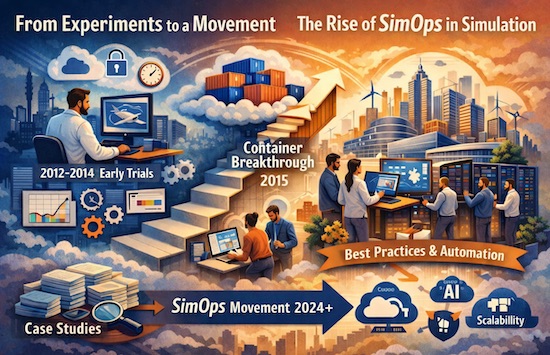
In 2024, the SimOps initiative has been launched, positioning itself as “The DevOps of HPC.” The comparison is deliberate. Just as DevOps transformed how software is built and deployed, SimOps addresses how engineering simulations and HPC infrastructures are run, managed, and scaled. SimOps is not about software development. It is about operational excellence in technical computing.
SimOps provides guidance on:
Workflow automation
Hybrid-cloud HPC orchestration
Containerization of simulation stacks
Data lifecycle management
Performance benchmarking
Cost optimization
Cross-functional collaboration between R&D and IT
It recognizes that simulation bottlenecks are rarely just about compute power. They are about process, governance, data management, cultural adoption, and operational repeatability.
Inspired by community-driven movements like DevOps and FinOps, SimOps was incorporated as an independent non-profit organization serving the HPC, AI, cloud, and engineering simulation communities. Today, SimOps offers:
Training courses and certifications
A SimOps software stack
A Practitioner community platform
Webinars and a growing podcast series
A structured maturity model for simulation-driven organizations
What began in 2012 as a practical cloud experiment has evolved into a broader operational philosophy. The early HPC/Simulation experiments asked whether and how simulations could move to the cloud. Today, SimOps asks how simulations can become a scalable, automated, and reliable enterprise capability. Over twelve years, the journey revealed a powerful insight: The true challenge was never just compute performance. It was operations.
Simulation projects fail not because solvers are weak—but because workflows are fragile, data is often chaotic, onboarding is slow, licensing is complex, and collaboration between engineering and IT is often misaligned. SimOps addresses those systemic gaps.
From Experiment to Ecosystem
The story of SimOps is not one of a single product or breakthrough technology. It is the story of a community learning, documenting, refining, and sharing operational knowledge across more than a decade. From 25 case studies in 2013 to 232 cloud-based engineering projects by 2024, the trajectory reflects a maturation of both technology and mindset. What started as an experiment has become a movement.
And if DevOps reshaped software engineering, SimOps may well define the next chapter in simulation-driven innovation—where HPC, AI, cloud, and engineering simulation converge into operational excellence. The experiment worked. Now the operations scale.
Want to join the movement? Explore the best practices, start your SimOps Fundamentals training, get certified, and join the SimOps Practitioner Club at www.simops.com.
This article originally appeared on HPCwire.
About the SimOps Foundation
The SimOps Foundation is an independent non-profit community organization dedicated to the standardization and automation of simulation operations (SimOps) within the High-Performance Computing (HPC) and engineering simulation sectors. By bridging the gap between engineering simulation and HPC infrastructure, the Foundation provides a vendor-neutral framework for improving the efficiency, scalability, and reproducibility of complex simulations and data flows. Through its tiered certification programs, the “SimOps-compliant” software stack, and a global community of practitioners, the Foundation empowers organizations to accelerate AI-powered innovation and streamline product development. Headquartered in Sunnyvale, California, the SimOps Foundation is built on a decade of expertise and over 200 real-world engineering use cases. For more information, visit www.simops.com.


Join over 90,000 engineering professionals who get fresh engineering news as soon as it is published.






About Us · Contact Us · Editorial Team · Advertising · Privacy Policy · Subscriber Services · © 2026 Digital Engineering 24/7 · Peerless Media