Helping design and engineering professionals discover, evaluate and specify technologies and processes that shorten the design cycle and enable success.



Digital Engineering April 2026
In the latest issue of Digital Engineering, we take a look at the latest innovations in design for additive manufacturing, including the use of natural language inputs, social media cosplayers, and AI integration. The issue also includes a feature…

January Special Focus Issue: Design for Additive
In this Special Focus Issue of Digital Engineering, learn about the latest advancements in design for additive manufacturing, including new software tools, additive in automotive, custom medical devices, and more.
We’ll soon find out the answer to that question. Functionalize recently announced the launch of its F-Electric filament. The filament is currently being produced in 1.75mm and 2.85mm, with a resistance of 0.75 ohm*cm, and a mechanical strength exceeding that of standard PLA.
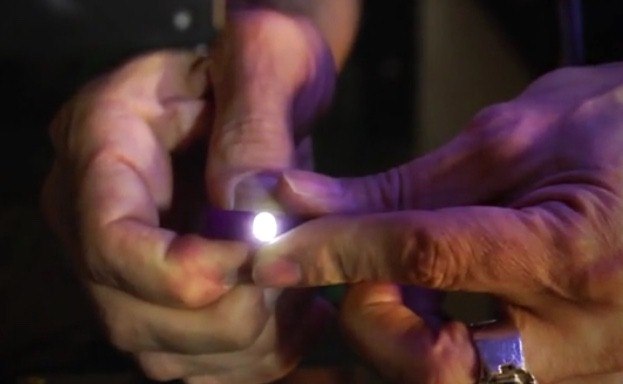 A LED flashlight that was printed using Functionalize's new F-Electric filament. Courtesy of Functionalize.
As is the case with many recent 3D printing stories, Functionalize got its start through Kickstarter. Unlike many stories, however, Functionalize didn’t get funded. What it did receive was enough attention to get pre-orders, and secure a partnership with existing filament manufacturer Protoparadigm, to keep the project rolling.
F-Electric filament offers many new design opportunities. It is possible, according to the company, to literally print out, “complete electrical circuits, sockets, switches, buttons, and connectors in your 3D printed structures with motors, active components, and chips connected by plastic and placed with 3D printed precision, exactly where they make sense.”
Mike Toutonghi, CEO and Founder of Functionalize offers an optimistic outlook for future uses of the new filament.
“Imagine the possibility of today’s 3D printed prosthetics being able to sense pressure through conductive pads in their fingertips, printable robots that people could share and improve, or active wearables as creative as their maker,” said Toutonghi. “We’re excited to be at the beginning of this trend. Shipping F-Electric is a historic milestone for Functionalize for our company and our customers. We’ve provided a new tool, and I can’t wait to see what creative people can do with it.”
Below you’ll find Functionalize’s Kickstarter video.
Sources: Functionalize, Kickstarter


John Newman is a Digital Engineering contributor who focuses on 3D printing. Contact him via [email protected] and read his posts on Rapid Ready Technology.
Follow DE
Join over 90,000 engineering professionals who get fresh engineering news as soon as it is published.






About Us · Contact Us · Editorial Team · Advertising · Privacy Policy · Subscriber Services · © 2026 Digital Engineering 24/7 · Peerless Media