Helping design and engineering professionals discover, evaluate and specify technologies and processes that shorten the design cycle and enable success.



Digital Engineering April 2026
In the latest issue of Digital Engineering, we take a look at the latest innovations in design for additive manufacturing, including the use of natural language inputs, social media cosplayers, and AI integration. The issue also includes a feature…

January Special Focus Issue: Design for Additive
In this Special Focus Issue of Digital Engineering, learn about the latest advancements in design for additive manufacturing, including new software tools, additive in automotive, custom medical devices, and more.
UK-based aerospace supplier GKN Aerospace has improved tooling production times by deploying an additive manufacturing solution from Stratasys at its Filton, UK, manufacturing plant.
The company has deployed the Stratasys F900 Production 3D Printer to reduce lag times for making production line tools and to create complex parts that would otherwise be impossible to fabricate with other types of manufacturing approaches.
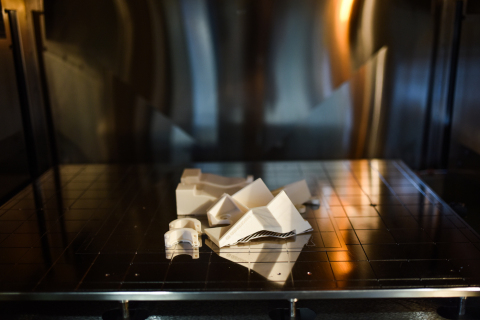 GKN is printing tooling on the Stratasys F900 Production 3D printer. Image courtesy of Stratasys/Businesswire.
“Since integrating the F900, we have dramatically reduced production line downtime for certain teams and are enjoying a new found freedom to design complex tools,” says Tim Hope, Additive Manufacturing Center Manager at GKN Aerospace.
According to GKN, the lead time typically required to produce a metal or plastic replacement tool is several weeks. With a 3D printer in the facility, the company can more quickly produce tools that are better suited to its operational needs.
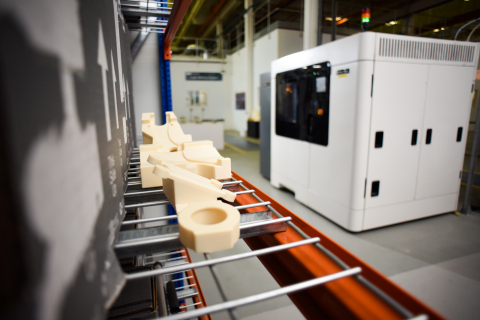 3D printing allows GKN to product fixtures and tooling that would be impossible to create with traditional methods. Image courtesy of Stratasys/Businesswire.
“We can now cost-effectively produce tools for our operators within three hours,” Hope explains. “This saves critical production time, and by printing in engineering-grade thermoplastics, we can produce 3D printed tools with repeatable, predictable quality every time. All while matching the quality of a traditionally-produced tool, and reducing the costs and concessions compared to equivalent metallic tooling.”
In addition, the company reports that material waste has decreased by 40% with the new system. Hope says that the use of 3D printing has also provided more flexibility regarding tool design.
“One of the key benefits of additive manufacturing is the creative freedom this technology affords users,” explains Hope. “The F900 offers the largest build-size of any FDM 3D printer, enabling us to rapidly produce tools to meet any requirements. Most notably, complex geometries and cavities that would otherwise be problematic are now practical with the F900. We’re utilizing it to design, and 3D print, previously inconceivable tools that enable us to manufacture complex parts that are uneconomical or just physically impossible by other methods.”
GKN is currently using a standard thermoplastic for the application, but is also testing Stratasys’ high-strength, heat-resistant ULTEM 1010 Resin material as well.
GKN is heavily involved in additive manufacturing, and recently received a contract from ArianeGroup (Airbus and Safran) to develop and additively manufacturing two turbines for a reusable rocket engine called Prometheus. Ground tests for that methane engine will take place in 2020.
GKN reported that the use of 3D printing would reduce the number of turbine parts from 100 to two, which significantly lowered costs.
Source: Stratasys


Every day, our customers find simpler, smarter approaches to stubborn design problemsand greater confidence to confront towering human and technological challenges. Less hindered by the usual constraints, they can imagine, design, iterate and…
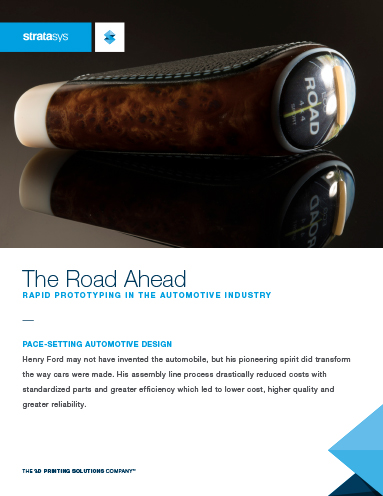
Rapid Prototyping in The Automotive Industry
Henry Ford may not have invented the automobile, but his pioneering spirit did transform the way cars were made. His assembly line process drastically reduced costs with standardized parts and greater efficiency which led to lower cost, higher quality and greater reliability.

Brian Albright is the editorial director of Digital Engineering.
Contact him at [email protected].

Join over 90,000 engineering professionals who get fresh engineering news as soon as it is published.






About Us · Contact Us · Editorial Team · Advertising · Privacy Policy · Subscriber Services · © 2026 Digital Engineering 24/7 · Peerless Media