Helping design and engineering professionals discover, evaluate and specify technologies and processes that shorten the design cycle and enable success.


Alert!
Digital Engineering ceased publication on July 1, 2026. This website remains available as an archive of engineering content.
For inquiries or information, please email [email protected].

May 2026 Special Focus: Artificial Intelligence in Design and Simulation
In this Special Focus Issue, learn about the latest developments in the integration of artificial intelligence into engineering workflows.

April 2026 Special Focus Issue: Generative Design
In this Special Focus Issue, Digital Engineering takes a look at how generative design solutions can be used across different types of design problems and with a variety of manufacturing approaches to accelerate design space exploration, and…
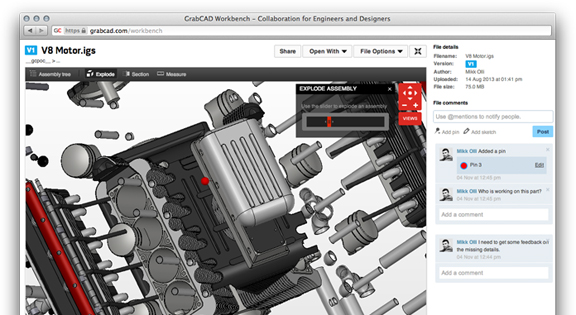
At $0 to $49 per user per month, GrabCAD Workbench, a cloud-hosted collaboration and file-sharing service, must have sounded like April Fools' joke to some, but it was not. Since it came online in April, the product has picked up 15,000 users. Last week, GrabCAD decided to boost its functionality with added features to join the desktop and the cloud repository.
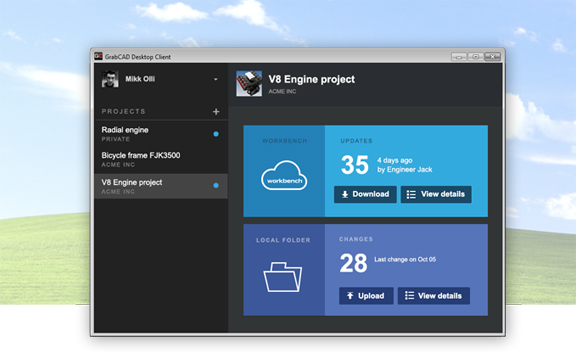
The initial release of Workbench was a strictly browser-based version. (For a video report on the Beta version, read my previous blog post here.) Last week GrabCAD released a desktop client you can download and install to keep your offline and online activities in sync. The file-locking option prevents collaborators from accidentally overwriting each other by working on the same document simultaneously. Workbench also gives you the option to unlock the file and notify the other person who has checked out the same file. This option addresses the all-too-common scenario where the person who took ownership of a file may have forgotten to work on the document or gone on vacation without relinquishing his or her control.
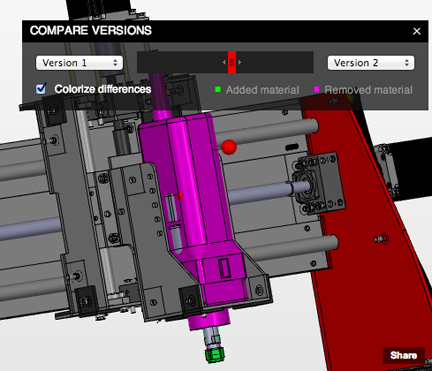
In case two people happen to be working on the same file, you may use Workbench's visual comparison function to identify and reconcile the files. Just as you might compare two different Word documents to single out the differences, Workbench lets you compare the geometry and features in two different versions and display the differences in highlights. The slider bar in the comparison view gives you an easy way to see where materials were added or removed (color-coded differently).
The latest version offers Partner Space, a cordoned off area where you may share specific versions of a file to contractors and partners (for instance, sharing an early version of the design with an outside firm that can help you run stress analysis).
GrabCAD is well-established as a 3D content-exchange community that fosters both social and professional networking. It's home to more than 945,000 3D CAD users and 327,000 shared 3D files. (In January 2012, when I wrote about founder Hardi Meybaum's immigrant success story, the two-year-old site boasted 72,000 users, sharing 19,000 models.) The company is now turning its attention to enterprise collaboration, a market also wooed by larger vendors like Autodesk, Dassault Systemes, PTC, and Siemens PLM Software.
Though relatively new as a collaboration service, GrabCAD Workbench has already inked integration agreements with Luxion Keyshot (for rendering) and Autodesk Fusion 360 (for CAD modeling and editing). The partnerships signal GrabCAD's desire to round out Workbench's basic functions with a comprehensive set of plug-ins.
Competition from smaller, nimbler SaaS players like GrabCAD, Arena Solutions, CADFaster, and others may be pressuring software titans to rethink the traditional strategy, characterized by significant upfront cost, long-term commitment, and complex process reengineering. The low-cost, low-risk proposition that comes with SaaS's pay-as-you-go monthly subscription proves more appealing to smaller manufacturers, and even autonomous divisions in bigger enterprises. Perhaps the best evidence of this changing attitude to collaboration and data management is in larger vendors' adoption of the piecemeal modular sales approach.


Kenneth Wong is Digital Engineering's resident blogger and senior editor. Email him at [email protected] or share your thoughts or suggestions at digitaleng.news/facebook.
Follow DE






About Us · Contact Us · Editorial Team · Advertising · Privacy Policy · Subscriber Services · © 2026 Digital Engineering 24/7 · Peerless Media