Helping design and engineering professionals discover, evaluate and specify technologies and processes that shorten the design cycle and enable success.



May 2026 Special Focus: Artificial Intelligence in Design and Simulation
In this Special Focus Issue, learn about the latest developments in the integration of artificial intelligence into engineering workflows.

April 2026 Special Focus Issue: Generative Design
In this Special Focus Issue, Digital Engineering takes a look at how generative design solutions can be used across different types of design problems and with a variety of manufacturing approaches to accelerate design space exploration, and…
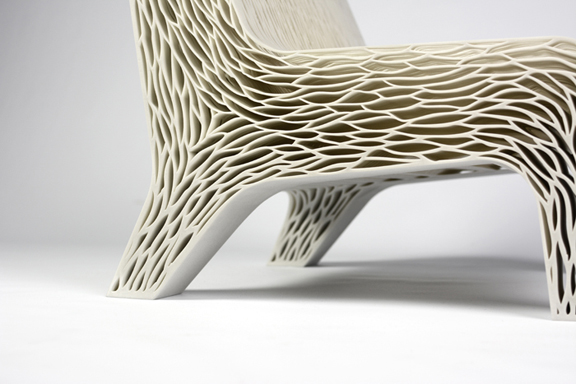
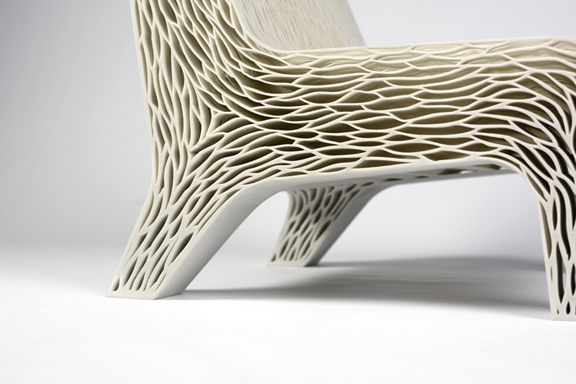 Lilian van Daal uses Rhino to design this Soft Seat, printed in 3D (image courtesy of Lilian van Daal).
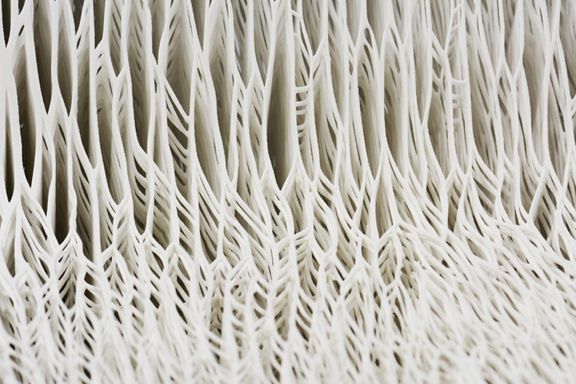 Close up of details from Lilian van Daal's Soft Seat (image courtesy of Lilian van Daal).
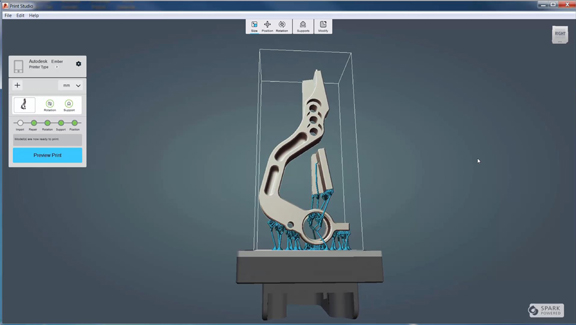 Support structure for 3D-printed design, generated in Autodesk Print Studio (image courtesy of Autodesk).
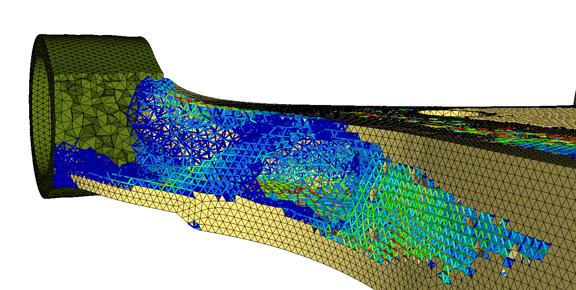 Lattice Structure optimization with Altair Engineering's OptiStruct software (image courtesy of Altair).
Lilian van Daal wants to bring Nature's engineering methods into people's living rooms. The 2013 graduate of The Royal Academy of Art (The Hague) created a series of 3D-printed soft seats. The softness comes from her clever use of Nature-inspired lattice structure to create flexibility out of stiff materials. Last month, she presented her project to the attendees of COFES 2015.
The method let her produce something "in one material in one factory, although it has the properties of various materials," she said. Her approach is an alternative to the traditional soft-seat manufacturing, which she pointed out is "normally far from sustainable: it is made from various materials prepared for assembly in different factories."
But Lilian's method also exposes a void in the design software industry. Even though additive manufacturing can produce Lilian's lattice structure, the tools to automatically generate such structures based on user-defined geometry are hard to find in the current design software packages.
"I was looking for software that could simulate and generate the most optimal [lattice] structures," she said. But she couldn't find any that could do what she wanted. "I had to model all the structures manually -- that's the problem," she added.
Historically, design software was developed to produce surfaces and solids, not micro-level structures. So the only way Lilian could model what she had in mind was to model every membrane in the seat. She did it in Rhino.
Lilian found that software in the market can help her get "optimal rigid structures with as little material as possible," but she needs something more. She said, "It's important to have a software where you can apply different properties to a product -- for example, for comfort, ventilation, waterproofing, and stiffness."
Since the current stress analysis and simulation software are designed to study geometry with uniform material properties (for example, steel, iron, or plastic), Lilian also had a difficult time finding a program to perform analysis on her chair, constructed of a single material but has varying stiffness in different regions. Her analysis, she said, was based on "trial and error."
Setting aside the lattice structure's aesthetic appeal and flexibility, there's also a more practical need for it in 3D-printed projects. It's an efficient way to generate support structures for designs that must be held up during the printing process. Dr. Andreas Vlahinos, the principal of Advanced Engineering Solutions and a regular at COFES gatherings, said, "The current workaround is to fill such gaps with a pattern. That works great for 2D or 2.5D design, but not for 3D."
In its 2016 product line, Autodesk began introducing Print Studio, which includes the ability to generate support structure for 3D printing. Late last year, at Autodesk University 2014, the company also revealed its aspiration to offer algorithm-driven design tools, dubbed Generative Design. Autodesk CTO Jeff Kowalski said Generative Design "would automate three types of optimization: topology, lattice-based structures, and strut/beam structures."
Currently, Project Shapeshifter, Autodesk's web-based form generator, offers a hint at what Generative Design could do. (For more on Generative Design, read my Autodesk University 2014 report, "Infusing Life into Dead Designs.")
In February this year, Altair Engineering also announced it has added a solver to optimize lattice structures in its OptiStruct software. The company states, "A unique capability of 3D printing lies in its ability to manufacture hollow shapes with complex external geometry using tiny cells known as lattice structures. OptiStruct now extends topology optimization to assist in the efficient blending of solid-lattice structures with smooth transitional material volume. Lattice performance can be studied under tension, compression, shear, flexion, torsion, and fatigue life."
The initiatives from Autodesk and Altair Engineering suggest software vendors are devoting R&D efforts to address the need.
Due to the limited size of a typical 3D printer's build chamber, Lilian can only print her chair in a miniature size, not at full scale. The best barometer for the performance of a chair, Lilian said, is comfort -- something that may elude software algorithms and solvers.
"Comfort is a totally different thing than flexibility. It's more complex," she said.
The only way to study a chair's comfort is to sit on it. That's why Lilian needs to produce her soft seat as a full-size model for the ultimate stress test.


Kenneth Wong is Digital Engineering's resident blogger and senior editor. Email him at [email protected] or share your thoughts or suggestions at digitaleng.news/facebook.
Follow DE
Join over 90,000 engineering professionals who get fresh engineering news as soon as it is published.






About Us · Contact Us · Editorial Team · Advertising · Privacy Policy · Subscriber Services · © 2026 Digital Engineering 24/7 · Peerless Media