Helping design and engineering professionals discover, evaluate and specify technologies and processes that shorten the design cycle and enable success.



Digital Engineering April 2026
In the latest issue of Digital Engineering, we take a look at the latest innovations in design for additive manufacturing, including the use of natural language inputs, social media cosplayers, and AI integration. The issue also includes a feature…

January Special Focus Issue: Design for Additive
In this Special Focus Issue of Digital Engineering, learn about the latest advancements in design for additive manufacturing, including new software tools, additive in automotive, custom medical devices, and more.
The plastic reactors can be used to perform hydrothermal chemical syntheses. University of Glasgow chemistry researchers Lee Cronin and Ross Forgan developed a process in which they print part of the vessels, add the reagents, and then finish the printing so that the reagents are sealed within before the whole thing is placed in an oven. Afterward, the vessels are removed and cut open. The reactors are able to maintain their integrity below 150˚C.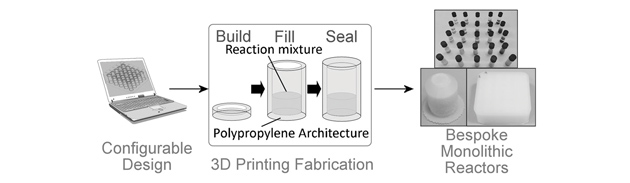
So far, sealed lab-scale reactors with varying capacities can be printed, along with grids of sealed chambers for high-throughput screening of reactants and conditions. Typically, stainless steel autoclave bombs are needed for hydrothermal synthesis, which requires heating mixtures up to 140˚C or more for several hours. 3D printed reactors could cut costs for laboratories.
In testing, the researchers were able to successfully achieve the synthesis of two metal-organic frameworks, with results comparable to those achieved using traditional equipment. A test of the 5x5 grid of reaction chambers made using the process yielded the discovery of two new three-dimensional coordination polymers.
The research was published in the journal Angewandte Chemie in July.
You can read the team's previous research in Nature, as well as our previous coverage of their work in 3D-printed reactionware here.
"We have shown that the concept works, and that you can use it to discover new materials," Cronin said. "Clearly there are limitations involving solvent compatibility and taking the temperature beyond 150˚C. But most hydrothermal reactions use alcohol or water and most are done at 140 to 150˚C. Also there are other plastics available that do melt at higher temperatures."
Source: ChemistryWorld


Brian Albright is the editorial director of Digital Engineering.
Contact him at [email protected].

Join over 90,000 engineering professionals who get fresh engineering news as soon as it is published.






About Us · Contact Us · Editorial Team · Advertising · Privacy Policy · Subscriber Services · © 2026 Digital Engineering 24/7 · Peerless Media