Helping design and engineering professionals discover, evaluate and specify technologies and processes that shorten the design cycle and enable success.


Sponsored

Digital Engineering April 2026
In the latest issue of Digital Engineering, we take a look at the latest innovations in design for additive manufacturing, including the use of natural language inputs, social media cosplayers, and AI integration. The issue also includes a feature…

January Special Focus Issue: Design for Additive
In this Special Focus Issue of Digital Engineering, learn about the latest advancements in design for additive manufacturing, including new software tools, additive in automotive, custom medical devices, and more.

 Dear DE Reader:
HP has been a disruptive technology outfit since 1938 when it made audio oscillators for Walt Disney's sound engineers. With its HP Jet Fusion 3D Printing, it appears HP aims to disrupt the manufacturing and design process. Today's Check It Out link goes to the mother lode of details on these 3D printers.
This is one comprehensive resource. Fascinating, too. It seems to cover all bases like the system's material handling and post-processing technologies, applications, user software and technical services/support. You'll find a bunch of videos, an on-demand webinar, animations, charts and annotated images. You can download white papers, a third-party industry report and brochures.
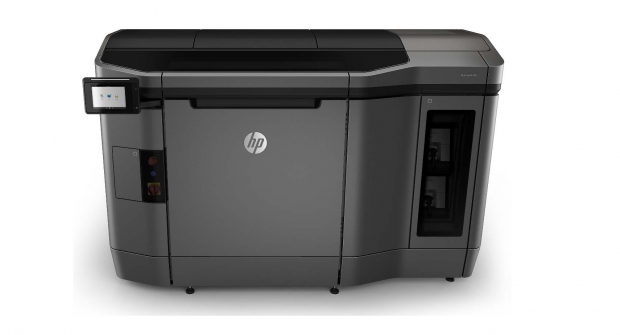 HP's Jet Fusion line of 3D printers offer technology that can manipulate a part's material properties voxel by voxel, enabling new design and manufacturing applications. Image courtesy of HP Inc.
Not only can you learn about the features of the Jet Fusion 3D printers, you also get a glimpse of design and manufacturing's future potential. More on that below.
The HP Jet Fusion 3D Printing line offers two models, the 4200 and the 3200. The 4200 handles prototyping and short-run manufacturing; the 3200 model targets prototyping. Both consist of a main printing workstation, a materials pre- and post-processing station and a rolling material build unit that fits into the 3D printing workstation.
They have large build volumes and produce high-resolution (1,200 dpi) parts. They can produce smooth, well-defined parts consistently and quickly.
To that end, HP says that the Jet Fusion has a lower per-part cost and are up to 10 times faster than comparably priced deposition and laser sintering 3D printers. A nifty live comparison chart lays out part quantities possible over a stretch of time. That speed comes in part from the Jet Fusion's dual-pass printing technology, which can lay 30 million drops of print materials and a fusing agent per second across its work area.
It's an intriguing process. You can see it in tight close-up view in a pair of videos, especially the one under the HP 3D Materials and Applications section. This is also where we get back to the future at about the three-minute mark.
The HP Jet Fusion's true design and manufacturing disruptive potential lies with the materials, something HP is deep into. HP's 3D print technology can manipulate a part's material properties voxel by voxel. This opens up a whole new world of applications, material combinations and so on bound by your engineering ingenuity. Heady stuff.
Innovation is manufacturing's future. Take the time to study the HP Jet Fusion 3D Printing resource. There's much to see and learn.
Thanks, Pal. – Lockwood
Anthony J. Lockwood
Editor at Large, DE


Anthony J. Lockwood is Digital Engineering's founding editor. He is now retired. Contact him via [email protected].
Follow DE
Join over 90,000 engineering professionals who get fresh engineering news as soon as it is published.






About Us · Contact Us · Editorial Team · Advertising · Privacy Policy · Subscriber Services · © 2026 Digital Engineering 24/7 · Peerless Media