Helping design and engineering professionals discover, evaluate and specify technologies and processes that shorten the design cycle and enable success.



Digital Engineering April 2026
In the latest issue of Digital Engineering, we take a look at the latest innovations in design for additive manufacturing, including the use of natural language inputs, social media cosplayers, and AI integration. The issue also includes a feature…

January Special Focus Issue: Design for Additive
In this Special Focus Issue of Digital Engineering, learn about the latest advancements in design for additive manufacturing, including new software tools, additive in automotive, custom medical devices, and more.
As China, the world’s largest manufacturing market, gears up for digital transformation, it is tapping into Multi Jet Fusion 3D printing technology from HP to empower new innovation centers capable of industrial-scale 3D printing.
HP’s latest score on this front is a deal inked with the Guangdong (Dali) 3D Printing Collaborative Innovation Platform, a new production-grade 3D printing center in China. The center, located in the town of Dali, Foshan, a manufacturing hub in the Guangdong Province, will exclusively employ 10 HP Multi Jet Fusion 3D printing systems to serve its customers in the automotive, consumer goods, and motorcycle markets as well as other industries in the Greater Bay Area of Southern China.
The HP printers serve as the heart of the new Lanwan Intelligence—HP Multi Jet Fusion Technology Mass Manufacturing Center, chosen to help usher in a new era of large-scale productivity and innovation using 3D printing technology as the springboard for what many call the Fourth Industrial Revolution.
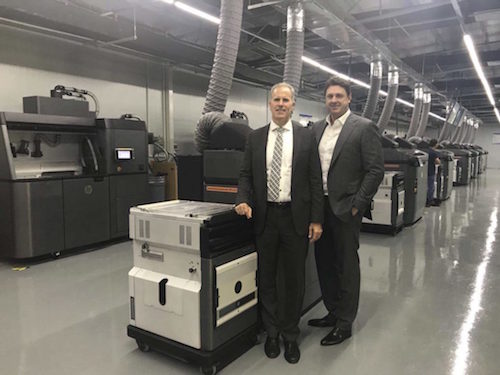 HP’s Multi Jet Fusion 3D printing systems buoy the Guangdong (Dali) 3D Printing Collaborative. Image Courtesy of HP.
Given that China represents nearly half of the $12 trillion global manufacturing industry and is the second largest economy, HP sees significant opportunity for its 3D printing technology in this market. “HP is uniquely positioned to capitalize on this market because we’ve cracked the code on moving large-scale digital production forward with lower production costs, greater speed, more sustainability, and a collaborative 3D partner ecosystem,” contends Rob Mesaros, head of HP 3D Printing for Asia-Pacific and Japan. “The main takeaway from this announcement is that industrial-scale 3D manufacturing is here and enabling local manufacturers to deliver cost-effective, production-grade parts quickly and efficiently.”
HP isn’t just cultivating these industrial-grade 3D manufacturing centers in China. The company has similar digital manufacturing centers in North America, including Forecast 3D, which maintains an inventory of 18 HP Jet Fusion 4210 systems, as well as in other areas, including the Jabil Additive Manufacturing Network in Singapore, which will be deploying HP Jet Fusion 4210 systems.
At these centers, HP has found success with customers across industries, including applications for race cars, commercial trucks, and electric vehicles, Mesaros says. For example, Australia’s Triple Eight Race Engineering group is using HP Multi Jet Fusion technology at digital manufacturing centers to 3D print final parts for race cars, including manifolds, air fill systems, and engine covers. Trucking customers have turned to 3D printing for highly customized interior parts like glove boxes and seat belt applications, and some electric vehicle customers are leveraging the technology to help address thermo challenges with batteries, he explains. “3D printing allows electric vehicle manufacturers to design and produce parts that are lightweight and improve the performance of the battery in battery cooling,” Mesaros says.
3D printing technologies like the HP Multi Jet Fusion can also help empower distributed manufacturing, another likely hallmark of digital manufacturing in the age of the Fourth Industrial Revolution. As manufacturing is digitalized, software design may occur in one location while the actual production of parts occurs somewhere else, halfway around the world. 3D printing is a way to bring everything together: “HP Multi Jet Fusion technology is a driver of this transformation by allowing manufacturers to 3D print custom parts, create rapid prototypes, and quickly adjust production,” Mesaros says.
To learn more about the Guangdong 3D Printing Collaborative Innovation Platform, check out this video.

We offer a product and service portfolio of personal systems, printers, and 3D printing solutions.

Beth Stackpole is a contributing editor to Digital Engineering. Send e-mail about this article to [email protected].
Follow DE
Join over 90,000 engineering professionals who get fresh engineering news as soon as it is published.






About Us · Contact Us · Editorial Team · Advertising · Privacy Policy · Subscriber Services · © 2026 Digital Engineering 24/7 · Peerless Media