Helping design and engineering professionals discover, evaluate and specify technologies and processes that shorten the design cycle and enable success.




Digital Engineering April 2026
In the latest issue of Digital Engineering, we take a look at the latest innovations in design for additive manufacturing, including the use of natural language inputs, social media cosplayers, and AI integration. The issue also includes a feature…

January Special Focus Issue: Design for Additive
In this Special Focus Issue of Digital Engineering, learn about the latest advancements in design for additive manufacturing, including new software tools, additive in automotive, custom medical devices, and more.
Owl Works is a company out of China preparing to crowdfund its new Morpheus AM system this July on Kickstarter. I don’t generally like to speculate about the potential success of a system before it becomes available on the market, but Morpheus isn’t just a FORM1 clone, and offers something new to the desktop resin market even before it goes on sale.
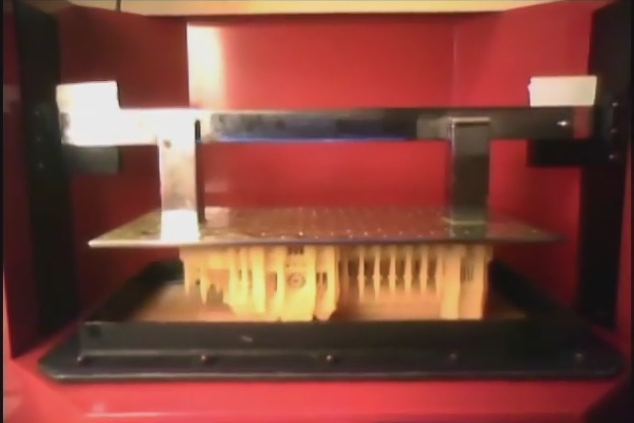 Morpheus uses LCD masking to produce 3D printed objects. Courtesy of Owl Works.
Morpheus isn’t technically an SLA system. Instead of using lasers or DLP projection, the company has developed its own process which it has dubbed LIPS (Light Induced Planar Solidification). The process employs a commercial grade LCD to create a photo mask on the surface of the resin. This is followed by a UV light that cures the exposed areas.
That process is strikingly similar to that developed by Carbon3D, except that it still relies on mechanical operation to build an object, rather than chemical reactions. While final specs may change, the system is projected to have a 170 micron x/y resolution, and a layer height resolution of 25 - 300 microns.
The name Morpheus was drawn from the classic sci-fi thriller, The Matrix. The Morpheus AM system is larger than life in the same way the character Morpheus was in the film. According to the company, the forthcoming system boasts the largest build envelope of any desktop resin system at 13 x 7.1 x 7.9 in. (33 x 18 x 20 cm), and requires about 30 seconds to print a layer.
The hinted at starting price for the system will be $3,000, which is fairly middle of the road. Below you’ll find a video of Morpheus at work.
Source: Owl Works


John Newman is a Digital Engineering contributor who focuses on 3D printing. Contact him via [email protected] and read his posts on Rapid Ready Technology.
Follow DE
Join over 90,000 engineering professionals who get fresh engineering news as soon as it is published.






About Us · Contact Us · Editorial Team · Advertising · Privacy Policy · Subscriber Services · © 2026 Digital Engineering 24/7 · Peerless Media