Helping design and engineering professionals discover, evaluate and specify technologies and processes that shorten the design cycle and enable success.



Digital Engineering April 2026
In the latest issue of Digital Engineering, we take a look at the latest innovations in design for additive manufacturing, including the use of natural language inputs, social media cosplayers, and AI integration. The issue also includes a feature…

January Special Focus Issue: Design for Additive
In this Special Focus Issue of Digital Engineering, learn about the latest advancements in design for additive manufacturing, including new software tools, additive in automotive, custom medical devices, and more.
Hyperbole aside, AM is indeed joining the ranks of accepted defense technologies. Israel is the latest country to test the potential of 3D printing. The Israeli Air Force (IAF) is considering how best to use the technology as part of its maintenance efforts. Success in that area could well mean a general adoption of AM by the IAF for larger projects as well.
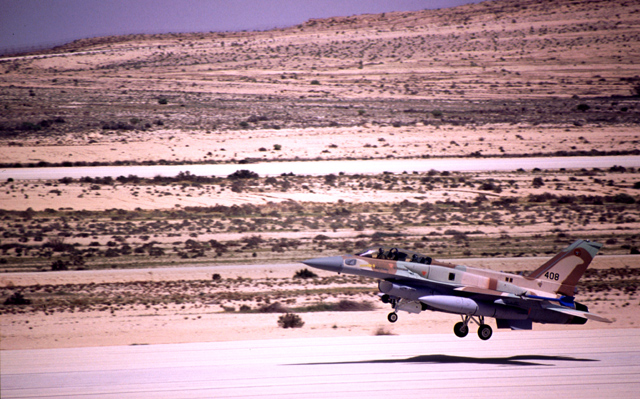 An Israeli F-16I, nicknamed "Sufa" (meaning storm) on takeoff. Courtesy of the IAF.
"We've conducted experiments on the ground with the parts that were printed and installed onto the planes, and it was successful," a senior IAF officer told Ynet. "We also got engine parts that were printed, and in the 3D era we could, in the future, print generators for planes, bearings or a full engine for an aircraft, with the pistons already inside. The vision is, of course, to print an entire plane."
Building an entire aircraft using AM is still unrealistic, but the IAF can certainly experiment with the principles of aeronautics and 3D printing by building drones. Much of the work performed by Israeli defense forces could benefit from inexpensive drones that can be custom-built for specific missions.
The IAF has not identified the US company that provided its new AM system, but Stratasys is my guess. In December of 2012, Stratasys began the process of merging with Objet, a 3D printing company based in Rehovot, Israel. Existing ties to Israel combined with the fact the 3D printer has been identified as polymer-based, lead me to the Stratasys conclusion.
The purchase of the AM system is part of a new IAF initiative to modernize its maintenance workforce. Along with the unnamed 3D printer, the IAF has also purchased robotic units that are capable of disassembling and reassembling parts of the fleet. Quicker maintenance would also lead to faster turnaround times during an active conflict.
Below you’ll find a video about the IAF.
Source: Israel News


John Newman is a Digital Engineering contributor who focuses on 3D printing. Contact him via [email protected] and read his posts on Rapid Ready Technology.
Follow DE
Join over 90,000 engineering professionals who get fresh engineering news as soon as it is published.






About Us · Contact Us · Editorial Team · Advertising · Privacy Policy · Subscriber Services · © 2026 Digital Engineering 24/7 · Peerless Media