Helping design and engineering professionals discover, evaluate and specify technologies and processes that shorten the design cycle and enable success.



Digital Engineering April 2026
In the latest issue of Digital Engineering, we take a look at the latest innovations in design for additive manufacturing, including the use of natural language inputs, social media cosplayers, and AI integration. The issue also includes a feature…

January Special Focus Issue: Design for Additive
In this Special Focus Issue of Digital Engineering, learn about the latest advancements in design for additive manufacturing, including new software tools, additive in automotive, custom medical devices, and more.
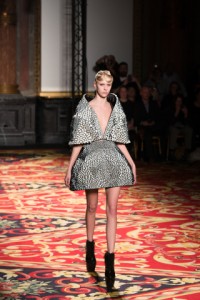 A cape and skirt featured at an exhibit of 3D-printed fashion items at the Museum of Fine Art in Boston. Image courtesy Stratasys.
Inventor, futurist, and Google’s machine learning guru Ray Kurzweil is pretty good at making predictions about technology. At the recent New York Times Global Leaders’ Collective conference in December, he predicted that 3D printing is going to be very big – in our closets.
Kurzweil believe that within the decade, we will use 3D printing technology to create or own clothes at home.
“As the variety of materials available to print in 3D become more extensive and less expensive, both free open-source and proprietary clothing designs will be widely available online in as little as 10 years,” he said. “By 2020 there will be a whole host of product available immediately to buy for pennies on the dollar and to print straight away. It will become the norm for people to have printers in their homes.”
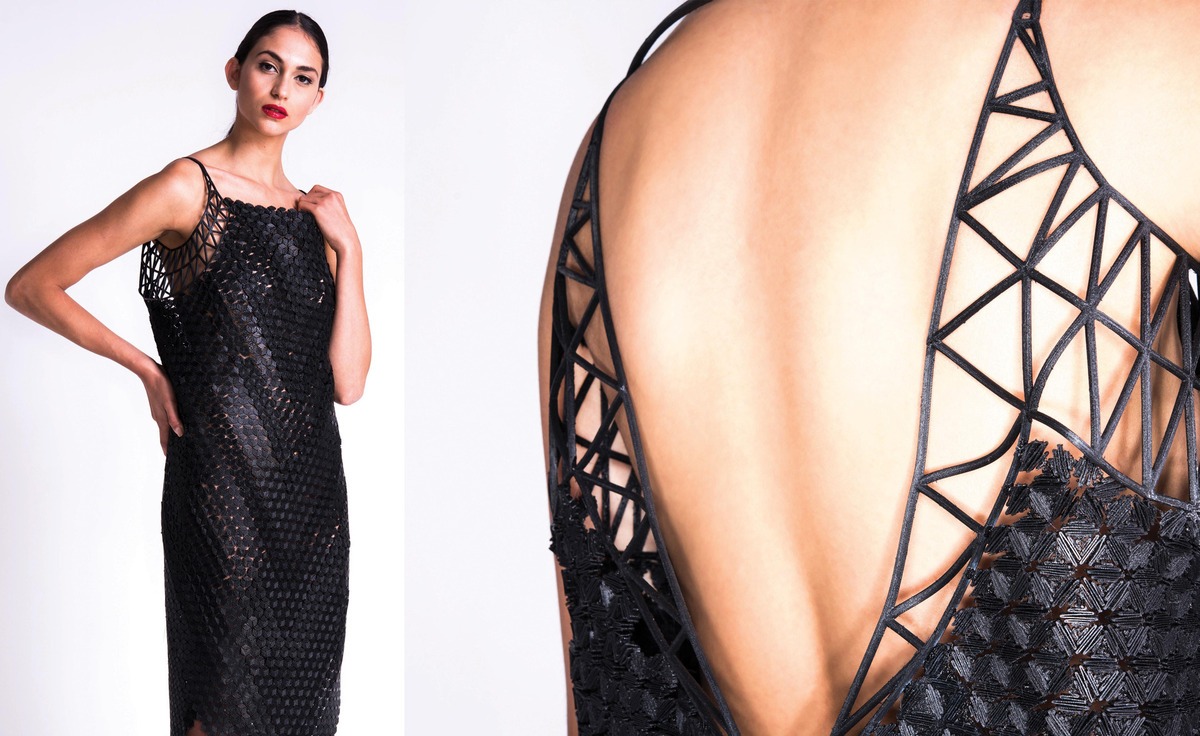
There are already companies that are 3D printing shoes (and custom insoles), as well as designers using 3D printing to create clothing. So far, however, printed clothing has been more of a runway novelty or art project – clothing that is certainly eye catching, but not necessarily practical.
In part, that’s because 3D printers can’t really replicate cloth right now, according to Quartz, which reported on Kurzweil’s predictions. One company, Nervous System, has come up with the Kinematics Cloth printing system, which can print a plastic dress that flows like fabric.
For Kurzweil’s vision of the future of fashion to become a reality, it would also have to be easier to for non-engineers to create their own clothing designs without needing to learn how to use complex computer-aided design (CAD) solutions. Kurzweil thinks there will be plenty of free, open-source designs, as well as brand-created designs from the big fashion houses and manufacturers.
Kurzweil also thinks that food and housing materials will be printable at home as well.
Source: Quartz


Brian Albright is the editorial director of Digital Engineering.
Contact him at [email protected].

Join over 90,000 engineering professionals who get fresh engineering news as soon as it is published.






About Us · Contact Us · Editorial Team · Advertising · Privacy Policy · Subscriber Services · © 2026 Digital Engineering 24/7 · Peerless Media