Helping design and engineering professionals discover, evaluate and specify technologies and processes that shorten the design cycle and enable success.



May 2026 Special Focus: Artificial Intelligence in Design and Simulation
In this Special Focus Issue, learn about the latest developments in the integration of artificial intelligence into engineering workflows.

April 2026 Special Focus Issue: Generative Design
In this Special Focus Issue, Digital Engineering takes a look at how generative design solutions can be used across different types of design problems and with a variety of manufacturing approaches to accelerate design space exploration, and…
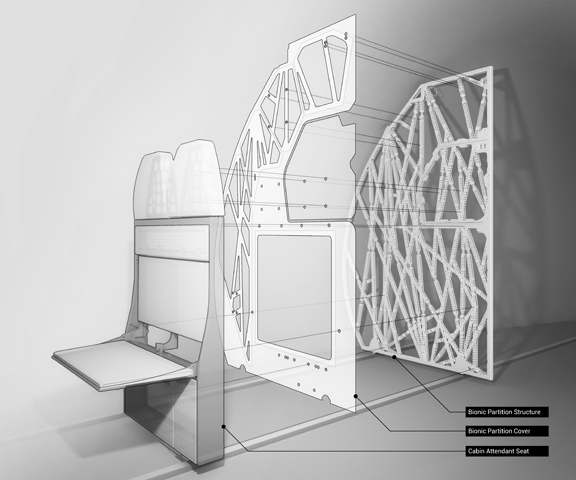
 This Airbus partition, dubbed "the bionic partition," is conceived using custom algorithms that generate cellular structures and bones. The structure is stronger and more light-weight than would be possible using traditional processes, according to the joint announcement by Autodesk and Airbus (image courtesy of Autodesk). The structural optimization technology is found in Autodesk Within software.
Last week, I moderated a roundtable talk on topology optimization and lightweighting, part of the DE webinar series. (The recorded webinar is now available online. To listen, please press the button below.)
Access the On-Demand Webcast No
The panelists were:
To set the scope and define the term, Keith Meintjes said, "The best way to think of topology optimization is as a layer placed on top of finite element analysis (FEA). One of the variables in FEA is material density. So the [topology optimization algorithm] helps you decide where materials need to be added, where it can be removed."
The desire to remove every excess gram from the vehicle is prompted not just by profit margins and fuel economy. Alan Taub pointed out, "Weight is also responsible for the performance of the vehicle. Weight distribution drives rollover tendencies and handling. The lighter the car, the easier it is for the vehicle dynamics engineer to tune the ride and handling."
Keith said, "The topology optimization software is not easy to use, so you need an FEA expert. The sculpted surfaces that come out of the optimization is difficult to interpret, so you need a freeform CAD surfacing expert. You also need someone who understands the product requirements -- loads, stresses, and so on. And you also need someone who understands manufacturing requirements." To assemble four such experts from four different parts of an organization is, Keith added, "a very big deal."
Along the same line, Alan Taub said, "It's one thing to say the manufacturing engineer is there. But true concurrent engineering means meshing the topology optimization code with the manufacturing code. From my perspective, that's one of the hardest challenges to take on."
The so-called optimized shapes are algorithm-driven; therefore, they often include jagged edges, vine-line structures, and asymmetrical features that cannot be made in standard manufacturing methods. Some look to additive manufacturing -- especially metal-based 3D printing -- as a way to overcome the hurdle.
Andreas Vlahinos, who has been closely watching the trend, predicted that in the future, when optimization software are capable of generating optimized lattice structures, "We will have a portion of the design in lattice structure, a portion in solids, all covered in skin" -- the best of both worlds for lightweighting. He observed, "In the past, we were able to design parts we couldn't produce; now, we have parts that we could make, but cannot design in the CAD system."
We also collected a number of questions from the audience who tuned in. Here are the panelists' responses to them, along with mine.
Q: I´d like to know why every topology optimization presentation just exposes Altair's OptiStruct? Why not other tools?


Kenneth Wong is Digital Engineering's resident blogger and senior editor. Email him at [email protected] or share your thoughts or suggestions at digitaleng.news/facebook.
Follow DE
Join over 90,000 engineering professionals who get fresh engineering news as soon as it is published.






About Us · Contact Us · Editorial Team · Advertising · Privacy Policy · Subscriber Services · © 2026 Digital Engineering 24/7 · Peerless Media