Helping design and engineering professionals discover, evaluate and specify technologies and processes that shorten the design cycle and enable success.



Digital Engineering April 2026
In the latest issue of Digital Engineering, we take a look at the latest innovations in design for additive manufacturing, including the use of natural language inputs, social media cosplayers, and AI integration. The issue also includes a feature…

January Special Focus Issue: Design for Additive
In this Special Focus Issue of Digital Engineering, learn about the latest advancements in design for additive manufacturing, including new software tools, additive in automotive, custom medical devices, and more.
LPKF is a German company with a line of PBS prototype machines. The Protomat S-Series are bench sized machines designed to be used in-house. Features include automatic tool change, solder paste dispensing and automatic milling depth adjustment. Each machine comes pre-loaded with software to assist with the prototyping process.
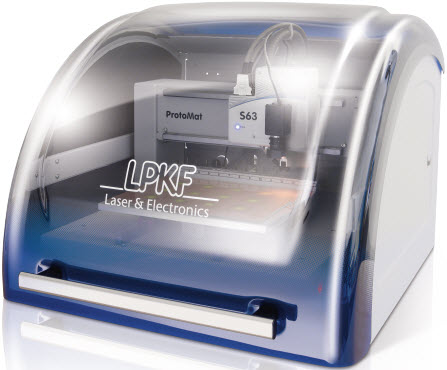
Taking a look at a specific member of the S-Series, the Protomat S63 can deploy up to 15 tools automatically, which allows for the machine to run without constant supervision or repeated setup. The S63 can produce isolation lines to 100 µm and is capable of drilling holes to 150 µm. The automatic conical milling offered by the S63 can create different insulation channels varying by depth and, according to the company, still maintain uniform track widths.
The Protomat S63 is designed to build multilayer boards when used alongside a board lamination press (such as the MultiPress S), and can also be used to rework bare boards. Other applications include single and double-sided circuit boards, plated-through holes, routing slots, cut outs and board profile.
According to LPKF, boards created with the S63 can be finished with a solder mask and a printed legend in around 40 minutes by using the company’s ProMask system. The PCB prototyping machines can also be used for precision engraving on materials such as Plexiglas, aluminum, brass and plastic.
LPKF will be showing the Protomat S63 and other PCB prototyping equipment at the AeroCon Exposition. The expo will be held at the Fort Worth Convention Center in Texas March 14-15.
Below you’ll find a video highlighting the Protomat S-Series.
Source: LPKF


John Newman is a Digital Engineering contributor who focuses on 3D printing. Contact him via [email protected] and read his posts on Rapid Ready Technology.
Follow DE
Join over 90,000 engineering professionals who get fresh engineering news as soon as it is published.






About Us · Contact Us · Editorial Team · Advertising · Privacy Policy · Subscriber Services · © 2026 Digital Engineering 24/7 · Peerless Media