Helping design and engineering professionals discover, evaluate and specify technologies and processes that shorten the design cycle and enable success.


Sponsored
 Dear Desktop Engineering Reader:
Designers and engineers typically don't view themselves as some knockoff Che Guevara revolucionario type, but many of you are. You've taken additive manufacturing technology – 3D printers and 3D production systems – and overthrown the way your outfit once made things. Alas, others of you still duel skeptics guarding the old order. Today's Check it Out link goes to a white paper that's for both of sides.
“Revolutionizing Manufacturing with 3D Printing: An Introduction” provides validation if you have succeeded in making 3D printing an equal partner with milling and injection molding in your design and manufacturing processes. You'll pick up some ideas of things you can do to further evolve your processes out of this paper. For you still championing additive manufacturing's potential, you'll get many facts and anecdotes from the field showing that 3D printing is a versatile tool that can improve and extend many design and manufacturing processes and help you make better products.
An engineer quoted in the paper nails its premise: 3D printing is “absolutely the right choice” for applications where it can economically optimize production. That could be parts like jigs, fixtures or injection molds. Or it means overnight manufacturing of single parts ranging from prototypes to a replacement for a broken piece in a critical production machine. 3D printing can even make small runs of end-use components or mass-customized parts cost-effective, fast and practical.
This paper, sponsored by Stratasys, tells its story mostly through the experience of real-world engineers and prototype managers. It uses comparisons like making many 3D prototypes overnight as opposed to waiting two weeks for a service bureau to deliver one. Or like spending a couple of hundred bucks on materials to make a fixture in-house instead of shelling out well over a grand for a machine shop to do it. It's shaving pounds off a design where weight is a key consideration and it’s shortening R&D processes up to 35%. These are terms that even bosses who don't get it will get.
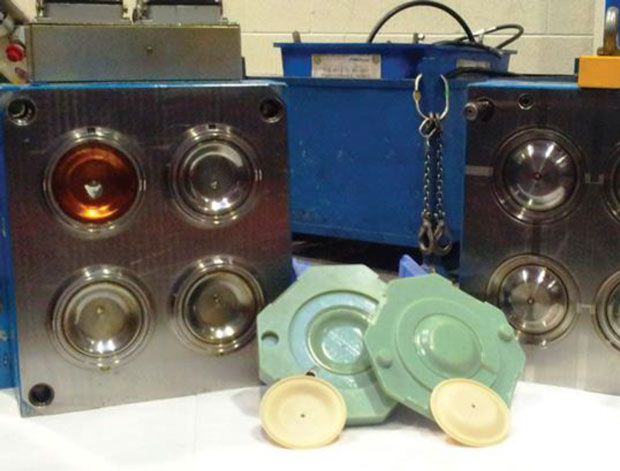 These functional prototype diaphragms were made with Santoprene thermoplastic rubber using a 3D-printed injection mold (foreground). The CNC tool previously used to create the same part is in the background. Image courtesy of Stratasys Ltd.
“Revolutionizing Manufacturing with 3D Printing: An Introduction” is an easy, engaging piece and eminently shareable read. It explains exactly what 3D printing of prototypes and production parts offers you in a clear, matter-of-fact style. Hit today's Check it Out link, download your complimentary copy, then leave a copy in the coffee room for the rest of your team.
Thanks, Pal. – Lockwood
Anthony J. Lockwood
Editor at Large, Desktop Engineering
Download “Revolutionizing Manufacturing with 3D Printing: An Introduction” here.


Anthony J. Lockwood is Digital Engineering's founding editor. He is now retired. Contact him via [email protected].
Follow DE
Join over 90,000 engineering professionals who get fresh engineering news as soon as it is published.






About Us · Contact Us · Editorial Team · Advertising · Privacy Policy · Subscriber Services · © 2026 Digital Engineering 24/7 · Peerless Media