Helping design and engineering professionals discover, evaluate and specify technologies and processes that shorten the design cycle and enable success.



Digital Engineering April 2026
In the latest issue of Digital Engineering, we take a look at the latest innovations in design for additive manufacturing, including the use of natural language inputs, social media cosplayers, and AI integration. The issue also includes a feature…

January Special Focus Issue: Design for Additive
In this Special Focus Issue of Digital Engineering, learn about the latest advancements in design for additive manufacturing, including new software tools, additive in automotive, custom medical devices, and more.
Rapid prototyping in the medical device industry poses a unique set of challenges. Products in this $220 billion industry may need to resist electromagnetic interference and withstand sterilization and water exposure. To meet this requirements, DSM Somos offers a selection of SLA (stereolithography) resins.
Clear, Water-Resistant Prototypes
Vaupell Rapid Solutions, part of a company that supplies complex molded products, has participated in the design review phase of more than 1,000 medical devices over the last decade. They use stereolithography for its accuracy in prototyping devices for the assessment of form, and function.
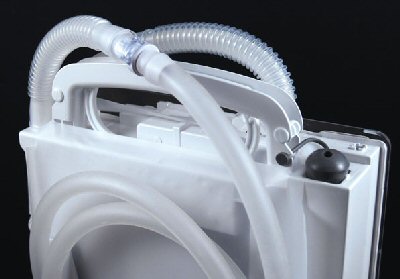 |
| Image 1:Completed chest drain was prototyped using Somos WaterShed 11120 stereolithography resin. |
One of Vaupell's customers manufactures chest drains that are used after open heart surgery. Clear, water-resistant prototypes are needed to effectively evaluate proposed chest drain designs, which incorporate various methods for controlling and monitoring flow. Though multiple rapid prototyping processes may be used (cast urethanes, CNC machining, etc.), Vaupell has found a quicker, more cost-effective solution in stereolithography using Somos WaterShed 11120 resin.
With optical clarity and a low 0.35% water absorption, Somos WaterShed is also tough enough to use in functional testing. It features a flexural modulus of 2200 MPa and elongation up to 20%.
"Vaupell prides itself on using the right prototype solution for the job," says Steve Ettelson, general manager of Vaupell. "We're finding that a broad range of Somos resins, including WaterShed 11120, enables us to provide the best solution to our customers."
Details, Details
For companies developing medical devices such as inhalers, intravenous fluid delivery pieces, syringes, surgical tools, diagnostic equipment, and housings, another Somos resin has proved successful. FineLine Prototyping, a stereolithography service bureau based in North Carolina, uses Somos NanoTool to create extremely accurate, highly detailed parts that are also very heat resistant.
NanoTool is a reinforced composite material with a heat deflection temperature greater than 500°F (after thermal post-cure). Its flexural modulus is 10,000MPa. The resin's very low linear shrinkage (less than 0.001 in.) allows extremely accurate and high detailed parts to be prototyped.
"It's rare to find a material that is both tolerant of high temperatures and able to create accurate, fine details," says Rob Connelly, president of Fineline. "NanoTool does both with ease. In addition, we have many medical device manufacturers who use NanoTool in combination with structural nickel to make prototypes of parts that would normally be die-cast or investment-cast metals."
A 20-30% metal-to-resin volume ratio using NanoTool is enough to produce parts with a tensile strength similar to a variety of alloys, including magnesium, aluminum and zinc, but in much less time. In addition, as little as 0.002-in nickel plating allows the stereolithography parts to be used for electromagnetic interference shielding.
"NanoTool's extreme stiffness and strength, coupled with the toughness of the nickel coating, create a very stiff, strong part," notes Connelly. Beyond strength, he says that NanoTool delivers "amazing sidewall quality that requires little or no finishing." This results in faster production of metal-plated parts.
With the increasing variety and characteristics of resins on the market, stereolithography is proving to be a smart, cost-efficient solution for prototyping medical and bioscience products.
Sources: Press materials received from the company and additional information gleaned from the company's website.


DE's editors contribute news and new product announcements to Digital Engineering. Press releases may be sent to them via [email protected].
Follow DE
Join over 90,000 engineering professionals who get fresh engineering news as soon as it is published.






About Us · Contact Us · Editorial Team · Advertising · Privacy Policy · Subscriber Services · © 2026 Digital Engineering 24/7 · Peerless Media