Helping design and engineering professionals discover, evaluate and specify technologies and processes that shorten the design cycle and enable success.




May 2026 Special Focus: Artificial Intelligence in Design and Simulation
In this Special Focus Issue, learn about the latest developments in the integration of artificial intelligence into engineering workflows.

Design & Simulation Software Guide 2025
In this Special Issue, Digital Engineering presents its second annual guide to design and simulation software vendors.
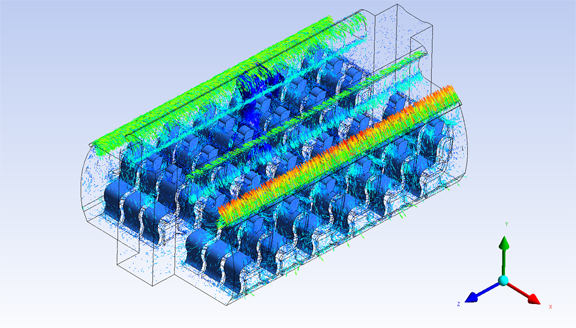 Raymond Wang's CFD simulation results (in ANSYS CFD) showing isometric sample of improved air flow (image courtesy of Raymond Wang)
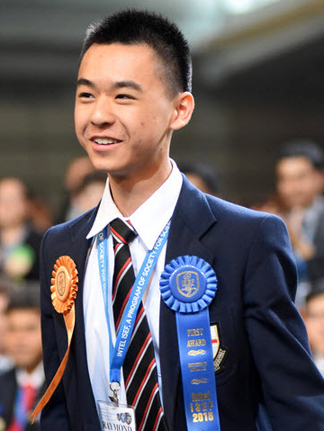 Raymond Wang, winner of Intel International Science and Engineering Fair, received the Gordon E. Moore award, carrying a cash prize of U.S. $75,000.
What happens to the particles when someone sneezes or coughs inside an airplane cabin? It's something frequent flyers probably prefer not to think about. The one person who takes an earnest interest in the phenomenon is Raymond Wang, a 17-year-old from Canada.
In a blog post, Raymond wrote, "When I learned about the Ebola outbreak last year, I was astonished at just how vulnerable the airplane cabin environment could be in propagating disease epidemics." In a tightly packed cabin with little room to maneuver, all passengers share the same pool of air; therefore, they are also exposed to the spread of pathogens and toxins among themselves.
Raymond had just come up with an idea for a cabin air inlet director system that "increases passenger fresh air availability by over 190% and reduces pathogen inhalation concentrations by up to 55 times versus conventional, unmodified cabins." What's more? His fix could be "manufactured for the price of a typical passenger’s airline ticket and installed overnight at the gate," he said.
It's a $75,000 idea, as far as Intel is concerned. In May, at the Intel International Science and Engineering Fair, Raymond won the crash prize and the Gordon E. Moore Award, named in honor of the Intel co-founder and fellow scientist.
To test out his theory, Raymond used ANSYS CFD simulation solver, designed for airflow analysis. In the guest blog post he wrote for ANSYS, he explained, "Overwhelming amount of papers in industry pointed to ANSYS as the simulation code of choice. So, I made a cold call, explained my vision, and hoped for the best: here I was, an ambitious high school junior, wanting to change the way that airflow is handled in commercial aircraft cabins." Instead of hanging up on him, ANSYS gave him a license of the software.
Raymond, whose past projects included a roof that converted the impact energy of precipitation into electricity, a dynamically supportive knee brace that implements smart fluids, and a self-cleaning outdoor garbage bin, is no stranger to robotics, programming, calculus-based physics, and CAD modeling. (He calls some of them his spare-time interest.) But to run CFD, he needed a new skill set. "I embarked on a quest to learn the ropes of CFD, paging through papers, and going through Open Courseware," he recounted.
He then tested his airflow systems physically with scale models and put them through various feasibility studies. All the results, he explained, "concurred with the CFD findings." He wrote, "The logistics that lie on the road to implementation is a journey in and of itself. Moving forward, I hope to continue using ANSYS to support my implementation efforts as I engage in ongoing talks with airlines who have already expressed interests in my solution."
Raymond will appear in a Google Hangout session organized by ANSYS, moderated by me. It's set for July 7, 2015, 5 PM Pacific. The session is part of the ANSYS Tech Tips YouTube channel. If you have questions for Raymond, please send them via Twitter under the hashtag #RWANGLIVE.
Watch the YouTube clips below for a comparison of conventional cabin airflow (top) and improved airflow (bottom).


Kenneth Wong is Digital Engineering's resident blogger and senior editor. Email him at [email protected] or share your thoughts or suggestions at digitaleng.news/facebook.
Follow DE
Join over 90,000 engineering professionals who get fresh engineering news as soon as it is published.






About Us · Contact Us · Editorial Team · Advertising · Privacy Policy · Subscriber Services · © 2026 Digital Engineering 24/7 · Peerless Media