Helping design and engineering professionals discover, evaluate and specify technologies and processes that shorten the design cycle and enable success.



Digital Engineering April 2026
In the latest issue of Digital Engineering, we take a look at the latest innovations in design for additive manufacturing, including the use of natural language inputs, social media cosplayers, and AI integration. The issue also includes a feature…

January Special Focus Issue: Design for Additive
In this Special Focus Issue of Digital Engineering, learn about the latest advancements in design for additive manufacturing, including new software tools, additive in automotive, custom medical devices, and more.
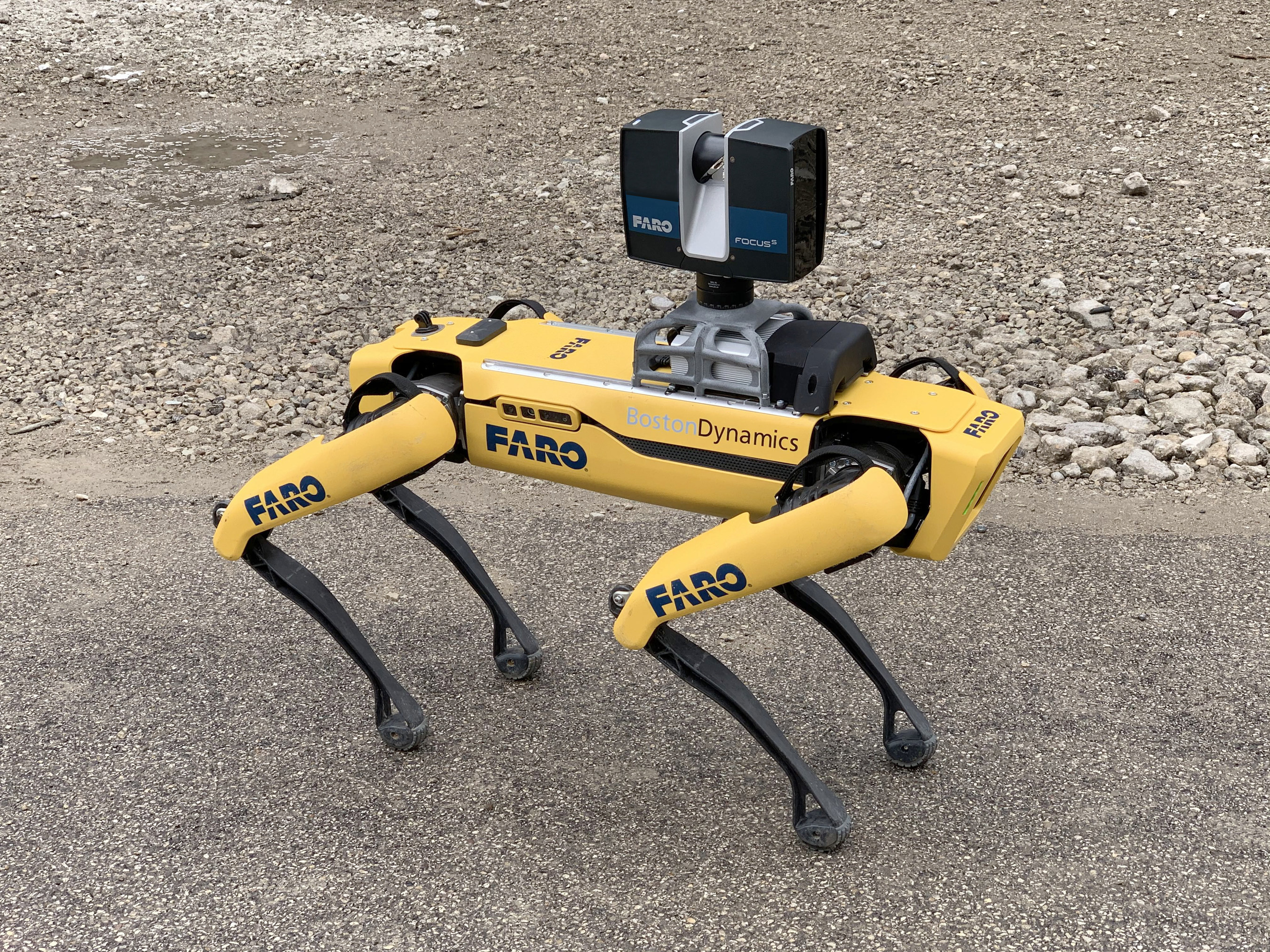
What do you get when you combine a laser scanner with a robot capable of remote data capture? You get Trek, a fully autonomous 3D mobile scanning device capable of remotely monitoring the progress and condition of commercial construction projects or creating digital twins of a manufacturing floor, among emerging use cases.
FARO, a leader in laser scanning technology, teamed up with robotics trailblazer Boston Dynamics on Trek, which combines the scanning speed and accuracy of the FARO Focus Laser Scanner with Spot, the quadruped robot capable of doing remote and autonomous data capture in challenging environments. Aimed initially at construction applications to verify progress and quality on job sites, Trek could also be tapped for other potential markets and applications that could benefit from automated scanning workflows or remote scanner operations, including the creation of digital twins of manufacturing facilities and for disaster mitigation purposes, FARO officials say.
FARO had been researching how to marry its scanning technology with a robot when in May 2019, Boston Dynamics officially launched Spot as a commercial product. It was the quadruped design of Spot that led the firm to seek a partnership as it would solve challenges navigating tough conditions like stairs and other obstructions, officials say.
While the use of 3D scanners in construction has grown over the years, the accuracy of the process is heavily reliant on repeatability, which means attention to scan settings, the location of the scanner, and the on-going activity during the scan. Because the scanning process is not highly interactive, companies often rely on less experienced operators. Yet inefficiencies can occur or scan quality can be compromised due to lack of knowledge or experience, which can result in not choosing the best location, using the wrong settings, or capturing people as part of the scan.
FARO Trek, on the other hand, automates this process, providing an assist to less experienced workers who can work off a pre-programmed guide. Spot’s Autowalk feature is used to create a repeated, automated scanning workflow, which ensures the information collected is the same each time and enhancing analysis and reporting.
“Someone experienced in laser scanning can be responsible for ensuring the proper settings are used, the best locations are selected, and then the scan can be run without needing to tie up an operator,” a FARO official explains. “The result is that customers are able to capture consistent and better quality data with less labor.”
By leveraging FARO’s scanner API and Spot’s integrated sensors, FARO was able to create a reality capture experience that goes beyond what’s able to be captured when scanning on a tripod. In addition, customers can document true as-built site conditions in a repeatable fashion and the high-frequency point cloud data collected is automatically aligned, making it easier to continuously update a digital twin, whether that’s for a construction site or a manufacturing floor.
Here’s a look at Boston Dynamics’ Spot robot performing on-site inspections.


FARO is the world's most trusted source for 3D measurement, imaging and realization technology. The Company develops and markets computer-aided measurement and imaging devices and software. Technology from FARO permits high-precision 3D…
Designing for Automotive/Transportation
The automotive industry is past the point of talking about the disruption coming from demand for electric vehicle powertrains or the potential of autonomous vehicles, and well on its way to responding to those disruptions thanks to advanced engineering technologies. Download this special digital edition.

Beth Stackpole is a contributing editor to Digital Engineering. Send e-mail about this article to [email protected].
Follow DE
Join over 90,000 engineering professionals who get fresh engineering news as soon as it is published.






About Us · Contact Us · Editorial Team · Advertising · Privacy Policy · Subscriber Services · © 2026 Digital Engineering 24/7 · Peerless Media